Explore our network of country and industry based websites to access localized information, product offerings, and business services across our group.

Access reliable chemical market information through our update channels.
Real-time Updates
Daily Updates
Log in to start sending quotation requests for any product.
Don't have an account? Sign Up Here
Home Future Applications of Crude Glycerine in Sustainable Manufacturing
Trade Insights | Applications and Buyers | 22 January 2026
What Crude Glycerine Really Is
Why Crude Glycerine Fits the Circular Manufacturing Agenda
Future Ready Applications That Can Absorb Volume
The Real Constraints That Decide Commercial Success
Conclusion
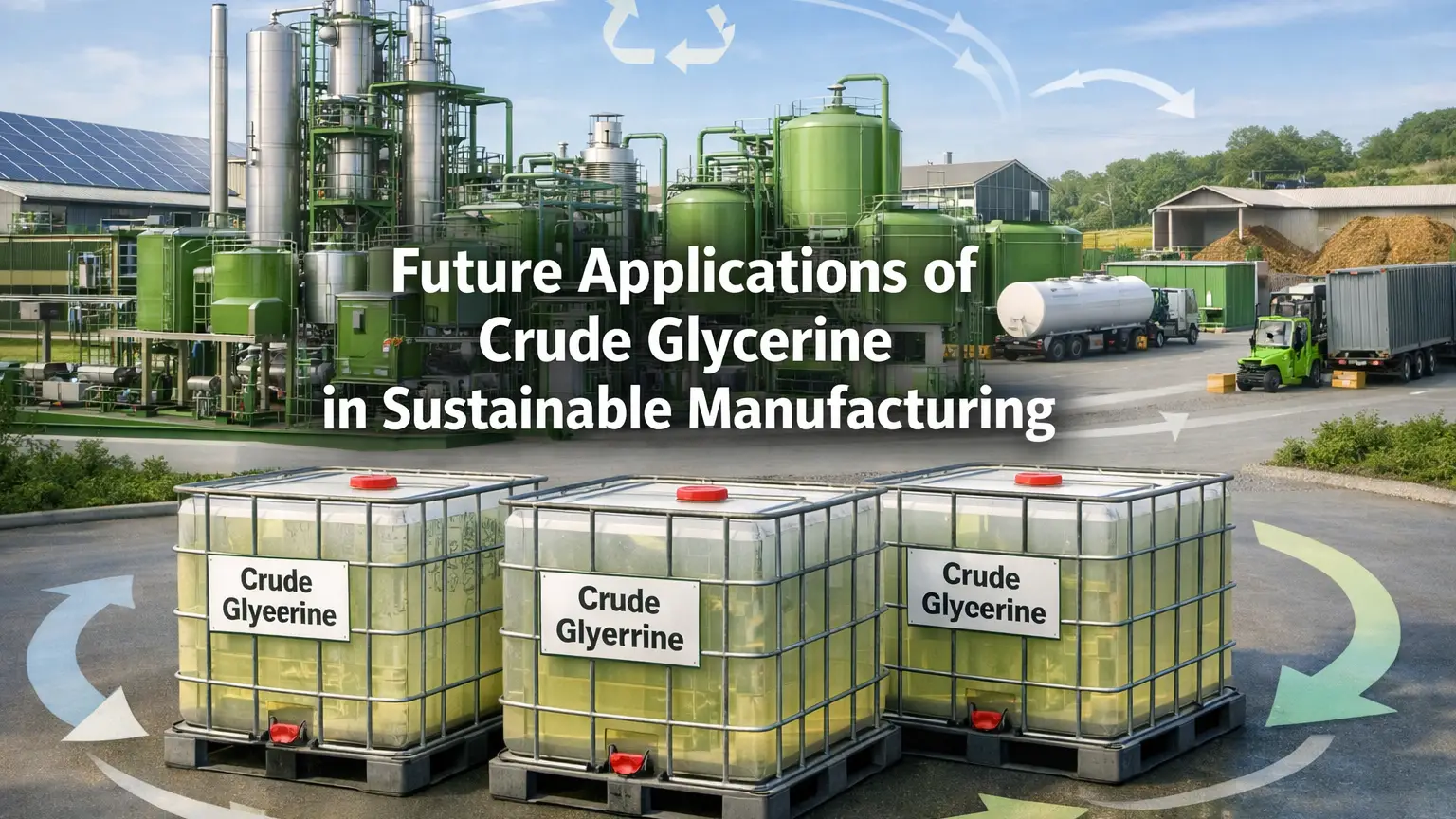
Crude glycerine is quickly moving from “biodiesel residue” to a serious renewable feedstock for manufacturers. As biodiesel output expands, the industry generates a large stream of crude glycerine, commonly around 10% of biodiesel production by mass or volume. At the same time, chemical and materials producers are under pressure to reduce Scope 3 emissions, increase bio based content, and adopt circular manufacturing models. That combination is turning crude glycerine into a strategic input for low carbon chemicals, fuels, and materials.
This article explains what crude glycerine contains, why it matters for sustainable manufacturing, and which future applications are most promising. It also covers the practical barriers that decide whether a concept scales from pilot to full production.
Biodiesel is produced through transesterification of oils or fats with an alcohol (often methanol) and an alkali catalyst. The reaction yields biodiesel (fatty acid methyl esters) plus glycerol as a co product, typically in a rough 10 to 1 biodiesel to glycerol ratio. That makes crude glycerine supply closely tied to biofuel policies and blending mandates.
Indonesia’s higher biodiesel blending programs illustrate the direction of travel. Official announcements confirm a move to B40 from January 1, 2025, with public planning toward higher blends such as B50 being discussed for 2026. Whether or not every region follows the same path, more biodiesel generally means more crude glycerine entering global trade.
Crude glycerine is not refined glycerol. Typical crude streams contain glycerol plus water, methanol, soaps, salts, free fatty acids, and other organics, and composition varies by feedstock and process. In many biodiesel plants, some initial conditioning happens (such as methanol recovery or acid splitting to separate fatty acids), but the product still differs widely from refined grades used in food, pharma, or cosmetics.
For manufacturers, this sets the core rule for future applications:
Either the process must tolerate impurities, or the upgrading step must be cheap enough to keep the economics attractive.
Crude glycerine can be difficult to dispose of responsibly because of high organic load and salts. Finding industrial outlets converts a surplus stream into a usable input, improving overall resource efficiency. That is the circular economy logic: keep carbon in productive loops instead of sending it to waste handling.
Glycerine carbon originates from biomass oils and fats, which supports lower fossil carbon intensity compared with petroleum feedstocks in many value chains. In certain chemical routes, this can create measurable greenhouse gas reductions.
A high profile example is epichlorohydrin (ECH). Commercial glycerine based processes such as EPICEROL are marketed as reducing CO2 emissions significantly versus conventional propylene routes, with claims around 60% in some technical materials, while other databases present lower figures depending on assumptions and system boundaries. The exact reduction depends on feedstock origin, energy mix, allocation method, and plant design, but the direction is clear: glycerine can unlock lower carbon options in large volume chemicals.
Crude glycerine has many “possible” uses. The important question is which ones offer a realistic path to scale, stable demand, and tolerable operating risk. Four categories stand out.
Epichlorohydrin (ECH) for epoxy resins
ECH is a key building block for epoxy resins used in coatings, composites, electronics, and construction. The glycerine route is already commercial and offers a strong narrative for renewable content in epoxy chains. For manufacturers looking for near term impact, this pathway has one of the clearest “future application” profiles because it links into existing high volume downstream markets.
Propylene glycol (MPG)
Glycerine can be converted to propylene glycol through catalytic hydrogenolysis, offering a renewable route into antifreeze, resins, and industrial fluids. Academic and industry literature consistently treats glycerol to glycols as a major upgrading direction, although catalyst tolerance to crude impurities remains a key barrier for wider adoption.
Green solvents and functional intermediates
Derivatives such as glycerol carbonate and related solvent families can support greener formulations in coatings, polymers, and battery related chemistries. These tend to require cleaner feed than raw crude, but they can justify upgrading because of higher value per tonne.
When chemical markets cannot absorb all crude glycerine, energy pathways can act as a flexible sink.
Anaerobic digestion for biogas
Crude glycerine can serve as a co substrate to increase methane yield in anaerobic digesters, especially when blended carefully to avoid overloading. This application tolerates lower purity than chemical manufacturing and can be integrated near biodiesel sites for local energy generation.
Hydrogen and syngas via reforming or gasification
Thermochemical conversion of glycerine to hydrogen rich gas has a long R and D history and ongoing demonstration interest. It becomes more attractive when paired with local hydrogen demand, such as industrial heating, upgrading processes, or decentralized energy systems.
Crude glycerine can support materials manufacturing in two ways: direct use after light cleanup, or conversion into monomers and polyols.
Polyols for resins and foams
Glycerine’s multi functional structure makes it useful in alkyd resins, polyurethane systems, and crosslinking applications. With controlled impurities, crude glycerine can contribute renewable content in paints, coatings, and insulation materials.
Bio based epoxy chains
When ECH comes from glycerine, epoxy resins inherit renewable content in the backbone. This is one of the most commercial and procurement friendly narratives in sustainable materials because epoxy buyers increasingly request lower footprint options.
Bioplastic plasticizer applications
Glycerine is widely used as a plasticizer for starch based materials. Crude grades may require odor and color reduction, plus control of salts and moisture, but the performance role is well understood.
Fermentation uses glycerine as a carbon source to produce acids, polyols, and other biochemical building blocks. Reviews and studies consistently highlight crude glycerol composition challenges, but also show strong interest in microbial valorization because it can produce products beyond simple combustion value.
High potential directions include:
Crude glycerine quality changes based on feedstock oils, catalyst choice, recovery steps, and plant operating discipline. Reviews emphasize that water, methanol, soap, ash, and organic non glycerol matter strongly in downstream performance.
For chemical conversion, salts and metals can shorten catalyst life. For fermentation, methanol and extreme pH can reduce productivity. That drives the need for:
Common conditioning steps include methanol removal, neutralization to split soaps, and basic filtration. The more the process drifts toward full refining, the more the cost advantage disappears. Most scalable “future applications” will be the ones that work with modest cleanup, not full distillation to pharma grade glycerol.
Crude glycerine is viscous, sometimes dark, and may contain solids. Storage heating, agitation, and appropriate materials of construction become important. Manufacturers planning adoption should treat handling design as a real project scope, not an afterthought.
Crude glycerine is moving into a new role in sustainable manufacturing. What used to be treated mainly as a biodiesel byproduct is increasingly viewed as a renewable carbon stream that can support real industrial demand, especially as companies push for circular inputs, lower Scope 3 emissions, and reduced dependence on petrochemical feedstocks. Its availability is likely to remain strong in the near term because supply tracks biodiesel production, while demand is expanding through commercial pathways such as glycerine-based epichlorohydrin, broader interest in bio-based solvents and intermediates, and energy and biotech routes that can absorb volume when chemical markets soften.
If you want to explore how crude glycerine could fit into your production system, Chemtradeasia can support your sourcing and qualification process with grade matching, specification alignment, and supply route planning. This helps procurement and technical teams evaluate feasibility faster and build a more reliable path from pilot testing to long-term, scalable adoption.
We're committed to your privacy. Tradeasia uses the information you provide to us to contact you about our relevant content, products, and services. For more information, check out our privacy policy.


 English
 Indonesian
 简体字
简体字
 العربية
 Español
 Français
 Português
 日本語
日本語
 한국어
한국어
 Tiếng Việt