Explore our network of country and industry based websites to access localized information, product offerings, and business services across our group.

Access reliable chemical market information through our update channels.
Real-time Updates
Daily Updates
Log in to start sending quotation requests for any product.
Don't have an account? Sign Up Here
Home PKFAD Economics Outlook in Soap & Oleochemicals 2020–2040
Trade Insights | Applications and Buyers | 18 January 2026
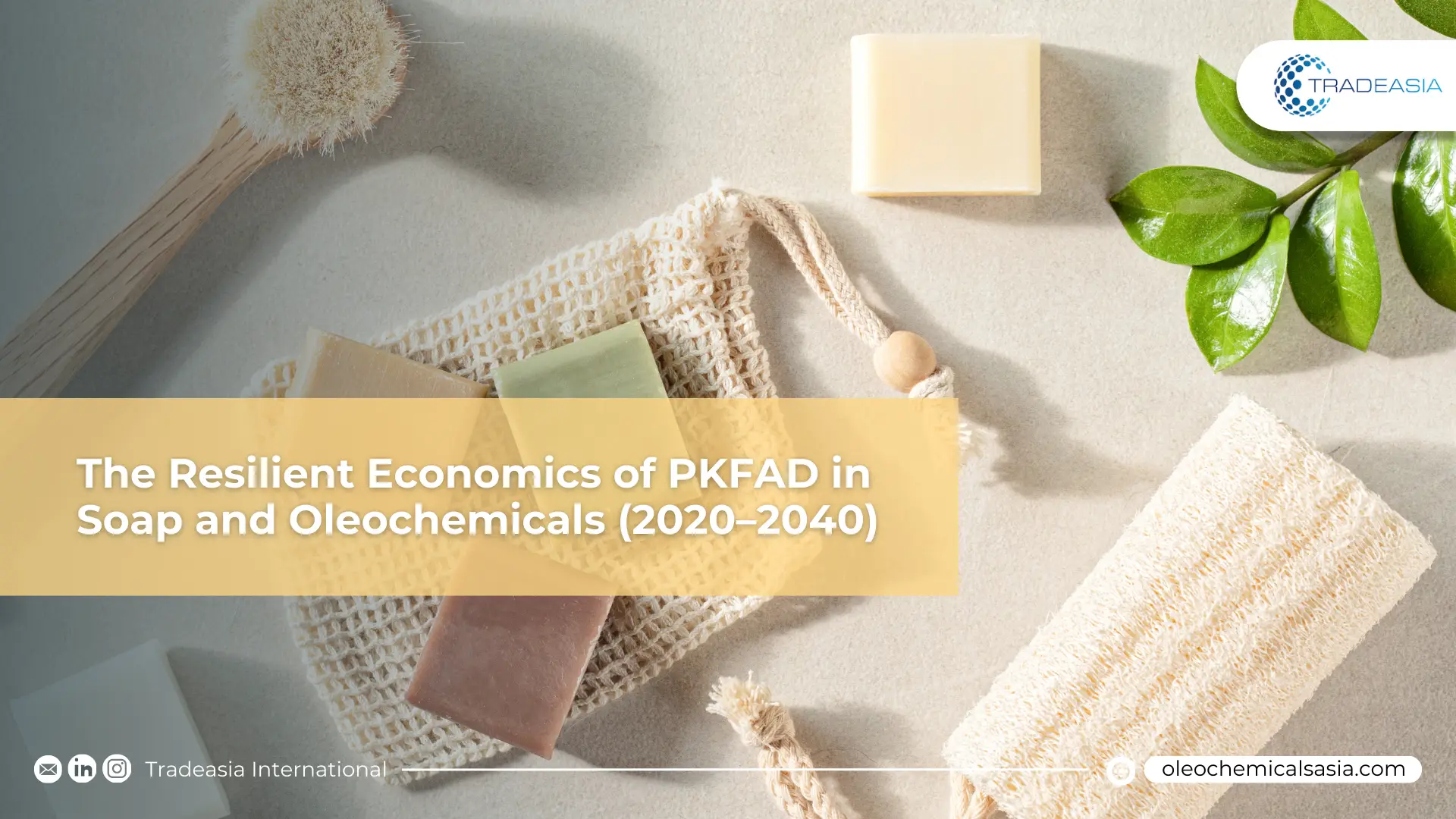
The Unshakable Demand of Personal Care
Adapting to a High-Stakes Future
Palm Kernel Fatty Acid Distillate (PKFAD) serves as a cornerstone of the $28 billion global oleochemical industry. It is the foundational raw material for hundreds of consumer products, from soap noodles and detergents to personal care and animal feed. As such, its price and availability are critical to downstream manufacturers. However, with new demand from the energy sector, securing this key ingredient has become increasingly competitive. Tradeasia International reinforces this vital supply chain, acting as a dedicated trading partner to the oleochemical industry. We ensure that manufacturers of soaps, detergents, and chemicals get the high-quality PKFAD they need to operate.
While the energy sector often dominates the headlines, the traditional oleochemical industry remains the resilient backbone of the PKFAD market. The price volatility of 2020–2022 served as a stress test, where approximately 12% of animal feed manufacturers abandoned PKFAD for cheaper substitutes once prices breached the $800/MT threshold. Yet, the soap and detergent sectors held firm. For soap noodle manufacturers, the specific C12-C14 Lauric carbon chains found in PKFAD are irreplaceable assets that provide essential foaming properties not easily replicated by synthetics.
Tradeasia International supports these traditional industries by maintaining dedicated supply lines for essential Lauric oils. This ensures that soap and detergent manufacturers are not sidelined by the energy sector's growing appetite, providing stability in a market defined by fluctuation. By prioritizing long-standing industrial partnerships, Tradeasia serves as a buffer against the volatility of the energy spot market.
Forecasting through 2040, the personal care sector is expected to maintain a rigid "consumption floor" of roughly 3.5 million MT annually. Because of this inelastic demand, the oleochemical buyer's market share is predicted to stabilize at 40% of global volume by 2030. Although this is a drop from 65% in 2015, it represents the highest-value segment of the market. To survive this high-cost environment, the period of 2030–2040 will likely see producers shifting strategies toward higher-margin downstream derivatives. We anticipate a 15% increase in specialized fatty acid production capacity in Southeast Asia by 2035, utilizing lower-grade PKFAD that biofuels cannot process to create a secondary niche market.
We're committed to your privacy. Tradeasia uses the information you provide to us to contact you about our relevant content, products, and services. For more information, check out our privacy policy.


 English
 Indonesian
 简体字
简体字
 العربية
 Español
 Français
 Português
 日本語
日本語
 한국어
한국어
 Tiếng Việt