Explore our network of country and industry based websites to access localized information, product offerings, and business services across our group.

Access reliable chemical market information through our update channels.
Real-time Updates
Daily Updates
Log in to start sending quotation requests for any product.
Don't have an account? Sign Up Here
Home Decyl Alcohol Scarcity Amid 2026 La Niña
Trade Insights | Supply Chain | 02 February 2026
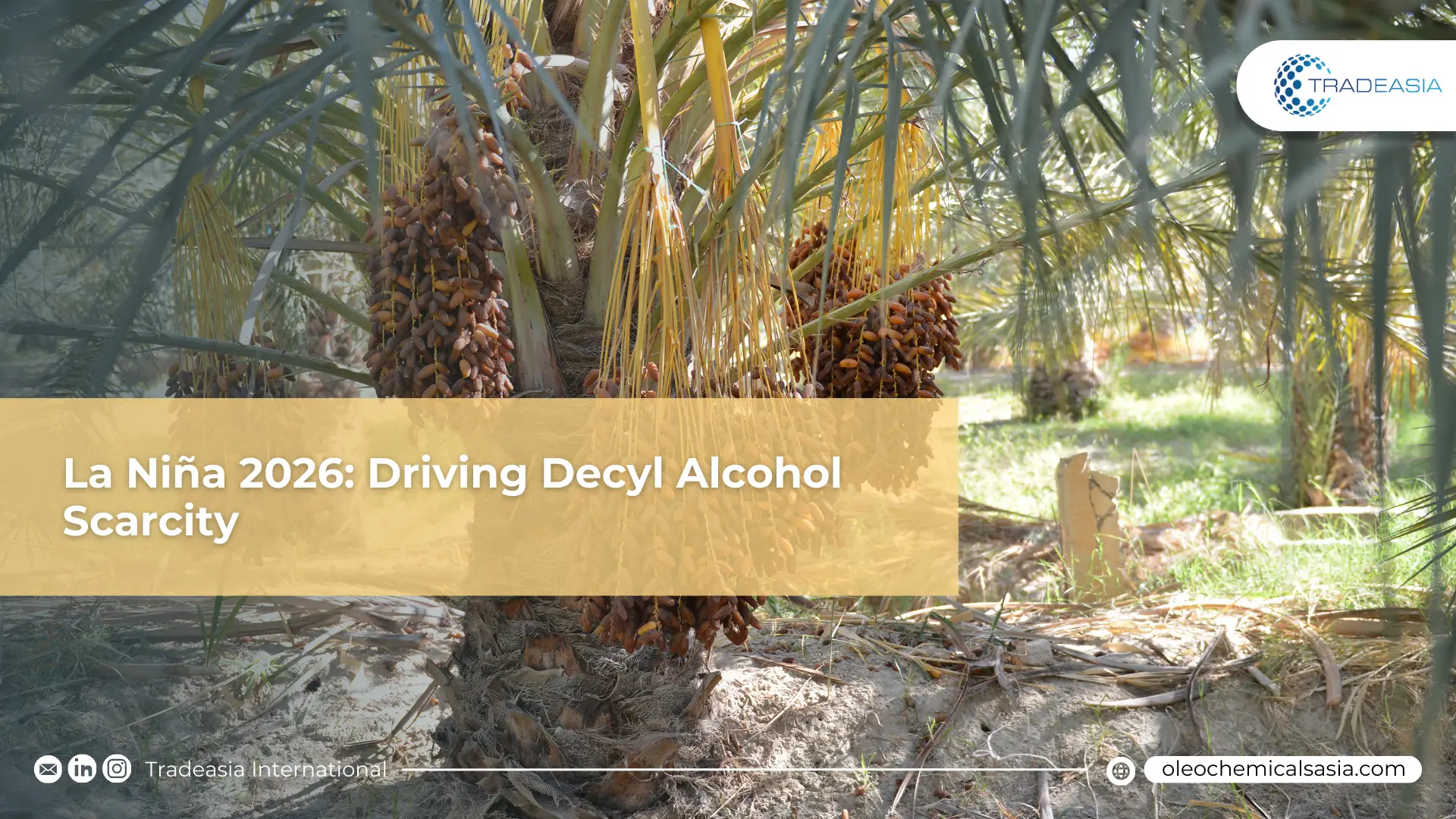
The 2026 La Nina event has transitioned from a meteorological warning to a significant financial burden for the global Decyl Alcohol market. Throughout the first quarter of this year, Southeast Asia has experienced rainfall levels 30 to 40 percent above the historical average. While long-term palm yield might eventually benefit from this hydration, the immediate impact on the oleochemical supply chain is purely disruptive. For Decyl Alcohol, a product that relies on the steady flow of palm kernel oil from inland plantations to coastal refineries, the persistent flooding in Sumatra and Kalimantan has created a series of logistical "choke points." This has manifested in a volatile pricing environment where the "weather premium" is now a permanent fixture of the weekly quote.
By February 2026, Decyl Alcohol spot prices have touched the USD 2,750 per Metric Ton mark, a direct result of increased transportation costs and vessel delays. The sheer volume of water has made many secondary roads impassable for tanker trucks, leading to a "feedstock drought" at the fractionation plants despite an abundance of fruit on the trees. When refineries cannot operate at 90 percent capacity due to feedstock arrival delays, their fixed costs are spread over a smaller output, forcing an upward revision in the FOB price. Furthermore, port congestion in the Malacca Strait has worsened as ships wait for safe loading windows during intensified tropical squalls, adding thousands of dollars in demurrage costs to every ISO tank shipment.
The biological impact of the 2026 La Nina on palm kernel oil production cannot be ignored. Excessive rain disrupts the pollination process and makes the physical harvesting of fresh fruit bunches nearly impossible in low-lying areas. This has led to a projected 5 percent shortfall in PKO availability for the 2026 season. Since Decyl Alcohol is a fraction of the total fatty alcohol cut, this feedstock squeeze is felt most acutely in the C10 and C8 markets. Buyers are currently competing for a dwindling pool of unallocated material, and the "bid-ask" spread has widened significantly. We are observing a trend where European buyers are paying an additional USD 80 per ton just to jump the queue for March and April 2026 loadings.
In this climate of uncertainty, the most successful B2B procurement teams are those that have diversified their port of origin. Relying solely on a single Indonesian exit point in 2026 is a high-risk strategy. By splitting contracts between East Malaysian and Western Indonesian suppliers, companies are hedging against localized weather disasters that might shut down one region while leaving the other operational. Additionally, the use of "flex-tank" logistics in 2026 has increased as a way to bypass the shortage of traditional ISO tanks caused by slow turnaround times at flooded ports. Understanding that the 2026 La Nina is a structural reality rather than a temporary glitch is the first step in building a resilient Decyl Alcohol sourcing strategy.
We're committed to your privacy. Tradeasia uses the information you provide to us to contact you about our relevant content, products, and services. For more information, check out our privacy policy.


 English
 Indonesian
 简体字
简体字
 العربية
 Español
 Français
 Português
 日本語
日本語
 한국어
한국어
 Tiếng Việt