Explore our network of country and industry based websites to access localized information, product offerings, and business services across our group.
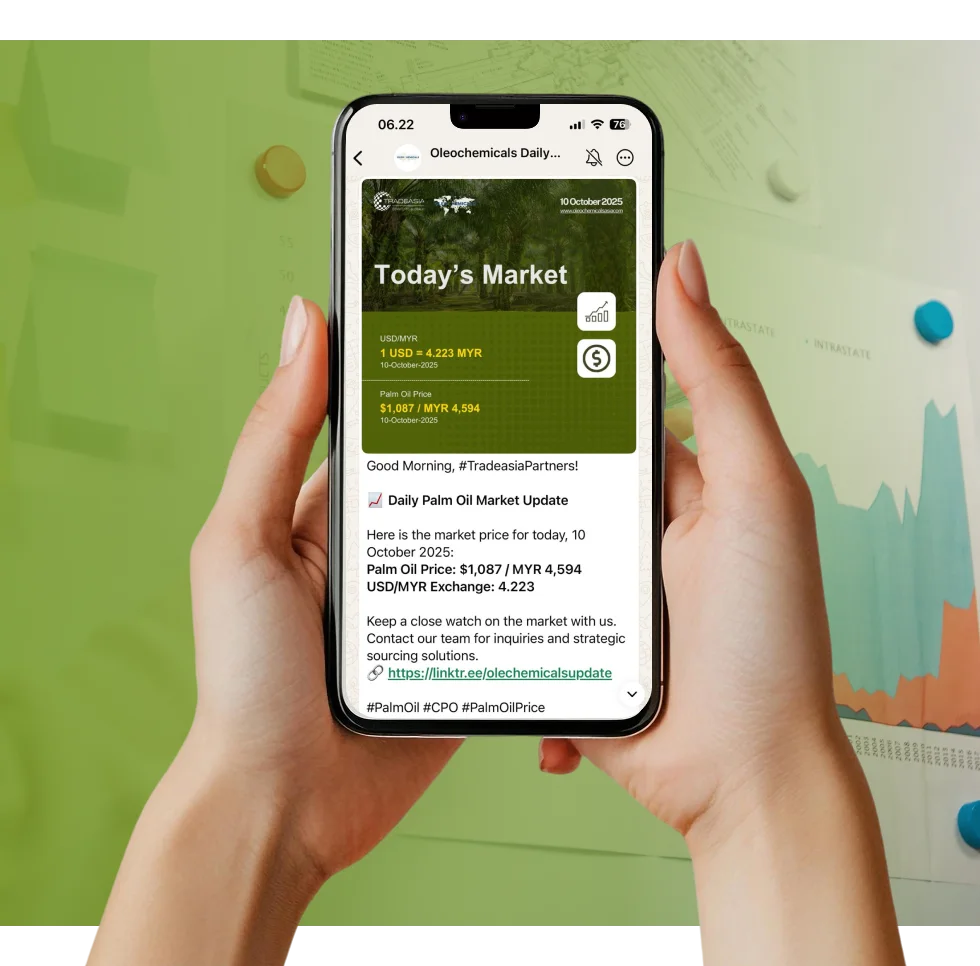
Access reliable chemical market information through our update channels.
Real-time Updates
Daily Updates
Log in to start sending quotation requests for any product.
Don't have an account? Sign Up Here
Home The Biofuel-Food Nexus: Quantifying the Supply Squeeze on RBD Palm Olein to 2040
Trade Insights | Supply Chain | 24 November 2025
The Premium on Proven Sustainability
Navigating Regulatory Headwinds and Future Costs
The strategic allocation of palm oil feedstock has become a high-stakes decision, fundamentally altering the supply outlook for RBD Palm Olein. The primary constraint in the 2020-2040 period is the structural diversion of feedstock into the energy sector, creating an artificial, policy-driven tightness in the edible oil market. Indonesia’s aggressive expansion of its mandatory biodiesel blending rates exemplifies this. The shift from B30 (2020) to B35 (2023) immediately absorbed an estimated 1.2 Million Metric Tons (MMT) of additional CPO/Palm Olein feedstock annually. Looking ahead, a potential B40 mandate by 2030 could consume up to 20% of Indonesia’s total CPO output, fundamentally redefining export availability.
While governments drive the energy transition, consumers and regulators demand sustainability, particularly in the EU. Amidst these shifting demands, it becomes clear that reliable supply is tied directly to accountability. Tradeasia International has long demonstrated that sourcing high-quality palm products responsibly is not a cost, but a competitive advantage. This commitment to transparent and sustainable sourcing is what separates resilient businesses from the rest. This pressure is quantified in the market by a significant "Green Premium." In 2024, the average price difference for Certified Sustainable Palm Olein (CSPO) over conventional olein averaged $45 per MT in key European ports, fluctuating seasonally between $38/MT and $65/MT. Furthermore, the volume of imports into the EU declined by approximately 15% between 2020 and 2024, partly due to anticipatory adjustments to the EU Deforestation Regulation (EUDR).
The cumulative effect of these mandates is staggering: between 2025 and 2035, an estimated 13.5 MMT of CPO equivalent will be permanently taken off the global food market and shifted into domestic energy use. This structural drain on supply acts as a robust price floor for RBD Palm Olein. Managing this complex supply chain—where sustainability certifications are non-negotiable and energy policies determine feedstock availability—is critical. Companies must integrate sophisticated compliance and tracking systems, which are projected to add an average of 1.5% to 2.5% to CIF costs globally, making the choice of a resilient, policy-aware supplier paramount.
Sources
We're committed to your privacy. Tradeasia uses the information you provide to us to contact you about our relevant content, products, and services. For more information, check out our privacy policy.


 English
 Indonesian
 简体字
简体字
 العربية
 Español
 Français
 Português
 日本語
日本語
 한국어
한국어
 Tiếng Việt




















