Explore our network of country and industry based websites to access localized information, product offerings, and business services across our group.

Access reliable chemical market information through our update channels.
Real-time Updates
Daily Updates
Log in to start sending quotation requests for any product.
Don't have an account? Sign Up Here
Home Analyzing the Pipeline: India’s Oleochemical Import Trajectory for 2026
Trade Insights | Supply Chain | 26 January 2026
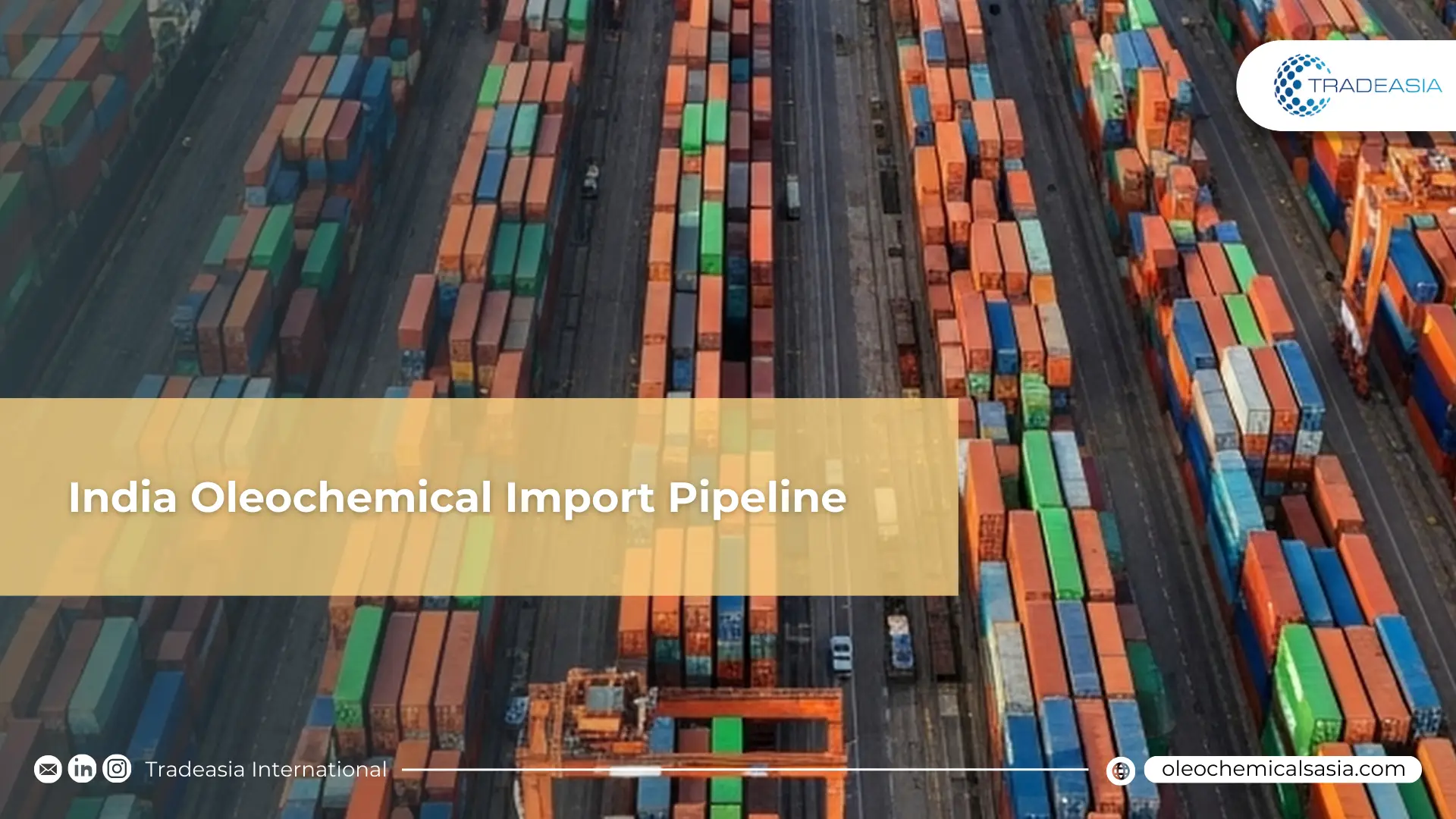
Logistical Bottlenecks and the 2026 Monsoon Impact at Kandla
Analytical Summary of 2026 Import Trends
The Indian industrial sector in 2026 finds itself at a critical juncture of growth and dependency, with the oleochemical supply chain serving as its vital marrow. For a senior procurement officer, the 2026 landscape is defined by a persistent 85% reliance on imported high-purity stearic acid and distilled glycerine to satisfy domestic pharmaceutical and polymer demands. Market data for the first half of 2026 indicates that import volumes at the Port of Kandla have surged by 4.5% year-on-year, driven primarily by the expansion of polymer additive manufacturing in the western industrial corridor. However, this volume growth is tempered by a significant shift in landed costs. As of early 2026, triple-pressed stearic acid (C18) prices under HS Code 382311 have stabilized at approximately 1,420 USD/MT CIF India, a sharp increase from the 1,350 USD/MT averages observed in mid-2025.
The strategic importance of India’s western gateway, encompassing Kandla, Nhava Sheva, and Mundra, cannot be overstated, as these hubs process over 65% of the nation's total oleochemical inflows. In 2026, the cost of these imports is being heavily influenced by the Indonesian government’s B45 biodiesel mandate, which has effectively diverted a larger share of crude palm oil toward domestic energy production. This policy has tightened the exportable surplus of the C16 and C18 feedstocks required by Indian refiners. Consequently, Indian buyers are navigating a high-volatility environment where spot market liquidity is often restricted, forcing a move toward more defensive, forward-contracting strategies. By the midpoint of 2026, the delta between the Indonesian CPO reference price of 915 USD/MT and finished fatty acid quotes in India has reached record spreads, reflecting the added logistical and regulatory costs of the 2026 trade cycle.
A defining feature of the 2026 fiscal year is the emergence of unseasonable "Mega-Monsoon" patterns that have extended the period of maritime disruption across the Arabian Sea. For Indian oleochemical importers, this has manifested as severe anchorage delays at the Port of Kandla, where chemical tankers are currently facing a 15-to-20-day queue for berth allocation. These delays are not merely a scheduling inconvenience; they represent a tangible financial drain in the form of demurrage costs, which analysts estimate are adding 15 to 25 USD/MT to the final landed cost of bulk fatty acids. For a procurement manager operating on thin margins, these "weather-driven surcharges" have necessitated a shift toward containerized cargo via Nhava Sheva, which, despite higher base freight rates, offers a more predictable 7-day turnaround compared to bulk discharging.
Furthermore, the 2026 La Niña event in the Malacca Strait has introduced "Upstream Friction" by disrupting the collection of fresh fruit bunches in Sumatra. This has degraded the quality of incoming feedstocks, with several shipments arriving at Indian ports showing elevated Free Fatty Acid (FFA) levels. This requires additional domestic refining, further inflating the operational costs for Indian soap and detergent manufacturers. To mitigate these risks, the 2026 market is seeing a notable trend toward regional diversification. Indian firms are increasingly securing 20% to 30% of their annual requirements from Malaysian and Middle Eastern suppliers who, while sometimes priced at a premium, offer a more stable logistical framework during the peak of the Indonesian monsoon season.
Looking toward the second half of 2026, the Indian oleochemical market is projected to reach a valuation of approximately 2.2 billion USD. This growth is being underpinned by a 5.2% increase in the import of specialty esters and fatty alcohols through Nhava Sheva, reflecting a maturing industrial base that is moving away from bulk crude oils toward value-added derivatives. The extension of the 10% basic customs duty on crude palm oil through early 2026 has provided some relief to domestic refiners, yet the competitive friction between pure importers and local splitters remains intense. Successful procurement in this environment requires a dual-track approach: locking in core bulk volumes at Kandla while maintaining agile, spot-ready lines at Nhava Sheva to capture price dips in the specialty segment.
In conclusion, the 2026 oleochemical trade between Southeast Asia and India is a study in calculated resilience. With the Indian manufacturing sector accelerating and the Southeast Asian supply chain facing both policy-driven and climate-driven constraints, the role of the procurement officer has transitioned into that of a supply chain strategist. Those who can navigate the complexities of 2026 port data and leverage regional logistical shifts will be best positioned to maintain production stability in an increasingly unpredictable global market.
We're committed to your privacy. Tradeasia uses the information you provide to us to contact you about our relevant content, products, and services. For more information, check out our privacy policy.


 English
 Indonesian
 简体字
简体字
 العربية
 Español
 Français
 Português
 日本語
日本語
 한국어
한국어
 Tiếng Việt




















