The Unseen Additive: How 0.5% of Methyl Stearate Increases PVC Output by 20%
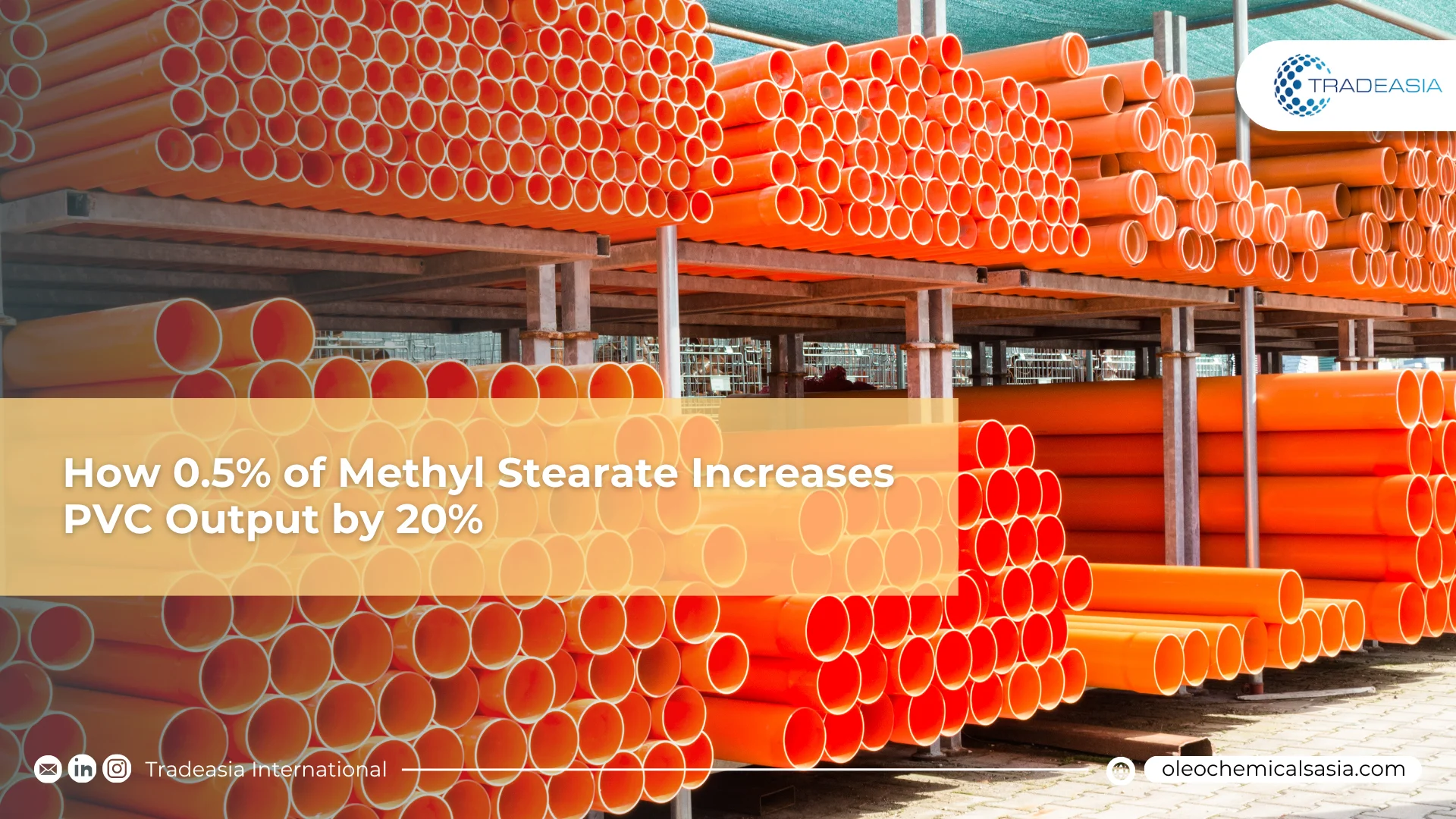
Table of Content
-
The 1% Additive with a 20% Output Gain
-
Beyond Speed: Slashing Downtime and Saving Energy
In the world of high-volume polymer processing, the smallest additives often have the largest financial impact. Methyl Stearate is a perfect example. While it constitutes a tiny fraction of the final product, its role as a processing aid in the plastics and rubber industry delivers a massive, quantifiable return on investment. This isn't just an ingredient; for many manufacturers, it's a direct route to higher throughput and lower operational costs.
When a single, low-dose additive has such a massive impact on profitability, supply chain reliability becomes paramount. You simply cannot afford to run out. Sourcing from a trusted global partner like Tradeasia International, with our robust palm and oleochemical network, ensures that this critical component is never the bottleneck in your production. We turn supply chain security into your competitive advantage.
The 1% Additive with a 20% Output Gain
In rigid PVC extrusion, Methyl Stearate acts as a highly efficient dual-function lubricant. As an external lubricant, it creates a microscopic film that reduces friction between the molten polymer and the hot metal of the extruder and die. As an internal lubricant, it reduces melt viscosity, allowing the polymer to flow more easily. The results are dramatic: adding just 0.5 to 1.0 phr (parts per hundred resin) has been consistently shown to increase production line speeds for PVC pipes and window profiles by up to 20%.
Beyond Speed: Slashing Downtime and Saving Energy
The value is even more pronounced in highly filled formulations, such as those containing 30% or more calcium carbonate. Here, Methyl Stearate prevents die buildup, a common problem that forces line stoppages for cleaning. Manufacturers report this function alone can reduce production downtime by as much as 40% per week. In the rubber industry, adding 1-2% of Methyl Stearate as a dispersing agent helps carbon black mix evenly, shortening Banbury mixer cycle times by up to 15%. In both cases, the math is clear: this "unseen additive" is an efficiency multiplier.
Sources:
-
https://www.oleochemicalsasia.com/category/market-news/
-
Plastics Technology Magazine (The Handbook of PVC Compounding)
-
AOCS Press (Additives for Plastics Handbook)
Leave a Comment