Explore our network of country and industry based websites to access localized information, product offerings, and business services across our group.

Access reliable chemical market information through our update channels.
Real-time Updates
Daily Updates
Log in to start sending quotation requests for any product.
Don't have an account? Sign Up Here
Home Analyzing the Logistics Corridor: Singapore to Dubai Freight Dynamics in 2026
Trade Insights | Supply Chain | 12 January 2026
Weather Disruptions and the La Niña Supply Shock
Strategic Procurement Outlook for the Middle East and India
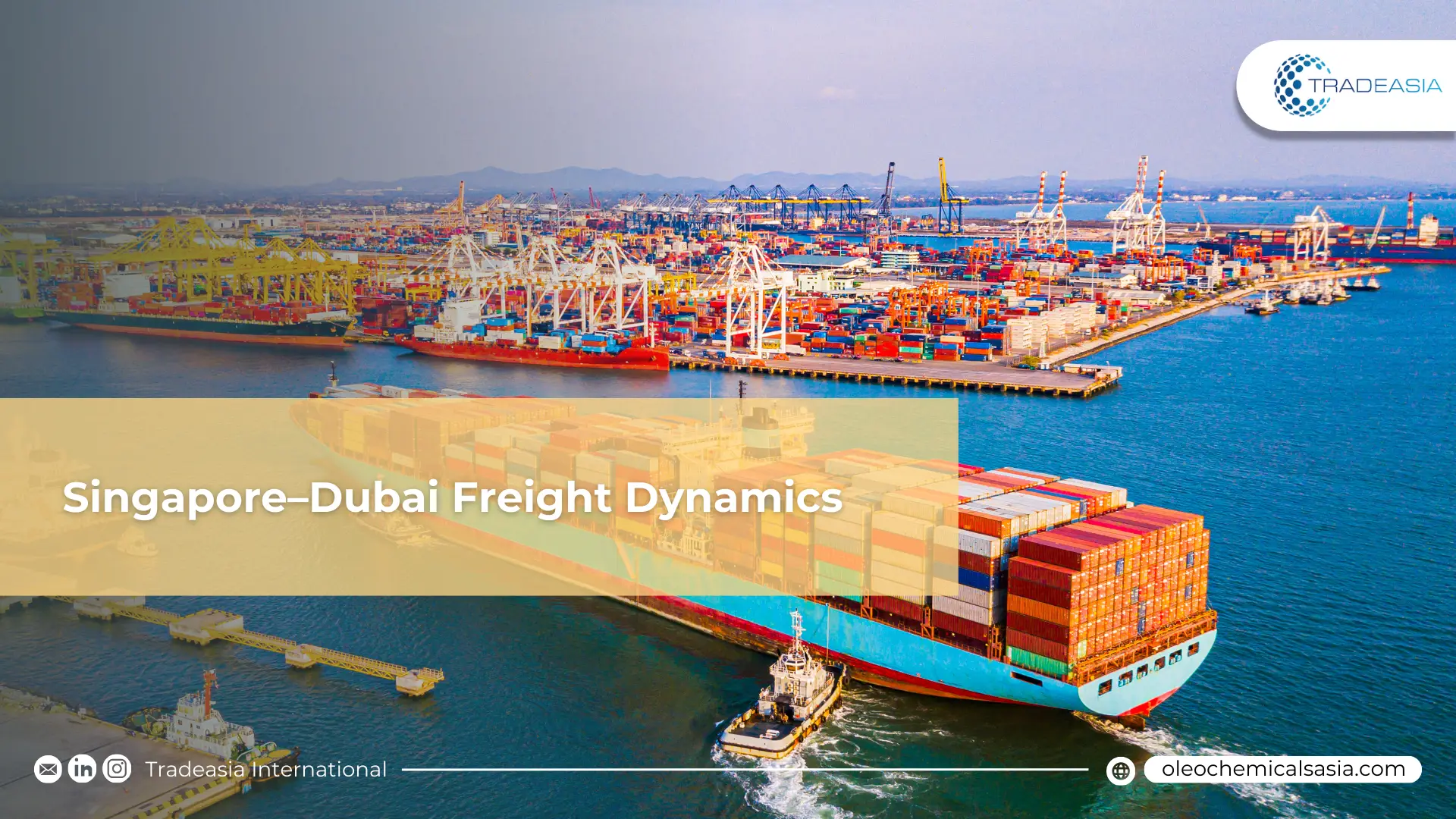
The transshipment corridor between Singapore and Dubai remains the most critical artery for the global oleochemical industry, connecting the refining hubs of Indonesia and Malaysia with the burgeoning manufacturing sectors of the Middle East and the Indian Subcontinent. As we move through the first quarter of 2026, procurement officers are navigating a landscape defined by structural overcapacity in container markets contrasted against extreme volatility in the specialized liquid bulk and chemical tanker segments. While global container spot rates are projected to soften by nearly 25 percent this year, the niche vessels required for high-purity fatty acids and alcohols are facing a different set of pressures. In early 2026, spot freight rates for ISO tank movements and chemical parcels from Singapore to Jebel Ali have stabilized between 850 USD and 1,100 USD per 20-foot equivalent unit, though these figures remain highly sensitive to the persistent regional bottlenecks that have come to define post-pandemic maritime trade.
Strategic planning for 2026 must account for the dual-pressure system of Southeast Asian production and Indian transit delays. The primary transshipment hub of Singapore is currently grappling with vessel bunching that has extended average waiting times to four days, a spillover effect from the continued rerouting of vessels around the Cape of Good Hope to avoid Red Sea instability. For the Indian market, this creates a secondary crisis at gateway ports like Kandla and Nhava Sheva. In June 2025 and continuing into 2026, Kandla has seen berth wait times for chemical tankers reach upwards of 12 days. These delays are not merely operational inconveniences; they represent a significant cost burden in the form of demurrage, which is currently averaging 25,000 USD per day for mid-sized tankers. For Indian oleochemical importers, this logistics friction adds an estimated 15 percent to the landed cost of C16 and C18 acids, even when the underlying commodity price remains stable.
The 2026 market is further complicated by the emergence of a moderate-to-strong La Niña event affecting the primary growing regions of Sumatra and Kalimantan. Unlike the dry stress caused by El Niño, the current La Niña cycle is characterized by persistent, heavy rainfall that has historically disrupted the harvesting of fresh fruit bunches and the subsequent logistics of transporting crude palm oil to refineries. Analysts observe that such weather patterns typically correlate with a 3 percent to 5 percent decline in Southeast Asian output, which has already pushed Crude Palm Oil prices toward 1,050 USD per metric ton in early 2026. The excessive moisture in Sumatra has specifically hampered the transport of feedstocks to the ports of Belawan and Dumai, creating a supply-side squeeze that forces Singaporean exporters to maintain higher inventory cushions, further tightening the available space on outbound vessels to Dubai.
This meteorological volatility coincides with the 2026 implementation of Indonesia’s B45 biodiesel mandate, which has effectively diverted a larger portion of domestic CPO supply away from the export market. With fewer refined oleochemicals available for the spot market, shipping lines are seeing more fragmented cargo parcels. This fragmentation is inefficient for bulk carriers and has led to a 10 percent increase in "less-than-container-load" rates for specialized chemical grades. Consequently, the freight-to-value ratio for low-margin products like crude glycerin is becoming increasingly difficult for Middle Eastern buyers to absorb. We are seeing a shift where long-term contracts, which were previously avoided during the rate spikes of 2024, are now being viewed as essential hedging tools for 2026 and 2027.
Looking toward the latter half of 2026, the intersection of industrial demand and logistics capacity suggests a period of "plateaued volatility." While the massive influx of new vessel deliveries in the container sector offers some relief for packaged oleochemicals, the specialized chemical tanker market remains undersupplied. In the Indian market, the rapid expansion of the personal care and surfactant sectors, growing at a CAGR of 7.5 percent through 2026, will continue to outpace the rate of port infrastructure upgrades at Nhava Sheva. This imbalance ensures that freight rates will not return to pre-2020 levels in the near term. Buyers in Dubai and the wider GCC region must prioritize "shipped-on-board" certainty over the pursuit of the lowest possible spot rate.
In conclusion, the Singapore-to-Dubai freight market in 2026 is a study in complexity, where meteorological events in Indonesia and port congestion in India dictate the bottom line more than global trade sentiment. The combined impact of La Niña harvesting delays and the B45 mandate has created a floor for prices, while maritime bottlenecks at transshipment hubs keep logistics costs elevated. Successful procurement in this environment requires a transition away from just-in-time sourcing toward a model that factors in a 15-day logistics buffer and prioritizes carriers with dedicated berthing rights at Jebel Ali and Kandla.
We're committed to your privacy. Tradeasia uses the information you provide to us to contact you about our relevant content, products, and services. For more information, check out our privacy policy.


 English
 Indonesian
 简体字
简体字
 العربية
 Español
 Français
 Português
 日本語
日本語
 한국어
한국어
 Tiếng Việt