Explore our network of country and industry based websites to access localized information, product offerings, and business services across our group.

Access reliable chemical market information through our update channels.
Real-time Updates
Daily Updates
Log in to start sending quotation requests for any product.
Don't have an account? Sign Up Here
Home Supply Chain Shift: Logistical Costs and Inventory Risks in RBD Palm Olein 2040
Trade Insights | Supply Chain | 24 November 2025
The Tight Rope: Inventory and Supply Vulnerability
The Emerging Corridor Strategy
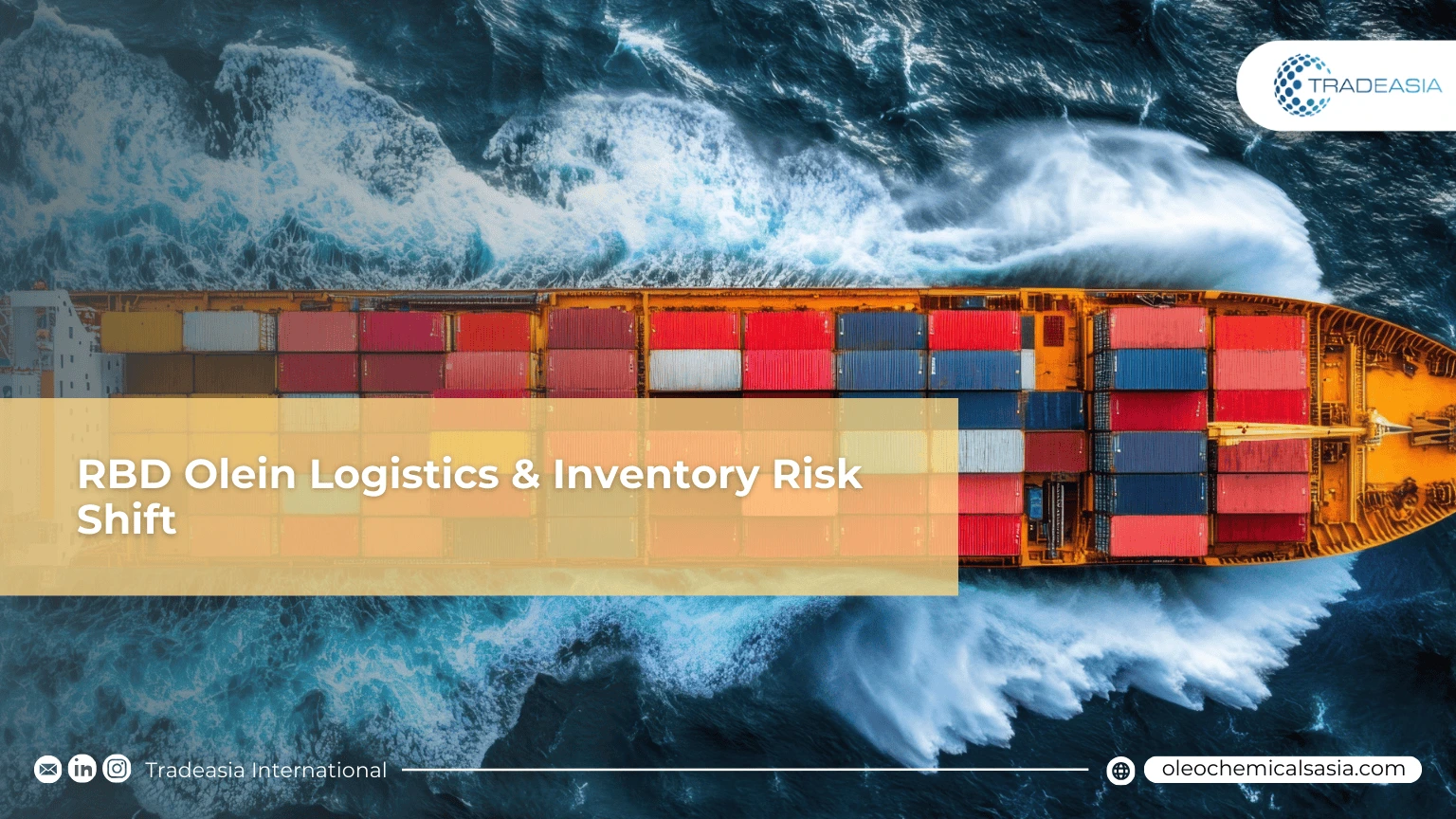
The efficiency of shipping, once a peripheral consideration, has dramatically reshaped the landed cost of RBD Palm Olein, transforming logistics into a primary source of price volatility since 2020. The turbulence experienced was unprecedented, with the average spot rate for a 40-foot container (FEU) from Southeast Asia to Rotterdam surging by over 450% between Q1 2020 and its peak in 2021. While rates have retreated from those historical highs, as of Q3 2024, average FEU costs remain stubbornly 25% above 2019 levels, indicating a persistent structural elevation in operational costs. This increased freight expense directly impacts the CIF (Cost, Insurance, and Freight) price, where logistics now account for an average of 12% to 15% of the total delivered price.
Beyond cost, effective inventory management is crucial for mitigating short-term supply shocks. The combined RBD Palm Olein stock in the two major producer nations, Malaysia and Indonesia, has become far more volatile, with the standard deviation in 2023 at 1.8 Million MT, double the 0.9 Million MT recorded in 2019. This volatility signals heightened market vulnerability. During periods of low stock, the global Days of Supply indicator briefly dipped to under 18 days in 2022, underscoring the acute risk of supply disruptions. This is where strategic warehousing and agile distribution come into play. Tradeasia International, through its established global network, ensures that inventory is not merely stored, but strategically positioned to mitigate the risks exposed by volatile supply-to-demand windows.
To counter geopolitical and logistical chokepoints, the global trade map is diversifying. Olein exports from Southeast Asia to newer markets, such as West Africa and Latin America, grew by a combined 35% between 2020 and 2024. This growth in non-traditional corridors, while stabilizing the overall inventory risk, necessitates greater supply chain adaptability. It introduces new challenges related to bulk storage standards and local regulatory compliance, adding an estimated 3% to 5% to the cost of trade in these regions. For companies navigating the 2020-2040 period, success will depend on moving beyond a single sourcing strategy to embrace a more fragmented and resilient global logistics model.
Sources
Global Container Freight Rate Index (SCFI): https://en.sse.net.cn/indices/scfi.jsp
MPOB Palm Oil Stock and Inventory Data (Malaysia): http://www.mpob.gov.my/en/
We're committed to your privacy. Tradeasia uses the information you provide to us to contact you about our relevant content, products, and services. For more information, check out our privacy policy.


 English
 Indonesian
 简体字
简体字
 العربية
 Español
 Français
 Português
 日本語
日本語
 한국어
한국어
 Tiếng Việt