Explore our network of country and industry based websites to access localized information, product offerings, and business services across our group.

Access reliable chemical market information through our update channels.
Real-time Updates
Daily Updates
Log in to start sending quotation requests for any product.
Don't have an account? Sign Up Here
Home Tracking the Spread of RBD Palm Olein (PO) vs. Soft Oils (SO) in November 2025
Pricing Indices | 24 November 2025
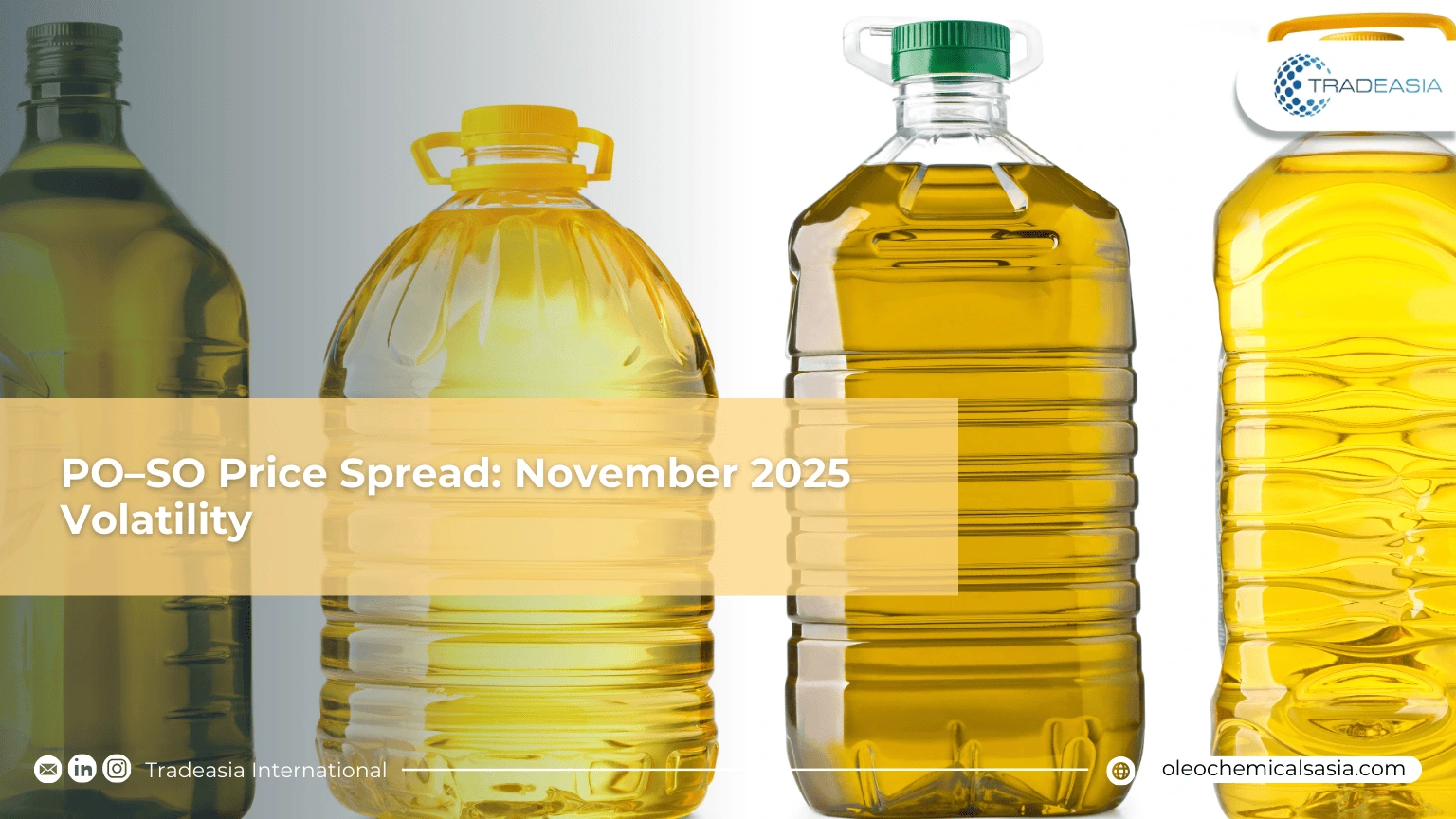
The Widening BOPO Spread and Its Influence on Usage
The Regulatory Floor and Price Stability
The pricing dynamics for RBD Palm Olein throughout November 2025 have been characterized by relative stability against a backdrop of increasing price swings in competing Soft Oils. This distinction is critically important for buyers and traders making inventory decisions. According to exchange data, the benchmark FOB Malaysia price for RBD Palm Olein traded in a predictable range of $1,030 - $1,040/MT for much of the month. This steady price range, which is 4.5% higher than the Q2 2025 average, speaks volumes about the product's fundamental market support.
In this environment of nuanced price movements and complex regulatory impacts, partnering with a veteran commodity trader is essential for leveraging market shifts. Tradeasia International provides the clarity needed to navigate these spreads, ensuring that your procurement strategy maximizes the cost-efficiency of using palm derivatives. "The true value of a commodity lies not just in its cost, but in the certainty of its delivery and quality," a commitment we uphold when supplying high-grade palm olein and other industrial oils.
The most influential metric this November has been the widening Bean Oil-Palm Oil (BOPO) Spread. The price difference between Soybean Oil and Palm Oil products has grown significantly, climbing to approximately $66.71/MT from the end-October measurement. A wider spread fundamentally favors Palm Olein, making it substantially more cost-effective. This clear price disparity has already spurred a measurable demand switch, estimated at an increase of 1.5% in buying by price-sensitive industrial sectors across South Asia and the Middle East, confirming the product's high elasticity. Furthermore, despite the steady trading price, the 20-day rolling average volatility for Crude Palm Oil (CPO) remains high at about 14.8%, prompting a clear signal for increased hedging activities by traders.
The Indonesian government’s firm reference price for CPO, set at $963.75/MT for November export duties, along with an export duty of $71/MT on RBD Palm Olein, acts as a regulatory floor. This government-mandated structure is crucial, preventing prices from spiraling downwards and providing stability in volatile global markets. By maintaining this consistent structure, the price advantage of Palm Olein over other vegetable oils is sustained in November, ensuring its continued high usage across industrial blending and large-scale food manufacturing operations globally. This data confirms that strategic regulatory intervention, coupled with competitive pricing, is securing the RBD Palm Olein market this season.
Sources:
Kuala Lumpur Commodity Exchange (KLCE) Futures and Spot Price Data – Mid-November 2025
Reuters Commodity Wire: Soft Oils vs Palm Oil Price Spread Analysis (November 2025)
Oleochemicals Asia: Hedging Strategies and Volatility in the Palm Derivatives Sector (November 2025)
Access the complete article and discover related coverage.
We're committed to your privacy. Tradeasia uses the information you provide to us to contact you about our relevant content, products, and services. For more information, check out our privacy policy.


 English
 Indonesian
 简体字
简体字
 العربية
 Español
 Français
 Português
 日本語
日本語
 한국어
한국어
 Tiếng Việt