Explore our network of country and industry based websites to access localized information, product offerings, and business services across our group.

Access reliable chemical market information through our update channels.
Real-time Updates
Daily Updates
Log in to start sending quotation requests for any product.
Don't have an account? Sign Up Here
Home November Stearic Acid Surge Fuels Q4 Rubber and PVC
Trade Insights | Applications and Buyers | 19 November 2025
The Industrial Consumption Mandate
Focus on Quality and Geographic Concentration
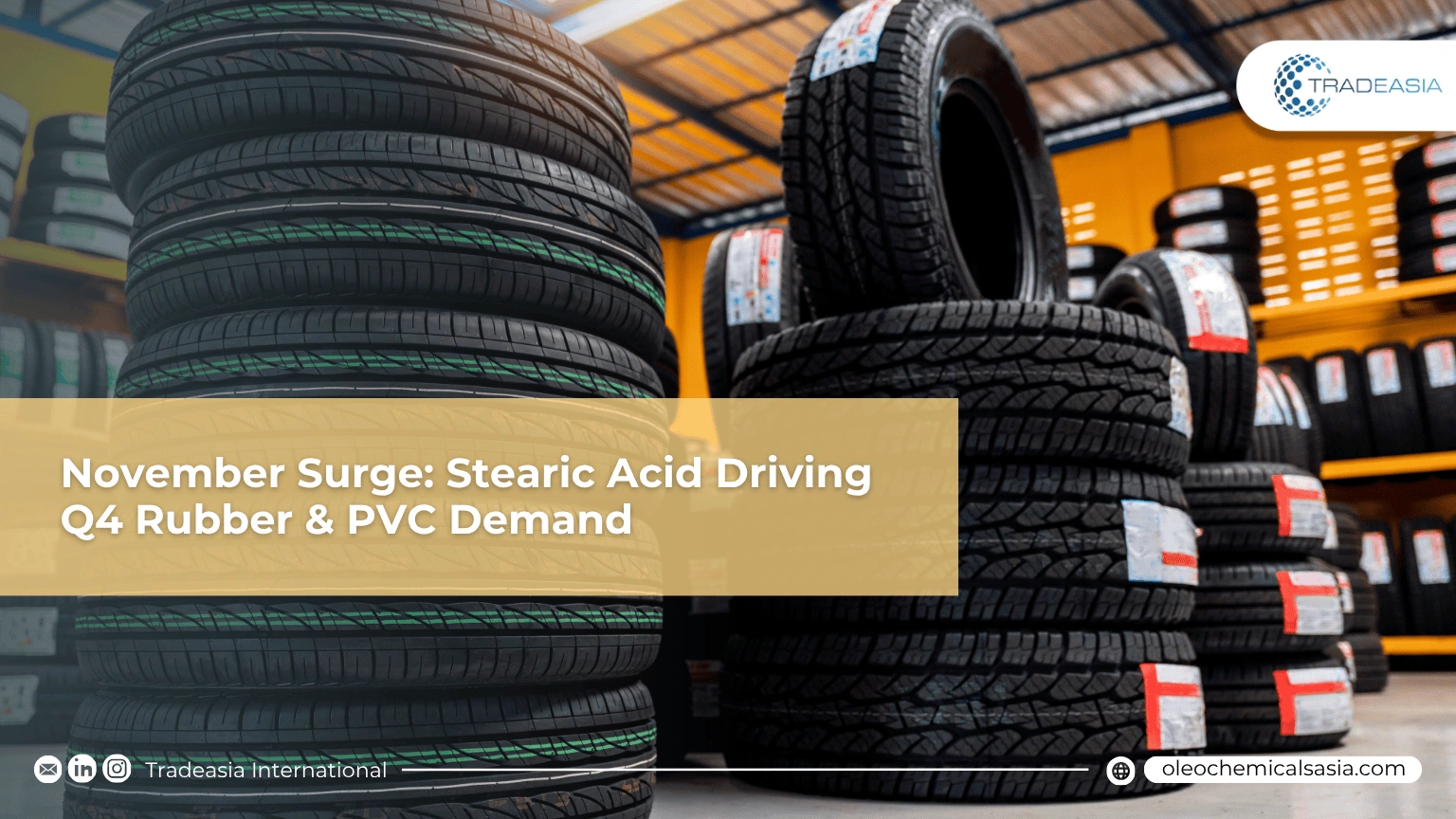
As the calendar turns to November, the industrial world enters its critical, high-volume Q4 manufacturing push. For the oleochemical sector, this translates directly into a pronounced spike in the usage of Stearic Acid (SA), driven by its essential, non-substitutable roles as an activator and stabilizer in the Rubber and Plastics segments. The increase is a predictable reflection of end-user demand across global automotive and construction supply chains.
The industrial sector is the bedrock of SA demand, collectively consuming an average of 65.5% of global volume. Within this, the Q4 surge is clearly segmented. Firstly, the Rubber processing industry, heavily focused on manufacturing tires for the impending Northern Hemisphere winter season, registered a significant consumption boost. SA acts as a crucial vulcanization activator and dispersant, and demand from this sector saw an estimated 5.0% volume jump in November compared to the Q3 average. This increase represents a substantial addition of approximately 3,200 MT to global requirements. Secondly, the Plastics/PVC sector, while maintaining its overall leading application status at 24.9% of total SA volume, also sees a tactical increase. Here, SA and its derivatives are vital as internal lubricants and heat stabilizers, supporting the production of construction components before winter halts. The continued need for reliable industrial sourcing underscores the value of partners like Tradeasia International; our expertise in managing complex global logistics ensures that this vital palm-derived oleochemical is delivered consistently, providing the stability manufacturers require to meet their Q4 production targets. This reliability is not merely a service—it’s a production guarantee.
The demanding nature of industrial application dictates a strong preference for high-purity, consistent grades. Consequently, Triple-Pressed Stearic Acid (TPSA) remains the staple, commanding a dominant 46.18% of the total SA market share in Q4. This preference minimizes batch variation and ensures predictable performance in complex chemical processes. Geographically, manufacturing strength remains highly concentrated; the Asia-Pacific (APAC) region accounts for a staggering 72.20% of the global SA market volume. Data reported via industry sources, including https://www.google.com/search?q=oleochemicalsasia.com, confirms that APAC production capacity is running at an intensified 91% utilization rate in November to meet this global demand. This underscores the intense production pressure and the non-negotiable need for stable, high-quality material supply as the year winds down.
We're committed to your privacy. Tradeasia uses the information you provide to us to contact you about our relevant content, products, and services. For more information, check out our privacy policy.


 English
 Indonesian
 简体字
简体字
 العربية
 Español
 Français
 Português
 日本語
日本語
 한국어
한국어
 Tiếng Việt




















