Explore our network of country and industry based websites to access localized information, product offerings, and business services across our group.

Access reliable chemical market information through our update channels.
Real-time Updates
Daily Updates
Log in to start sending quotation requests for any product.
Don't have an account? Sign Up Here
Home The Inventory Paradox: Why High Stearin Stocks makes Lower Stearic Acid Prices
Pricing Indices | 19 November 2025
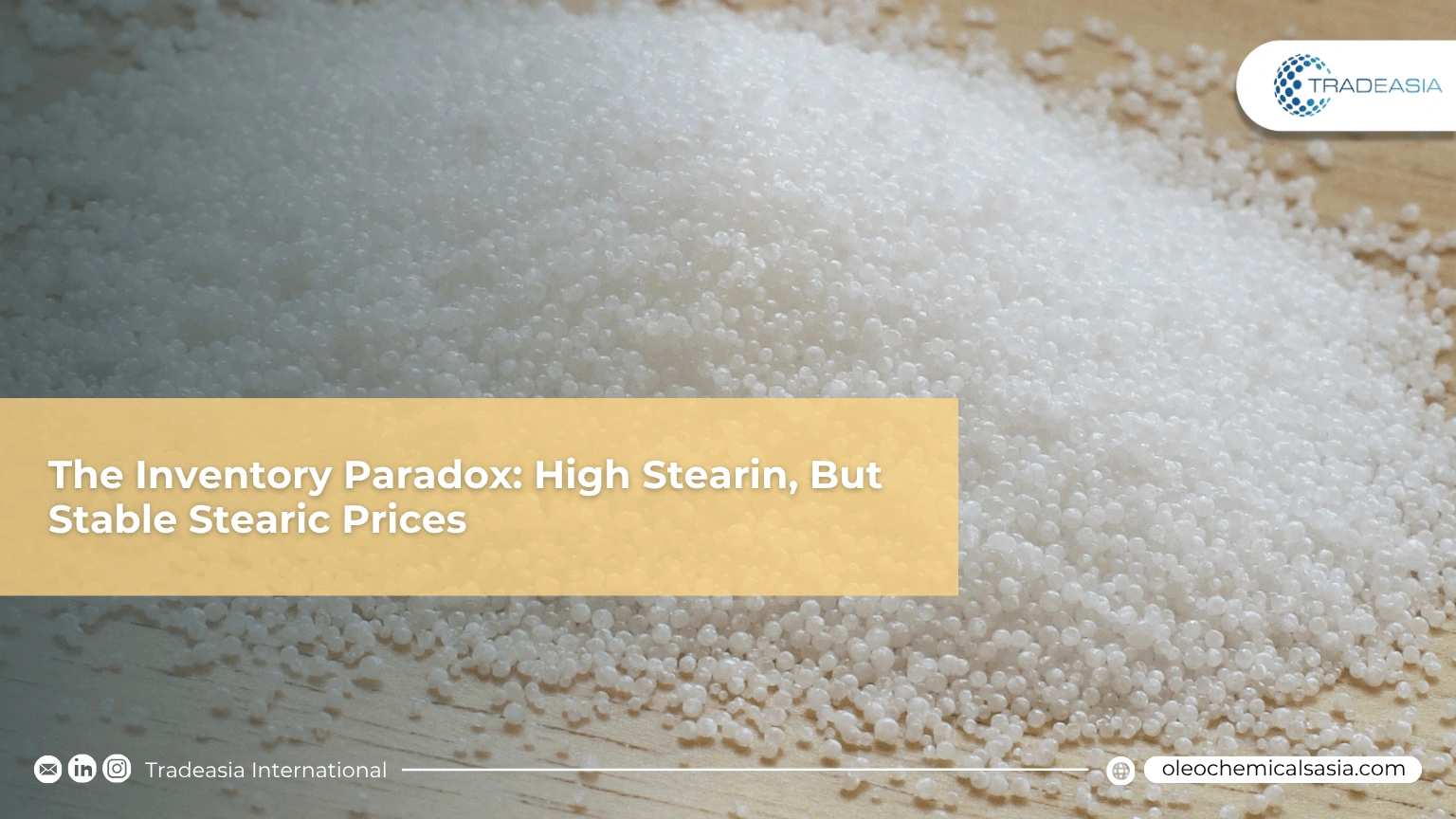
Strong Downstream Demand Overrides Inventory Volume
The Non-Feedstock Cost Floor: Hydrogenation Expenses
The Stearic Acid (SA) market in November is demonstrating a perplexing situation: the traditional supply-demand relationship seems to be inverted. Despite abundant supplies of the primary feedstock, RBD Palm Stearin (PST), the final product’s selling price remains stubbornly high, offering little relief to buyers hoping for a seasonal correction. This paradox is anchored by two powerful factors that supersede the initial inventory data.
Navigating contradictions in the supply chain requires a partner with deep market intelligence. Tradeasia International specializes in providing clarity within the complex trading landscape of palm oil derivatives, ensuring our clients understand the forces at play beyond simple stock reports. Our commitment to securing consistent supply, even when market signals are mixed, is why businesses rely on us. Indeed, official figures confirm that Malaysian palm oil inventory, which includes PST, stood at 2.36 Million Metric Tons (MT) at the end of October—a considerable 7.2% MoM rise, with preliminary November estimates suggesting continued growth. Historically, this high PST volume should signal a strong bearish correction.
The main counteracting force is the robust, consistent global demand for SA. This demand, driven by essential downstream sectors like rubber, lubricants, and personal care, acts as a powerful anchor. Export data confirms sustained volume for SA shipments throughout October and continuing into November, particularly to crucial markets like China and India. This resilient demand effectively converts the high PST inventory from a 'stockpile' into a 'working buffer,' rapidly absorbing the supply into the production pipeline rather than sitting stagnant.
The second, and perhaps more influential, barrier is the rising cost of converting PST into the final product. Stearic Acid production involves intensive hydrogenation—a process demanding significant energy and chemical input. This November, escalating Asian Natural Gas and Coal prices have inflated operating expenses. Analysts estimate that higher utility and chemical costs contribute an estimated 5% to 7% increase to the final SA manufacturing cost year-on-year. This non-feedstock cost floor prevents the final SA price from declining, regardless of the cheap or plentiful nature of the input PST ($\mathbf{\$855–\$870/MT}$). Ultimately, buyers must look beyond the initial inventory headlines; the total cost of production, driven by energy and demand, dictates the November price reality.
Access the complete article and discover related coverage.
We're committed to your privacy. Tradeasia uses the information you provide to us to contact you about our relevant content, products, and services. For more information, check out our privacy policy.


 English
 Indonesian
 简体字
简体字
 العربية
 Español
 Français
 Português
 日本語
日本語
 한국어
한국어
 Tiếng Việt




















