Explore our network of country and industry based websites to access localized information, product offerings, and business services across our group.

Access reliable chemical market information through our update channels.
Real-time Updates
Daily Updates
Home Oleochemicals Overview
From the soap that cleanses your skin to the food you eat, countless everyday items
share a common, natural origin: the palm fruit. The journey from this tropical fruit to
a finished product is a fascinating story of science and innovation. This is the world
of oleochemicals—chemicals derived from natural fats and oils.
While the term "oleochemical" might sound complex, the concept behind it is beautifully
simple. It's about harnessing the power of nature and transforming it through smart
science into ingredients that make our daily lives better, cleaner, and more efficient.
Before you even leave for work in the morning, you've likely interacted with dozens of
products made possible by this hidden science.
At their core, oleochemicals are chemicals derived from renewable sources like vegetable oils, making them a natural alternative to petroleum-based chemicals. We focus on the most significant source: the versatile palm fruit. Natural oils are primarily made of triglycerides, which are molecules containing two key parts: a glycerol backbone and three fatty acid chains. These are the fundamental building blocks of the industry. Through chemical processes like hydrolysis and transesterification, these triglycerides are split into their core components. Once separated and purified, they are transformed into the vast array of ingredients used in products worldwide.
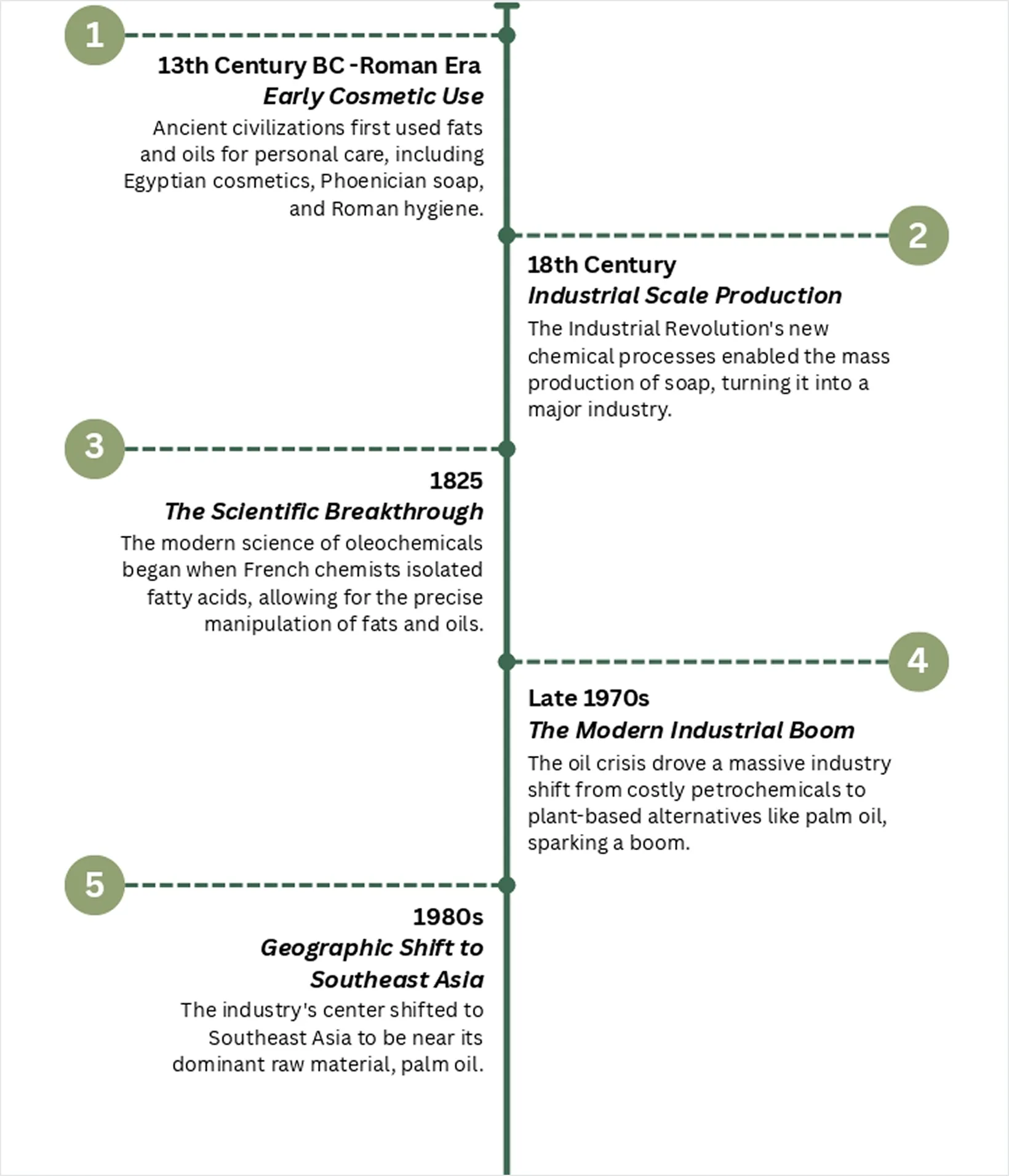
The use of natural oils is not a new concept. In fact, its history stretches back thousands of years, evolving from simple remedies to the sophisticated science we know today. What began as a basic human practice of using fats and oils for preservation, skincare, and fuel has blossomed into a global industry. This journey through time reveals how ingenuity and scientific discovery unlocked the hidden potential within these natural resources.
Every oleochemical starts inside a palm fruit, which uniquely provides two different oils. Palm oil comes from the fleshy outer part, while palm kernel oil comes from the inner seed. The key difference is their composition: palm kernel oil is highly saturated (rich in C12 Lauric Acid), making it solid and ideal for soaps, while palm oil is more unsaturated. This allows palm oil to be physically separated by cooling (fractionation) into solid stearin (for margarine) and liquid olein (for cooking oil).
Before working with any oleochemical, your first step should always be to consult the Safety Data Sheet (SDS). Because oleochemicals can range from solid flakes to viscous liquids, the SDS provides the specific chemical profile, flash points, and reactive hazards necessary for a safe workspace.
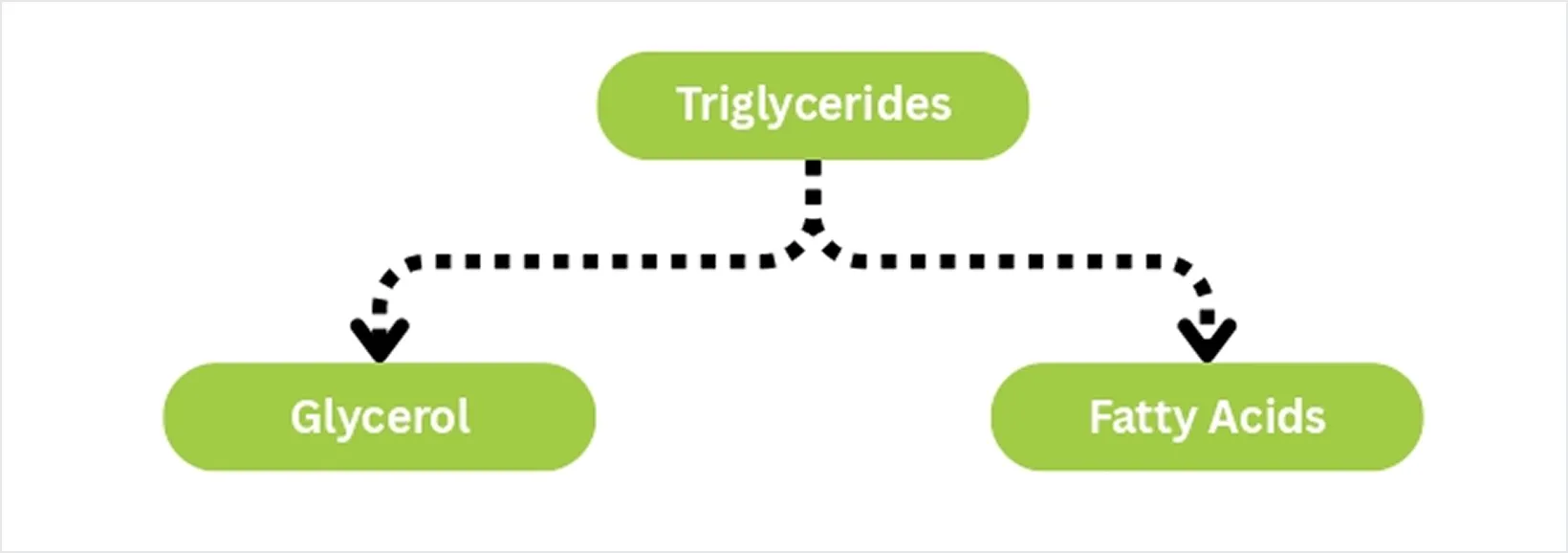
Glycerol is purified through distillation to become Refined Glycerine, which is a key ingredient in pharmaceuticals, food, and cosmetics. Fatty Acids are also distilled and precisely separated by their carbon chain length (e.g., C12, C16, C18). These individual acids can be used directly or processed further through methods like hydrogenation to create Fatty Alcohols, which are essential for making surfactants for detergents and shampoos.
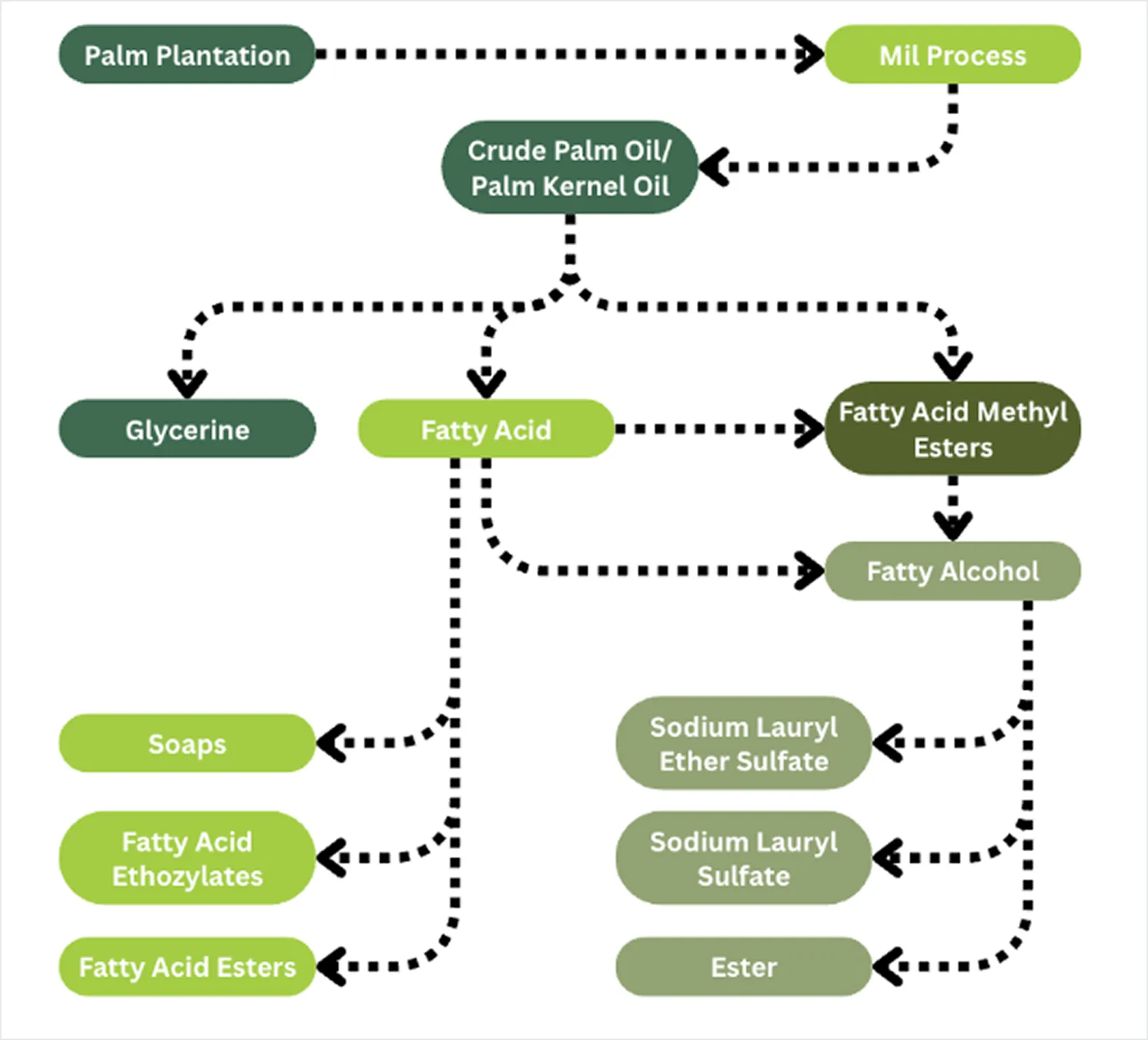
The oleochemical production journey begins at the Palm Plantation, which leads to the Mil Process to produce Crude Palm Oil/Palm Kernel Oil. This oil is then split into two core components: Glycerine and Fatty Acid. Fatty Acid is a versatile building block, used directly to create Soaps, Fatty Acid Ethoxylates, and Fatty Acid Esters. Alternatively, it can be processed into Fatty Acid Methyl Esters, which are then converted into Fatty Alcohol. This final Fatty Alcohol is the key ingredient for making Sodium Lauryl Ether Sulfate, Sodium Lauryl Sulfate, and other Esters.
Crude vegetable oils are refined to remove impurities before processing.
Triglycerides are split under high temperature and pressure into:
Fatty acids are separated by carbon chain length and purity level.
Unsaturated fatty acids may be hydrogenated to improve stability.
Fatty acids react with alcohol to form esters.
Final products undergo:
Products are packed in:
Strict quality standards ensure consistency across global supply chains.
From Palm Fruit to Final Product
| PRODUCT | GRADE | APPLICATION |
|---|---|---|
| Crude Glycerine |
Crude Glycerine 80% Min Crude Glycerine 70% Min Crude Glycerine 80% High MONG |
|
| Refined Glycerine |
Refined Glycerine 99.5% Min Refined Glycerine 99,7% Min (Mixed Animal Fat) Refined Glycerine 99.5% Min USP/BP Refined Glycerine 99,7% USP/BP Refined Glycerine 99,5% USP (Palm Based) Refined Glycerine 99,7% USP Grade Refined Glycerine 99.5% Min USP grade Refined Glycerine 99.7% Min USP/BP Grade Refined Glycerine 99.7% Min USP Refined Glycerine 99.5% Min USP Refined Glycerine 99.7% Min BP Refined Glycerine 99,5% USP Grade Refined Glycerine 99.6% Min |
|
| Stearic Acid |
Stearic Acid B1810 Stearic Acid B1800 Stearic Acid B1801 Stearic Acid 1820 Stearic Acid 1860 Stearic Acid 1838 Stearic Acid 1842 Stearic Acid 1850 Stearic Acid 1865 ST 1 MY ST 8 MY Stearic Acid Sinar FAS (1843) Stearic Acid Rubber Grade |
|
| Soap Noodles |
Refined Glycerine 99.5% Min Refined Glycerine 99,7% Min (Mixed Animal Fat) Refined Glycerine 99.5% Min USP/BP Refined Glycerine 99,7% USP/BP Refined Glycerine 99,5% USP (Palm Based) Refined Glycerine 99,7% USP Grade Refined Glycerine 99.5% Min USP grade Refined Glycerine 99.7% Min USP/BP Grade Refined Glycerine 99.7% Min USP Refined Glycerine 99.5% Min USP Refined Glycerine 99.7% Min BP Refined Glycerine 99,5% USP Grade Refined Glycerine 99.6% Min |
|
| Lauric Acid | Lauric Acid 70% Liquid | A core ingredient in shampoos, body washes, and facial cleansers. |
| Oleic Acid | Oleic Acid 75% | Used in cosmetic formulas for hydration and as a key component in industrial lubricants. |
Presented above represent only a small fraction of the diverse and expansive palm derivatives market. From high-performance lubricants and sustainable plastic additives to advanced surfactants for personal care and high-purity emulsifiers for the food industry, palm derivatives offer unparalleled versatility and bio-based efficiency. As global manufacturing continues to transition toward green chemistry and renewable feedstocks, the applications for these palm derivatives are expanding into new industrial frontiers, reinforcing the role of palm-derived solutions as a cornerstone of the modern bio-economy.
Safety and product quality go hand-in-hand. While most basic oleochemicals—such as fatty acids, alcohols, and glycerin—are generally considered non-hazardous, following rigorous handling and storage procedures is essential to protect your team and maintain the integrity of the product.
Before working with any oleochemical, your first step should always be to consult the Safety Data Sheet (SDS). Because oleochemicals can range from solid flakes to viscous liquids, the SDS provides the specific chemical profile, flash points, and reactive hazards necessary for a safe workspace.
When working with oleochemicals, your Personal Protective Equipment (PPE) should be tailored to the product's physical form:
The future of the manufacturing world is firmly rooted in renewable chemistry. As the global community seeks alternatives to fossil-fuel derivatives, the oleochemical industry has moved from the periphery to the center of the "Bio-Economy." Market forecasts reflect this powerful trend, with projections showing the global oleochemical market growing from approximately $30 billion in 2025 to over $50 billion by the early 2030s.
A clear and decisive global shift away from petroleum-based products (petrochemicals) toward bio-based feedstocks. This change is fueled by two key forces:
This shift places oleochemicals at the heart of industrial breakthrough. We are seeing a wave of secondary oleochemical derivatives specialty esters and amides-that are enabling the creation of:
We understand that every business is unique. At Tradeasia, we provide tailored oleochemical solutions to meet your specific needs.
Browse Product

 English
 Indonesian
 简体字
简体字
 العربية
 Español
 Français
 Português
 日本語
日本語
 한국어
한국어
 Tiếng Việt



















