Explore our network of country and industry based websites to access localized information, product offerings, and business services across our group.

Access reliable chemical market information through our update channels.
Real-time Updates
Daily Updates
Log in to start sending quotation requests for any product.
Don't have an account? Sign Up Here
Home Palm Oil: The Unrivaled Feedstock Powering Global Crude Glycerine Production
Market Insight | 13 October 2025
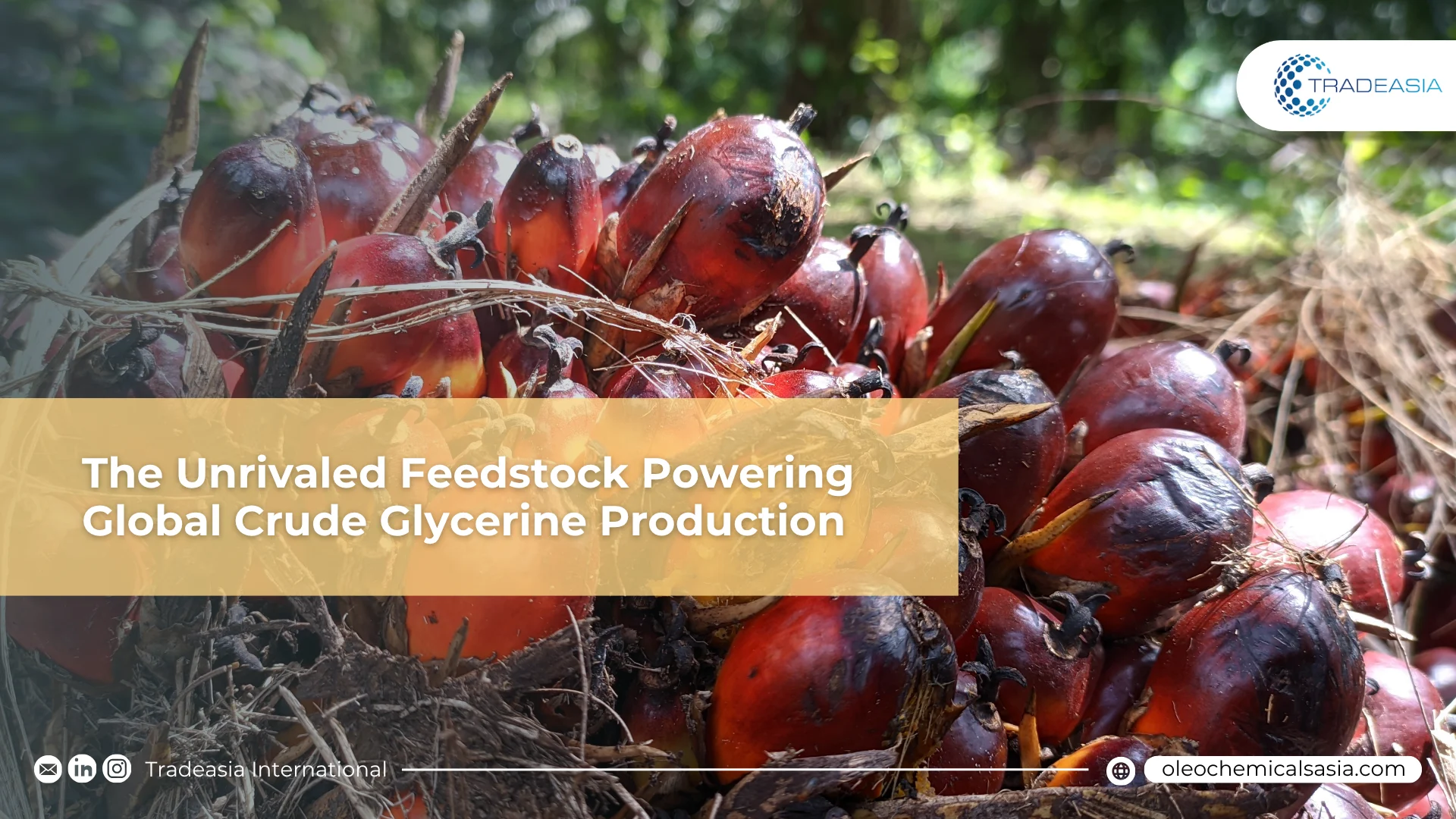
In the vast world of oleochemicals, crude glycerine's production story is overwhelmingly dominated by a single, powerful raw material: palm oil. While other feedstocks play their part, palm oil's sheer scale and unmatched efficiency have cemented its position as the bedrock of the industry, a reality that shapes global trade flows and pricing strategies.
As the world's reliance on this versatile oil grows, securing a consistent and high-quality supply of its derivatives is no longer just a logistical task—it's a strategic imperative. This is where deep expertise in the palm oleochemical supply chain, like that of Tradeasia International, becomes a critical business advantage, bridging the gap between world-class production and global demand.
A Production Story Told in Numbers
The statistics are compelling. Palm oil accounts for over 40% of the world's total vegetable oil production, yet it does so using less than 10% of the land allocated to all oil crops. The epicenter of this production is Southeast Asia, with Indonesia and Malaysia collectively responsible for over 85% of the global supply. This massive output directly translates into glycerine production, where palm serves as the raw material for an estimated 60% of the world's crude glycerine. This market dominance provides a level of supply stability that other feedstocks struggle to match.
Efficiency by the Hectare: The Commercial Advantage
The core reason for palm's dominance lies in its unparalleled land-use efficiency. A single hectare of oil palm can yield approximately 4.0 metric tons of oil annually. In stark contrast, soybean and rapeseed yield only around 0.5 and 0.8 metric tons per hectare, respectively. This significant advantage means a more consistent and cost-effective raw material stream for the entire value chain. As one industry expert noted, “For consistent volume and predictable output in oleochemicals, nothing matches the reliability of the palm supply chain,” underscoring its foundational role in future market growth and the importance of a well-managed sourcing strategy.
Sources:
United States Department of Agriculture (USDA): Oilseeds: World Markets and Trade.
Palm Chemicals: Palm Oil's Role in the Oleochemical Industry.
Council of Palm Oil Producing Countries (CPOPC): Palm Oil Supply & Demand Outlook Report.
We're committed to your privacy. Tradeasia uses the information you provide to us to contact you about our relevant content, products, and services. For more information, check out our privacy policy.


 English
 Indonesian
 简体字
简体字
 العربية
 Español
 Français
 Português
 日本語
日本語
 한국어
한국어
 Tiếng Việt