Explore our network of country and industry based websites to access localized information, product offerings, and business services across our group.
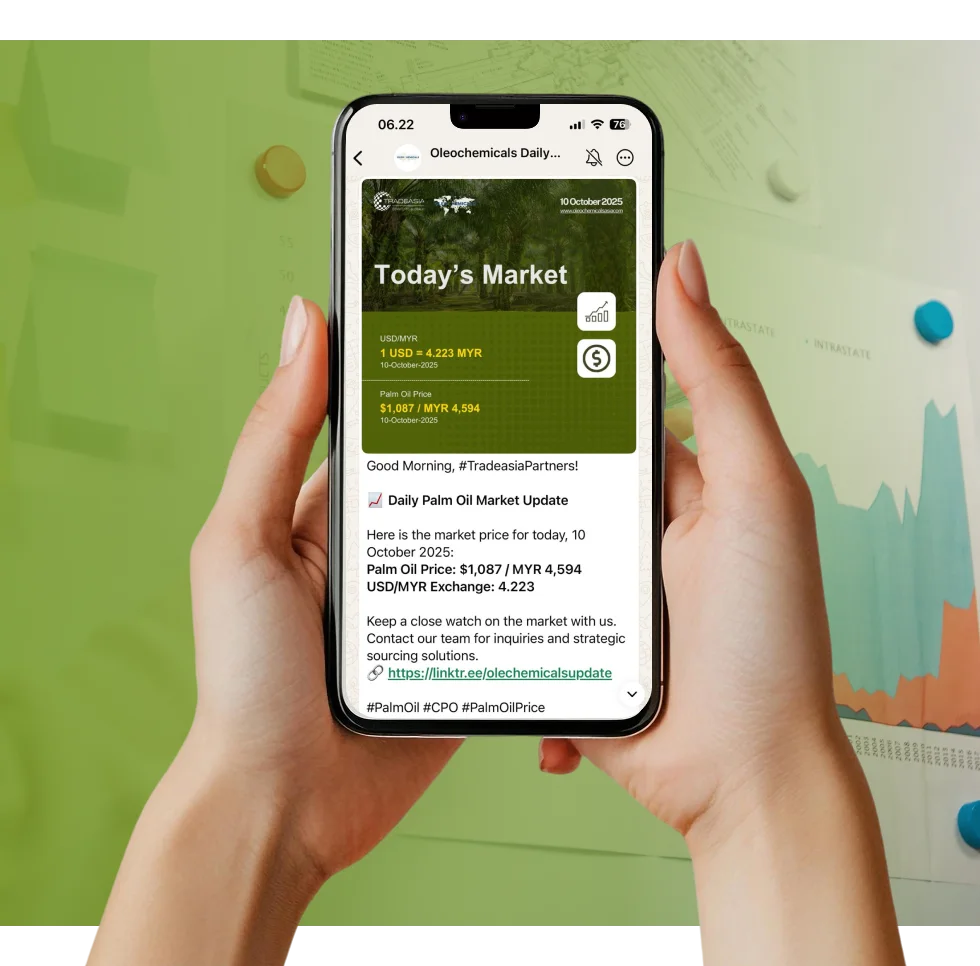
Access reliable chemical market information through our update channels.
Real-time Updates
Daily Updates
Log in to start sending quotation requests for any product.
Don't have an account? Sign Up Here
Home Beyond the Barrel: The 2026 Pivot to Green Chemistry in RBD Palm Oil Procurement
Trade Insights | Supply Chain | 07 March 2026

The global landscape for RBD Palm Oil is no longer dictated solely by food-grade volumes; in 2026, the real needle-mover is the structural shift in how FMCG and pharmaceutical giants handle their "green chemistry" mandates. We are witnessing a fundamental restructuring of procurement departments where technical performance now shares equal weight with carbon-intensity scores. Large-scale buyers are moving away from spot-market reliance, instead seeking multi-year off-take agreements for refined products that serve as the backbone for next-generation bio-surfactants and eco-emollients. This change is driven by a 2026 market reality where "sustainable" is not a premium tier but the baseline for entry into Western markets.
Global demand for bio-surfactants has reached a critical tipping point in 2026, with an estimated market value exceeding 5.8 billion USD. RBD Palm Oil serves as the primary feedstock for these applications, particularly as home care brands phase out petroleum-based linear alkylbenzene sulfonates. Buyers are increasingly specifying C16 and C18 fatty acid profiles within their RBD orders to ensure high-performance foaming and cleaning properties in "sulfate-free" product lines. This transition is pushing refined palm oil volumes into high-value chemical streams that were previously dominated by synthetic alternatives, creating a tighter market for traditional edible applications.
The pharmaceutical and personal care sectors have tightened their specifications for RBD Palm Oil, prioritizing ultra-low impurity profiles to create high-stability eco-emollients. As consumers demand "clean label" cosmetics, manufacturers are utilizing refined palm oil as a carrier and base for complex skincare formulations. In 2026, the volume of RBD Palm Oil diverted to the personal care sector in Southeast Asia is projected to grow by 7.4% year-on-year. Procurement officers are now scrutinizing the refining process itself, favoring suppliers who can provide low-monochloropropanediol (GE/3-MCPD) grades that meet stringent new safety standards in both the EU and North America.
Procurement strategies have evolved from simple cost-minimization to complex risk-mitigation frameworks. In 2026, the average B2B buyer for a Fortune 500 FMCG company is looking for "embedded sustainability" where the geolocation data of the RBD Palm Oil is integrated directly into the digital invoice. We are seeing a move toward "Identity Preserved" (IP) supply chains, where the refined oil can be traced back to a specific cluster of mills. This level of transparency is allowing buyers to claim "deforestation-free" status with high confidence, effectively insulating their brands from the reputational risks that plagued the industry in previous decades.
The total global market for palm oil is projected to hit 85.91 billion USD in 2026, with the RBD segment maintaining a dominant share due to its versatility. While traditional food service demand remains a massive anchor, the industrial and chemical sectors are the primary engines of growth, expanding at a CAGR of nearly 6%. In terms of volume, the shift toward bio-based materials in the chemical industry is expected to absorb an additional 2.5 million metric tons of palm derivatives globally by the end of the 2026 fiscal year. This robust demand from "green" sectors is providing a strong support level for prices, even during periods of seasonal supply peaks.
Successful suppliers in 2026 are those who act as technical partners rather than mere commodity traders. By offering RBD Palm Oil with customized fatty acid distributions or specialized refining treatments, exporters in Indonesia and Malaysia are capturing higher margins. The integration of "circularity" into the procurement conversation—where even the by-products of refining are repurposed for energy or animal feed—is becoming a standard expectation. As we look toward 2027, the relationship between the refiner and the B2B buyer will likely become even more symbiotic, focused on long-term carbon reduction targets and joint innovation in renewable chemistry.
Sources:
We're committed to your privacy. Tradeasia uses the information you provide to us to contact you about our relevant content, products, and services. For more information, check out our privacy policy.


 English
 Indonesian
 简体字
简体字
 العربية
 Español
 Français
 Português
 日本語
日本語
 한국어
한국어
 Tiếng Việt




















