Explore our network of country and industry based websites to access localized information, product offerings, and business services across our group.
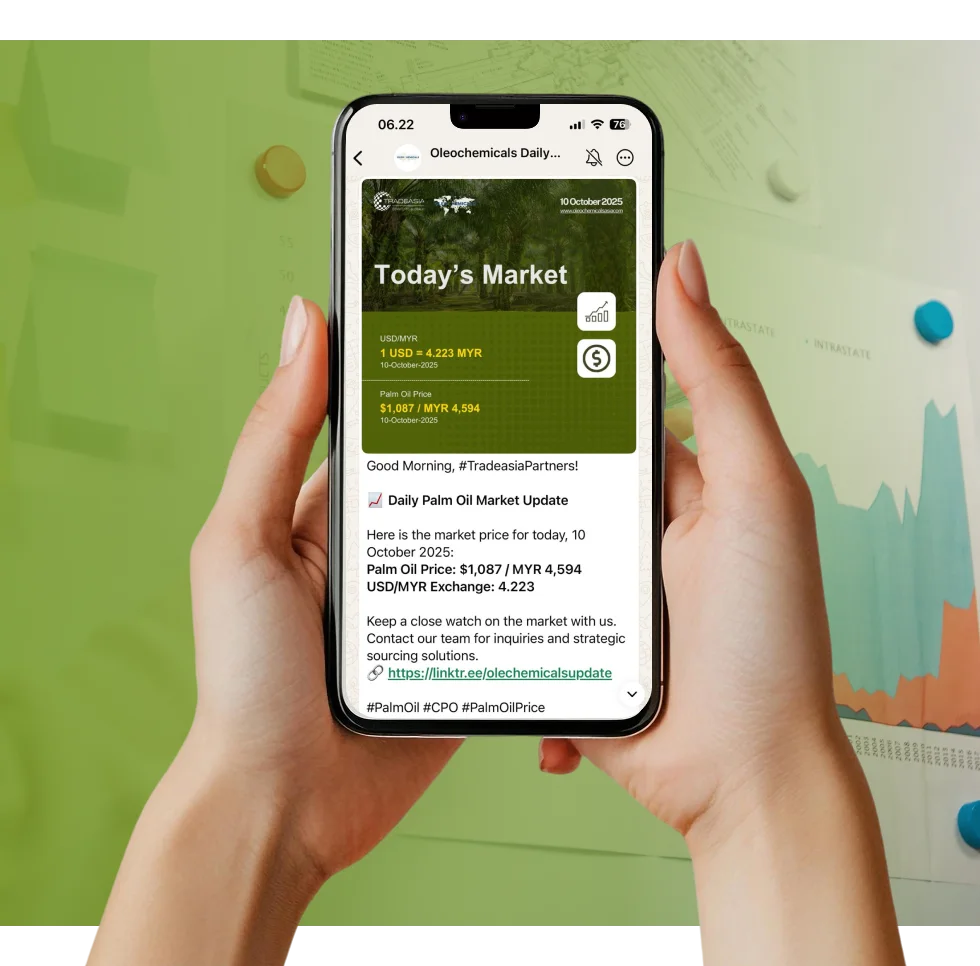
Access reliable chemical market information through our update channels.
Real-time Updates
Daily Updates
Log in to start sending quotation requests for any product.
Don't have an account? Sign Up Here
Home Value Chain Realignment: Southeast Asia’s Myristyl Alcohol Squeeze in 2026
Trade Insights | Supply Chain | 02 March 2026

The Southeast Asian oleochemical landscape is undergoing its most radical structural transformation in a generation. At the heart of this shift is Indonesia’s aggressive pursuit of energy self-sufficiency, specifically the move toward a B50/B60 biodiesel mandate in early 2026. This policy has fundamentally altered the feedstock economics for downstream derivatives like Myristyl Alcohol. By absorbing nearly 20 million kiloliters of palm-based oils into the domestic fuel pool, the Indonesian government has created a "feedstock squeeze" that is pushing refineries to prioritize higher-margin specialty cuts over bulk commodities. For global exporters of C14 alcohol, this means the era of abundant, low-cost palm-derived feedstocks is effectively over, replaced by a highly competitive environment where chemical manufacturing must outbid the energy sector for every ton of Crude Palm Oil (CPO).
The implementation of the B50 mandate has led to a projected 11.5% decline in the exportable surplus of palm-based fatty alcohols from Indonesia in 2026. This domestic absorption is not just a volume issue; it is a pricing floor. As the Indonesian Palm Oil Plantation Fund (BPDPKS) adjusts export levies to subsidize the biodiesel program, the "net-back" price for Myristyl Alcohol has risen significantly. Refiners in the region are now engaging in more sophisticated fractionation to extract maximum value from a smaller pool of available material. This has led to a tightening of the Myristyl Alcohol (C14) market specifically, as it is often co-produced with Lauryl Alcohol (C12), and any reduction in total throughput impacts the availability of both fractions in the global merchant market.
While the physical supply of Myristyl Alcohol is tightening, the "ticket to play" in the 2026 global market has become digital. The European Union Deforestation Regulation (EUDR) has entered a critical enforcement phase, making real-time, immutable traceability a non-negotiable requirement for any Southeast Asian exporter targeting Western markets. Leading producers in Indonesia and Malaysia have fully integrated blockchain-backed verification systems into their logistics. These platforms provide a digital breadcrumb trail from the specific plantation coordinates to the final ISO tank of Myristyl Alcohol. This level of transparency is no longer optional; it is a prerequisite for customs clearance in major ports like Rotterdam and Hamburg, effectively creating a bifurcated market where "digitally enabled" tons command a significant premium over standard grades.
The physical movement of Myristyl Alcohol is also facing new hurdles in 2026. Major transshipment hubs like Jakarta’s Tanjung Priok and Malaysia’s Port Klang are grappling with increased congestion as domestic biofuel shipments compete for berthing space with export vessels. This logistical friction is compounding the supply tightness, with average lead times for C14 shipments increasing by 15% compared to 2024 levels. In response, the "just-in-time" delivery model has been abandoned by most major B2B buyers. The "safety stock" strategy has returned as the dominant procurement philosophy, with manufacturers now holding 45 to 60 days of inventory on-site to insulate themselves from the unpredictability of Indonesian export permits and domestic allocation priorities.
We are currently witnessing a clear split in the Myristyl Alcohol market. On one side are the EU-compliant, blockchain-verified grades that meet all sustainability and traceability mandates. On the other are standard grades destined for regions with less stringent environmental hurdles, such as parts of Africa and the Middle East. This bifurcation is reflected in the pricing, with compliant Myristyl Alcohol trading at a significant spread. For Southeast Asian refineries, the strategic choice is clear: invest in the digital and sustainable infrastructure required for Western markets or face the lower-margin reality of the less-regulated global south. Most Tier-1 producers in the region have already made this pivot, further reducing the availability of non-certified material.
The realignment of the 2026 supply chain is not a temporary disruption but a permanent shift in how oleochemicals are traded. The integration of energy policy (B50) and environmental regulation (EUDR) has created a complex web that requires sophisticated management. Suppliers who can offer both physical volume security and digital compliance are becoming the preferred partners for global FMCG giants. As we move into the latter half of 2026, the focus will likely shift toward optimizing the "digital twin" of the supply chain—using AI and real-time data to predict logistical bottlenecks before they occur. In this new reality, the ability to manage data is becoming just as important as the ability to manage chemical reactions.
We're committed to your privacy. Tradeasia uses the information you provide to us to contact you about our relevant content, products, and services. For more information, check out our privacy policy.


 English
 Indonesian
 简体字
简体字
 العربية
 Español
 Français
 Português
 日本語
日本語
 한국어
한국어
 Tiếng Việt



















