Explore our network of country and industry based websites to access localized information, product offerings, and business services across our group.

Access reliable chemical market information through our update channels.
Real-time Updates
Daily Updates
Log in to start sending quotation requests for any product.
Don't have an account? Sign Up Here
Home C8 Compliance and Sustainability Reshaping Global Palm Derivatives Market
Trade Insights | Supply Chain | 05 November 2025
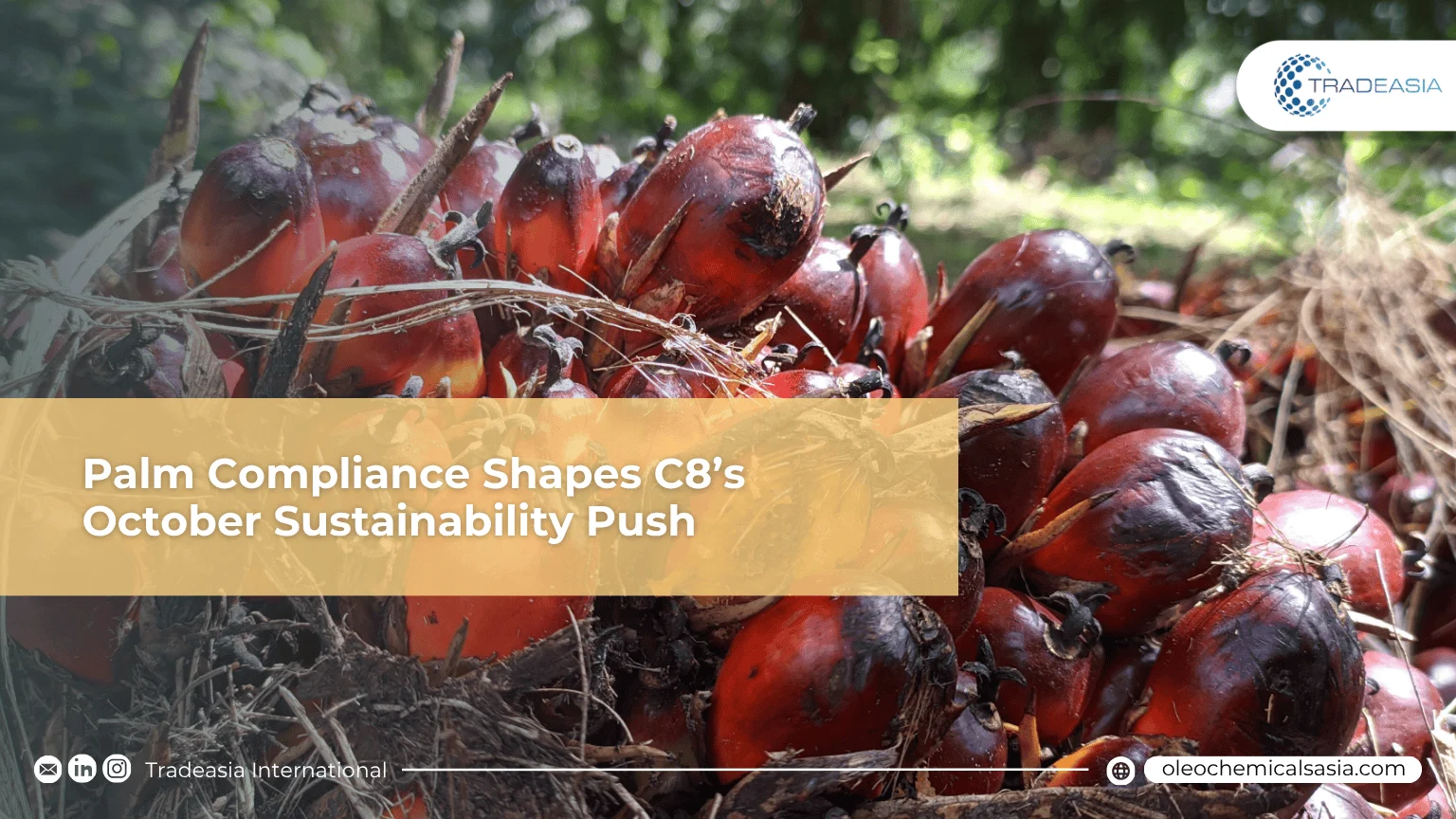
For the palm and oleochemical industry, October marked a period of intensive operational review driven by tightening global sustainability mandates and increasing competition for premium feedstock. Methyl Caprylate (C8), which relies on high-quality palm kernel and coconut-based inputs, sits directly at the intersection of these pressures. As regulatory scrutiny intensifies, transparency and verifiable sourcing are no longer optional—they are strategic imperatives.
In this environment, the value of a palm ester derivative is increasingly tied to the integrity of its origin. Tradeasia International navigates these evolving compliance landscapes by combining traceable sourcing systems with strong regional supplier networks. Being a reliable supplier today means guaranteeing both volume consistency and sustainability verification, ensuring product quality is fully aligned with global environmental standards.
October discussions across the industry emphasized the urgency surrounding the European Union Deforestation Regulation (EUDR). The regulation requires robust due diligence systems capable of demonstrating deforestation-free sourcing in real time. For C8 suppliers operating within Asia Pacific—which accounts for nearly half of global oleochemical production—this represents a significant compliance undertaking.
At the same time, policy developments such as increases in Coco-Methyl Ester (CME) biodiesel blending mandates created additional feedstock tension. By diverting C8-rich raw materials like coconut and palm kernel oil toward energy applications, biodiesel programs may contribute to tighter supply availability and upward pricing pressure within the specialty oleochemical segment.
The response from leading industry players has focused on operational innovation and decarbonization. A notable example gaining industry attention is the shift toward biomethane generated from palm oil effluent to power production facilities. Such initiatives directly reduce Scope 1 and Scope 2 emissions, strengthening the environmental profile of downstream derivatives such as Methyl Caprylate.
These structural changes illustrate a broader transformation within the palm derivatives market: sustainability is no longer a marketing narrative but a measurable performance benchmark. Companies investing in certified feedstock sourcing, transparent traceability systems, and low-carbon production technologies are positioning themselves for long-term competitiveness in regulated global markets.
October’s market dynamics confirmed that compliance, feedstock allocation, and operational sustainability now define strategic advantage in the C8 and broader palm ester trade. As regulatory frameworks tighten and buyers demand verifiable ESG alignment, the palm derivatives industry continues its transition toward a more transparent, accountable, and resilient global supply chain.
Sources:
We're committed to your privacy. Tradeasia uses the information you provide to us to contact you about our relevant content, products, and services. For more information, check out our privacy policy.


 English
 Indonesian
 简体字
简体字
 العربية
 Español
 Français
 Português
 日本語
日本語
 한국어
한국어
 Tiếng Việt



















