Explore our network of country and industry based websites to access localized information, product offerings, and business services across our group.

Access reliable chemical market information through our update channels.
Real-time Updates
Daily Updates
Log in to start sending quotation requests for any product.
Don't have an account? Sign Up Here
Home Green R&D in December: Decarbonizing Lauric Acid Production
Trade Insights | Regulatory and Compliance | 03 December 2025
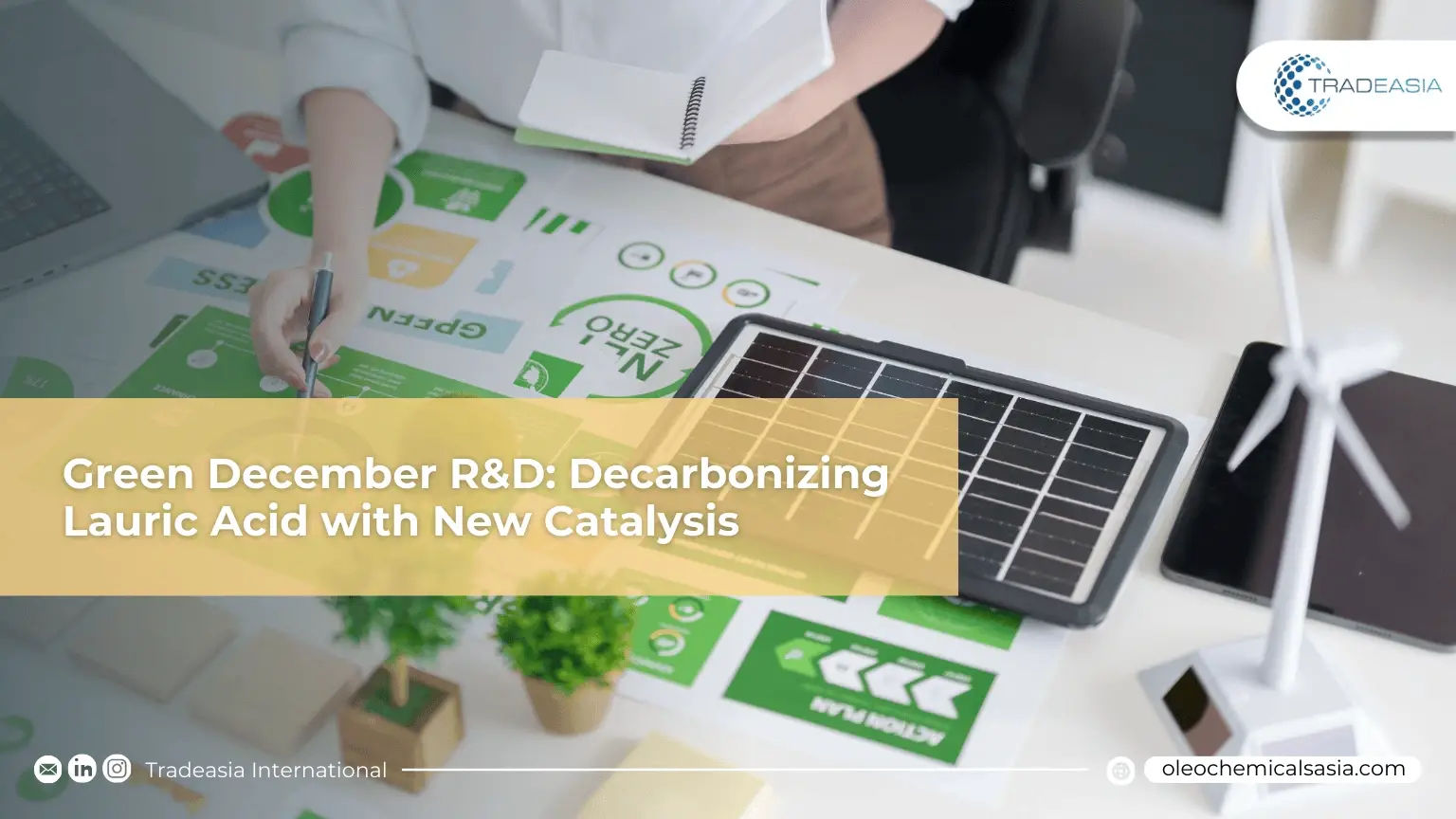
Achieving Sustainability Benchmarks Through Catalyst Innovation
The Long-Term Value of Lowering the Carbon Footprint
As the year closes, the spotlight is firmly fixed on corporate ESG reporting, making December a crucial deadline for validating sustainability targets. For the lauric acid sector, this translates into intense R&D efforts dedicated to process intensification under the banner of Green Chemistry. The goal is clear: to maintain high-volume output while achieving measurable reductions in energy consumption and carbon footprint, particularly in the production of high-volume Lauric Methyl Ester (LME).
Navigating the complexities of global sustainability standards requires a partner who embodies responsible sourcing and ethical trade practices. Tradeasia International takes pride in its transparent operations across the palm supply chain, ensuring that every shipment meets stringent environmental and social benchmarks. In a world demanding cleaner ingredients, R&D focused on efficiency is a core business necessity.
The global lauric acid market, valued at approximately $625 million in 2025, is seeing its growth trajectory, a projected CAGR of 2.6% to 2032, increasingly tied to sustainability credentials. Our R&D teams have successfully utilized a novel, heterogeneous zinc-based catalyst in the transesterification process of PKO to LME, yielding significant efficiency gains that will anchor our Q1 2026 reports. The data speaks for itself: the new process now requires an average of 185 kWh/ton of LME produced, marking a substantial 15% reduction from the previous standard of 218 kWh/ton. Furthermore, this solid, recoverable catalyst boasts a remarkable 99.5% separation efficiency, dramatically curtailing downstream waste streams associated with older homogeneous methods.
These December R&D successes provide a critical advantage in meeting demanding EU and US market specifications. Initial Life Cycle Assessments (LCA) demonstrate an overall 7.4% reduction in the Global Warming Potential (GWP) per kilogram of LME, making the final product highly attractive for applications in bio-lubricants and high-performance surfactants. This is not just environmental goodwill; it is sound business strategy. Oleochemicals Asia confirms that industry investment in sustainable oleochemical technology grew by 18% in the past year, confirming that companies are willing to pay a 5–10% price premium for ingredients with verifiable green credentials. Our December push on Green R&D is a necessary investment to capture this high-margin future.
We're committed to your privacy. Tradeasia uses the information you provide to us to contact you about our relevant content, products, and services. For more information, check out our privacy policy.


 English
 Indonesian
 简体字
简体字
 العربية
 Español
 Français
 Português
 日本語
日本語
 한국어
한국어
 Tiếng Việt