Explore our network of country and industry based websites to access localized information, product offerings, and business services across our group.

Access reliable chemical market information through our update channels.
Real-time Updates
Daily Updates
Log in to start sending quotation requests for any product.
Don't have an account? Sign Up Here
Home Methyl Caproate Feedstock: Why the PKO vs. CNO Battle is Already Won
Trade Insights | Supply Chain | 13 November 2025
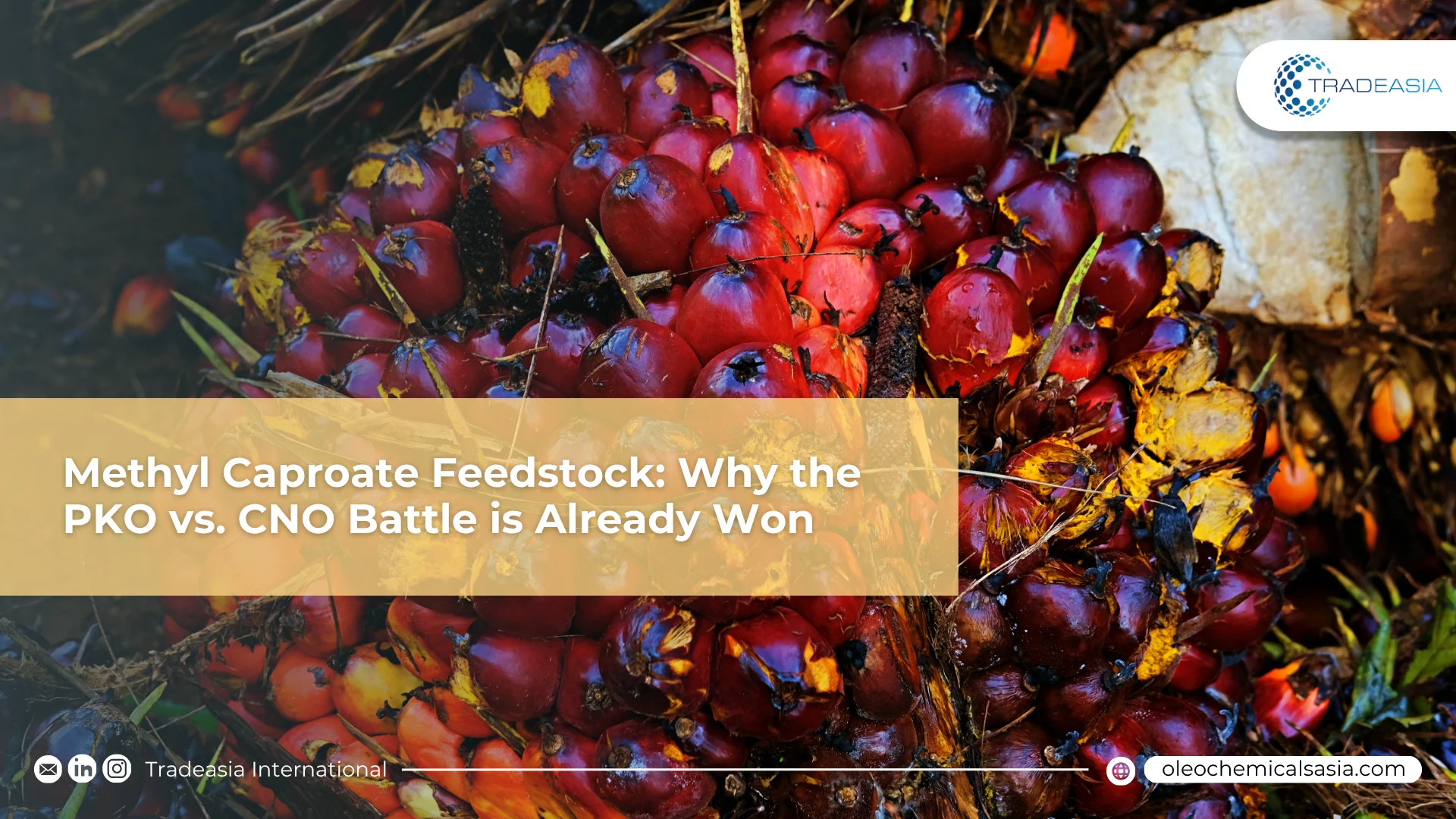
In the world of Methyl Caproate oleochemicals, the production of Methyl Caproate begins long before the esterification plant. It starts with a strategic choice of feedstock. The precursor, Caproic Acid, is fractionated from two primary lauric oils: Palm Kernel Oil (PKO) or Coconut Oil (CNO). This single decision dictates price, volume, and supply chain security for the final product. This complexity is precisely where procurement strategies succeed or fail. For global suppliers in the palm and oleochemical sector, like Tradeasia International, securing a stable, competitive supply isn’t just about trading—it’s about mastering the intricacies of this very feedstock comparison to deliver consistent value to end-users.
On paper, Coconut Oil (CNO) looks appealing. It offers a slightly higher average yield of Caproic Acid, typically ranging from 0.4% to 1.2% of its fatty acid profile, compared to PKO’s 0.2% to 0.8%. But in an industrial-scale market, volume, not just yield, is king. Global PKO production, at approximately 8.2 million metric tons in 2023, absolutely dwarfs the 3.4 million metric tons of CNO. With a supply base more than 2.4 times larger, PKO is the non-negotiable, reliable workhorse for large-scale Methyl Caproate fractionation. This is where the palm value chain demonstrates its true power, offering a level of scale and supply security that other lauric oils simply cannot match.
Ultimately, the choice is economic. The "PKO-CNO price spread" is the key metric traders watch. In Q4 2023, when this spread widened to over $120/ton, CNO became economically unviable for Methyl Caproate production, regardless of its yield advantage. This is compounded by geography. Data highlights, over 85% of the global PKO supply is concentrated in Indonesia and Malaysia, creating a highly efficient, centralized supply hub. For any serious buyer, PKO isn’t just an option; it’s the only strategic option for reliable, large-scale Methyl Caproate production.
Sources:
PKO and CNO Production & Trade Statistics 2023 (OleochemicalsAsia.com) http://oleochemicalsasia.com
Global Oilseeds Market Report: Lauric Oils (LMC International, 2024) https://www.lmc.co.uk/
Fatty Acid Compositions of Tropical Oils (Journal of the American Oil Chemists' Society, 2023) https://aocs.onlinelibrary.wiley.com/journal/15589331
We're committed to your privacy. Tradeasia uses the information you provide to us to contact you about our relevant content, products, and services. For more information, check out our privacy policy.


 English
 Indonesian
 简体字
简体字
 العربية
 Español
 Français
 Português
 日本語
日本語
 한국어
한국어
 Tiếng Việt



















