Explore our network of country and industry based websites to access localized information, product offerings, and business services across our group.

Access reliable chemical market information through our update channels.
Real-time Updates
Daily Updates
Log in to start sending quotation requests for any product.
Don't have an account? Sign Up Here
Home Indonesia’s B50 Impact on Methyl Caproate Feedstock Supply
Trade Insights | Regulatory and Compliance | 27 January 2026
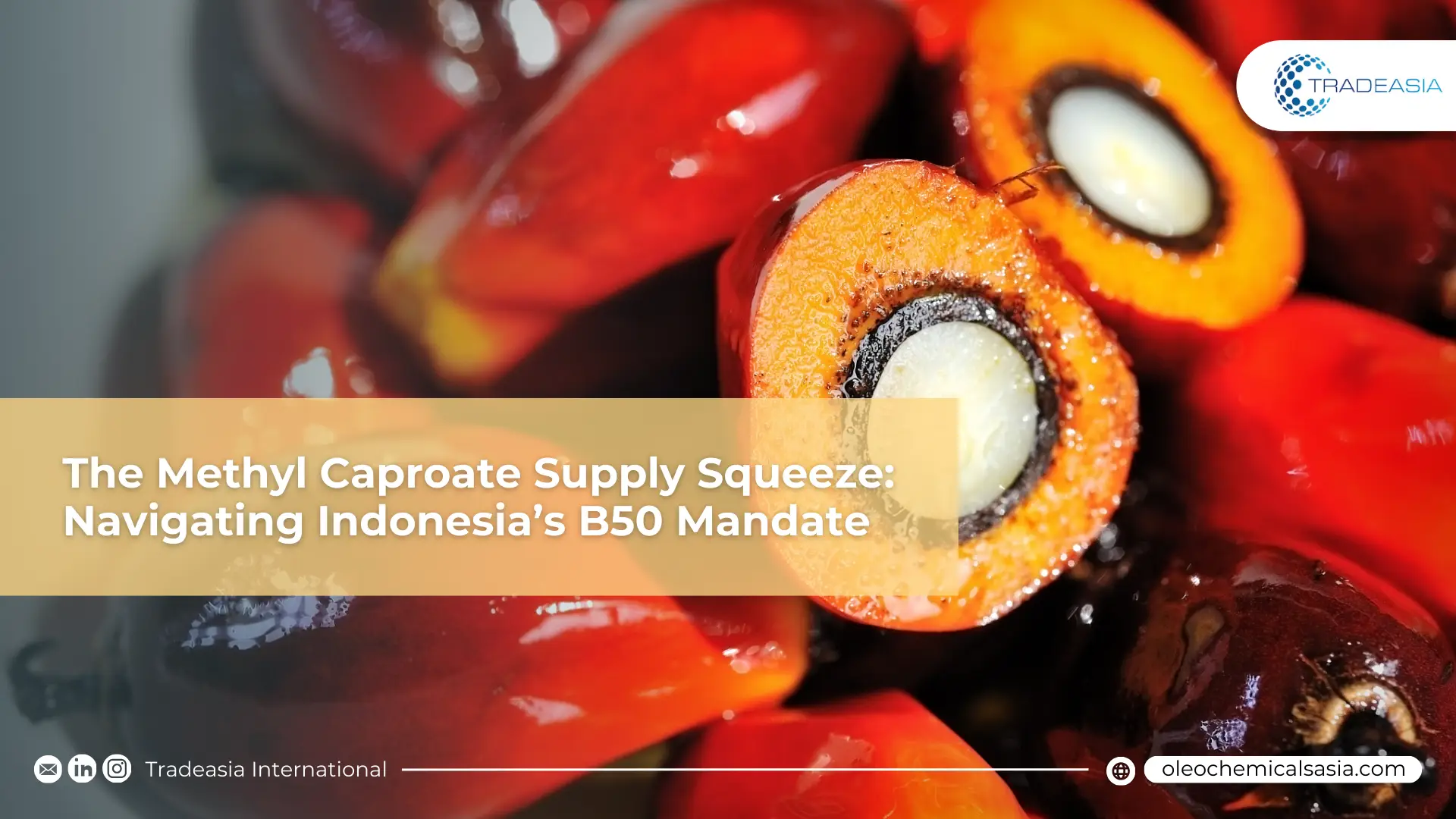
The global market for Methyl Caproate (Methyl Hexanoate) is currently navigating a period of significant supply-side pressure as of January 27, 2026. This pressure is primarily attributed to the tightening availability of short-chain fatty acid precursors derived from Palm Kernel Oil (PKO) and Coconut Oil (CNO). As the world’s largest producer, Indonesia, implements its B45 biodiesel mandate and prepares for the B50 transition in late 2026, the diversion of crude oils toward energy production has created a severe bottleneck for the oleochemical sector. Current market assessments indicate that industrial-grade Methyl Caproate is trading at approximately USD 2,480/MT, reflecting a steady climb from 2025 levels. Meanwhile, high-purity food-grade variants, essential for the flavor and fragrance industries, have reached price points as high as USD 2,950/MT due to the intensive distillation required to isolate the C-6 fraction from competing C-8 and C-10 esters.
Amidst these fluctuating supply dynamics, Tradeasia International continues to solidify its reputation as a global solution provider for palm and oleochemicals. By leveraging a robust, diversified supply chain that spans across Southeast Asia, Tradeasia ensures that manufacturers have uninterrupted access to critical esters like Methyl Caproate, effectively shielding their production schedules from regional feedstock shocks and logistical bottlenecks.
The logistics of Methyl Caproate distribution are increasingly complicated by land-tenure audits in Indonesia, which analysts estimate could put between 2 and 5 million metric tonnes of crude palm oil production at risk over the next 24 months. Furthermore, the global production volume for specialized methyl esters has seen a constrained expansion, hovering around 1.25 million metric tonnes annually. Manufacturers are also contending with the rising cost of secondary feedstocks; for instance, methanol—a vital component in the esterification process—is currently priced at approximately USD 318/MT on a CFR basis. This "double-squeeze" on both the fatty acid and alcohol fronts has forced many regional producers to operate at reduced capacity, further thinning the spot market availability for prompt delivery.
Projecting forward to the 2046 horizon, the viability of Methyl Caproate as a platform chemical remains exceptionally strong, driven by the global transition toward oxygenated, bio-based solvents. While the current market is growing at a 5.8% CAGR, we anticipate a secondary growth surge in the 2030s as petrochemical-derived solvents face increasing regulatory obsolescence. By 2046, Methyl Caproate is expected to be a staple in the production of bio-attributed plastics and advanced phase-change materials (PCMs) used in sustainable building insulation. Its high solvency power and low toxicity profile position it as a permanent fixture in the green chemistry revolution, ensuring a diverse demand profile that will sustain its market relevance for the next two decades.
Sources:
We're committed to your privacy. Tradeasia uses the information you provide to us to contact you about our relevant content, products, and services. For more information, check out our privacy policy.


 English
 Indonesian
 简体字
简体字
 العربية
 Español
 Français
 Português
 日本語
日本語
 한국어
한국어
 Tiếng Việt



















