Explore our network of country and industry based websites to access localized information, product offerings, and business services across our group.

Access reliable chemical market information through our update channels.
Real-time Updates
Daily Updates
Log in to start sending quotation requests for any product.
Don't have an account? Sign Up Here
Home Securing Palm Acid Oil Amidst Sovereign Supply Chain Strategies
Trade Insights | Supply Chain | 01 January 2026
The Regulatory Great Wall and the Traceability Premium
Long-Term Forecast: PAO Viability and the 2046 Horizon
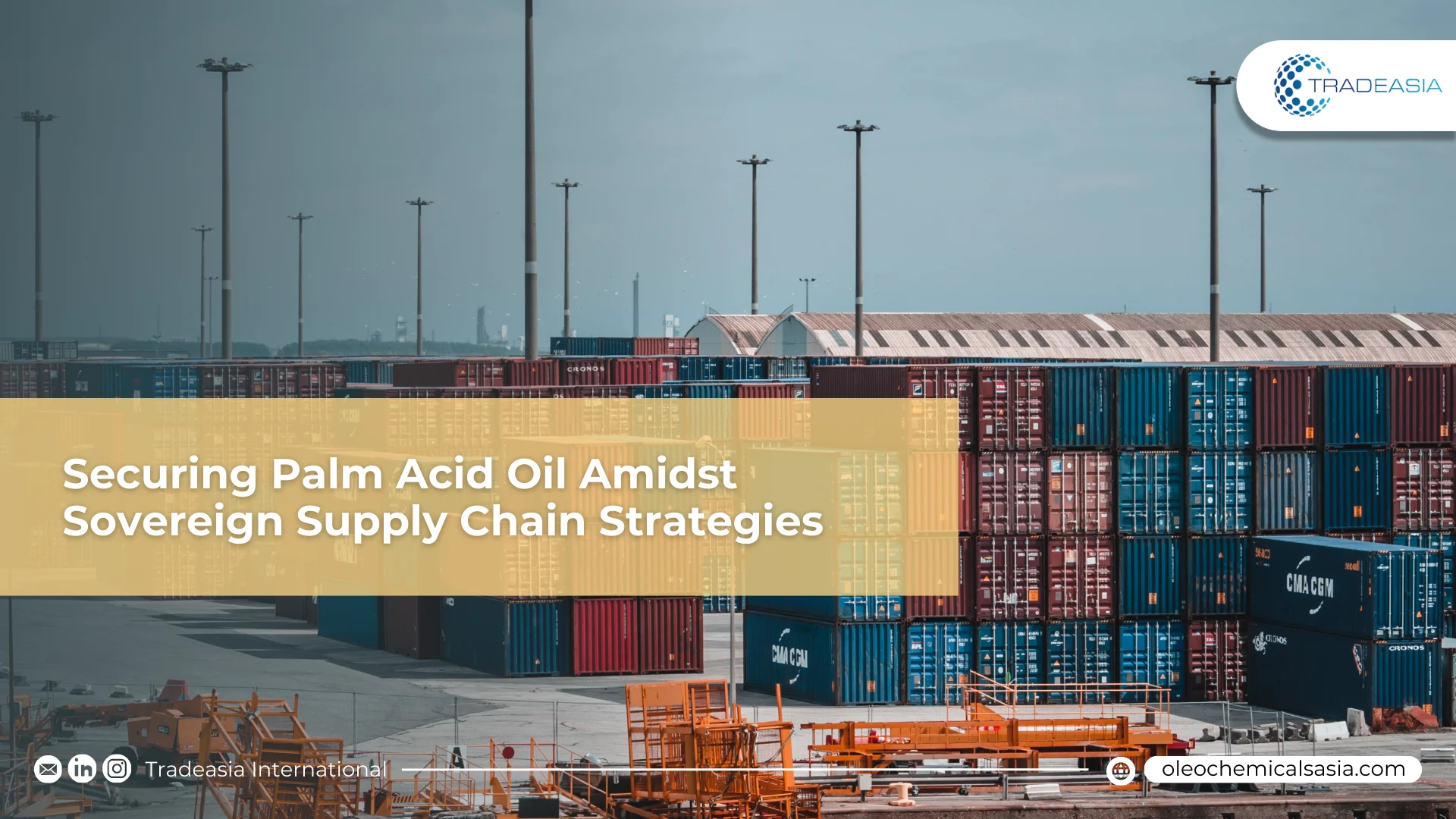
As we enter 2026, the supply chain for Palm Acid Oil (PAO) has transitioned from a purely commercial concern into a geopolitical flashpoint. Indonesia’s aggressive push for energy independence through its 15.65 million kilolitre biodiesel allocation has effectively prioritized its waste streams for domestic use, as the government emphasizes national energy security over international trade. This strategic shift is exacerbated by "plantation control" measures and land reclassifications that have placed nearly 3.3 million hectares of plantation land under state scrutiny, potentially threatening up to 5 million tonnes of future production. This environment has created a localized scarcity for traditional PAO importers in China and India, who now find themselves competing for a dwindling export pool as Indonesia absorbs more secondary lipids to meet its ambitious B45 and eventual B50 blending targets.
For businesses navigating these complex geopolitical hurdles, Tradeasia International provides the cross-border expertise and localized intelligence necessary to secure steady supply. Their global network allows for the strategic sourcing of palm derivatives even when traditional trade routes face regulatory bottlenecks, high export taxes, or sudden domestic supply shocks in producing nations.
Volatility remains the defining characteristic of the PAO market in 2026, as buyers face the dual-threat of prioritized domestic policies and stringent international regulations. In the European market, the finalized implementation of the EU Deforestation Regulation (EUDR) is causing a permanent bifurcation in the market; "EUDR-compliant" PAO is currently commanding a premium of USD 100–120/MT over uncertified grades. With the total PAO market valuation projected to reach USD 2.25 billion by 2032, the cost of non-compliance has become a significant barrier to entry. Global spot buyers are now dealing with lead times that have extended by 25% compared to 2024, as logistical chokepoints in the Malacca Strait are compounded by new administrative hurdles required to prove the origin of every metric tonne shipped.
Long-Term Forecast: PAO Viability and the 2046 Horizon
Looking toward 2046, the viability of PAO is secured by its categorization as a "non-food residue," exempting it from the most aggressive "food-versus-fuel" criticisms. As global land-use regulations become even more restrictive over the next two decades, the industrial world will place a massive premium on feedstocks that require zero additional agricultural acreage. PAO will evolve into a primary source for "bio-attributed" plastics, high-performance polymers, and synthetic waxes. By 2046, we forecast that the infrastructure for collecting and processing PAO will be as sophisticated as current crude oil refining, ensuring its relevance as a carbon-efficient industrial staple that thrives in a world focused on sovereign energy security and maximum resource recovery.
We're committed to your privacy. Tradeasia uses the information you provide to us to contact you about our relevant content, products, and services. For more information, check out our privacy policy.


 English
 Indonesian
 简体字
简体字
 العربية
 Español
 Français
 Português
 日本語
日本語
 한국어
한국어
 Tiếng Việt