How can we assist you?

Explore our network of country and industry based websites to access localized information, product offerings, and business services across our group.

Access reliable chemical market information through our update channels.
Real-time Updates
Daily Updates
Log in to start sending quotation requests for any product.
Don't have an account? Sign Up Here
Home How Palm-Based Stearyl Alcohol Cuts Carbon Footprint by 60%
Trade Insights | Regulatory and Compliance | 21 October 2025
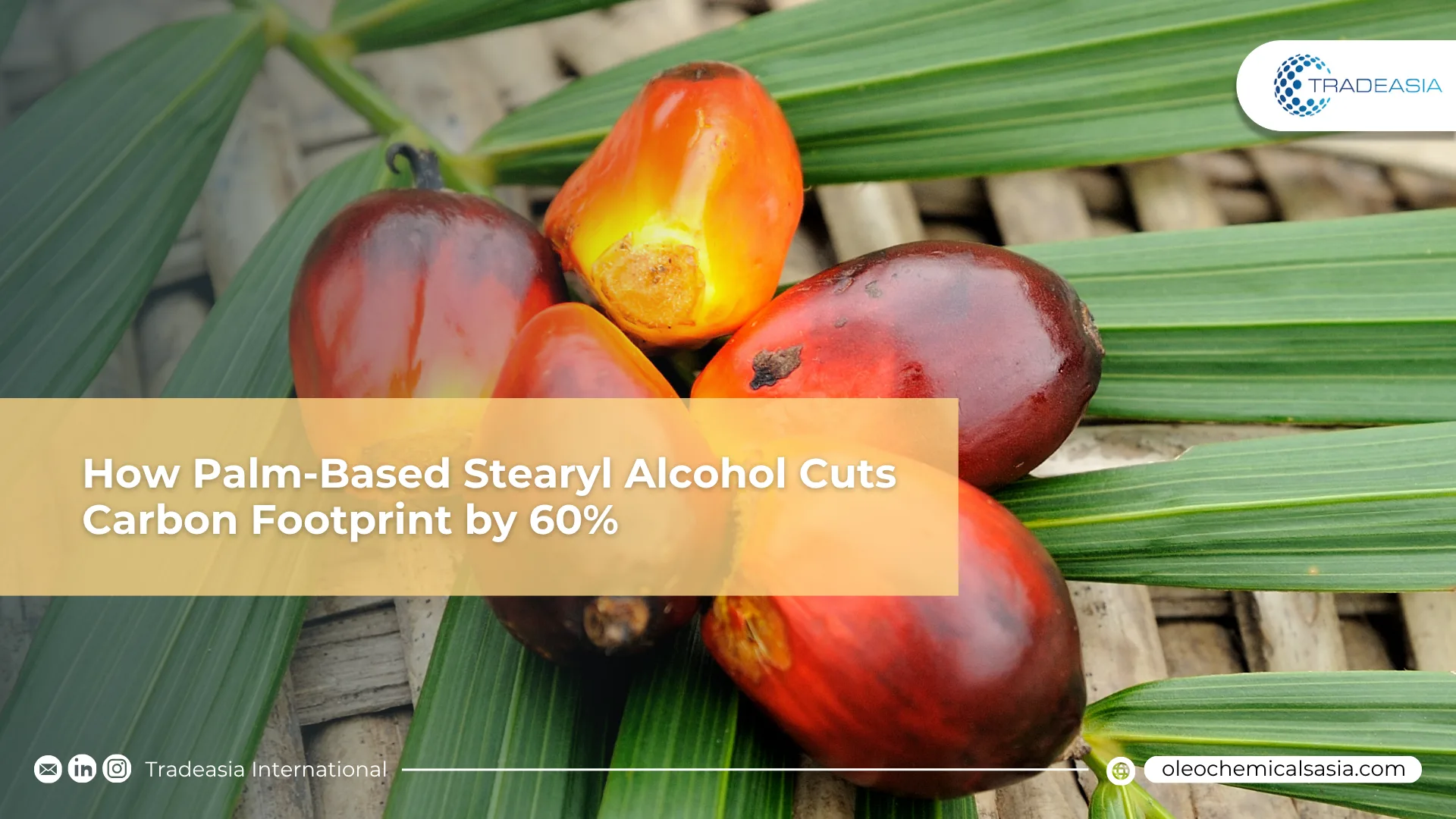
The Carbon Math: A 60% Emissions Advantage
Solving the Land-Use Equation with Unmatched Efficiency
For procurement managers focused on hitting corporate Net-Zero targets, the feedstock choice for C18 alcohol is one of the most impactful decisions they can make. A Life Cycle Analysis (LCA) reveals a stark difference: the petrochemical route (from ethylene) is a high-carbon liability, while the palm-based route is a quantifiable ESG asset.
This "Green vs. Black" carbon debate is central to modern chemical sourcing. As a committed partner in the green chemical supply chain, Tradeasia International has prioritized palm-based oleochemicals. We champion them not just for their functionality, but for their superior environmental mathematics. We believe the future is plant-based, and palm is simply the most efficient plant to deliver it.
The numbers are clear. Manufacturing petrochemical-based fatty alcohol is an energy-intensive process that emits 2.5 to 3.5 kg of CO2e per kg of product. In stark contrast, RSPO-certified palm-based Stearyl Alcohol can achieve a carbon footprint of less than 1.0 kg of CO2e per kg. This represents a massive 60% reduction in emissions, a critical win for any company reporting on Scope 3 emissions. This advantage is amplified by innovation, as over 40% of RSPO mills now operate methane capture facilities, turning biogas waste into clean energy and further slashing their carbon footprint.
But what about land use? The data proves palm oil is the world's most land-efficient oilseed, by far. Palm produces ~3.3 tons of oil per hectare. This is 5 times more efficient than rapeseed (0.7 tons/ha) and 8 times more efficient than soy (0.4 tons/ha). To produce the same volume of Stearyl Alcohol, switching to an alternative plant-based oil would require 5 to 8 times more land, creating a far greater environmental strain. For companies serious about both decarbonization and land preservation, certified sustainable palm is the only logical choice.
We're committed to your privacy. Tradeasia uses the information you provide to us to contact you about our relevant content, products, and services. For more information, check out our privacy policy.
How can we assist you?

 English
 Indonesian
 简体字
简体字
 العربية
 Español
 Français
 Português
 日本語
日本語
 한국어
한국어
 Tiếng Việt




















