Explore our network of country and industry based websites to access localized information, product offerings, and business services across our group.

Access reliable chemical market information through our update channels.
Real-time Updates
Daily Updates
Log in to start sending quotation requests for any product.
Don't have an account? Sign Up Here
Home What Should Buyers Know About Lauric Acid Sourcing and Trends Toward 2026?
Trade Insights | Applications and Buyers | 27 April 2026
Introduction Lauric Acid
Global Overview of Lauric Acid and Oleochemicals
Key Industrial Applications of Lauric Acid
Specifications, Grades, and Sourcing with chemtradeasia
Market Outlook and Buyer Strategies Toward 2026
Conclusion
The global oleochemical industry is undergoing a structural shift toward bio-based, renewable raw materials, and lauric acid sits at the center of this transformation. Derived primarily from coconut oil and palm kernel oil, lauric acid is a key saturated fatty acid used in surfactants, personal care, food, plastics, and industrial formulations. As manufacturers and brand owners commit to decarbonization and sustainable sourcing, demand for lauric-based intermediates is projected to grow steadily through 2026.
For procurement teams, formulators, and strategic planners, understanding the evolving landscape of lauric acid buyers, applications, and supply dynamics is essential. Price volatility in tropical oils, regulatory shifts on deforestation-free supply chains, and changing consumer preferences for “natural” ingredients are reshaping how companies approach lauric acid sourcing and usage. In this environment, reliable partners such as chemtradeasia help bridge the gap between producers and industrial users across multiple regions.
This article provides a detailed, data-informed overview of lauric acid within the global oleochemical value chain toward 2026. It examines key applications, product specifications, buyer profiles, and market trends, while highlighting how integrated supply solutions can support both cost competitiveness and sustainability objectives in a rapidly evolving market.
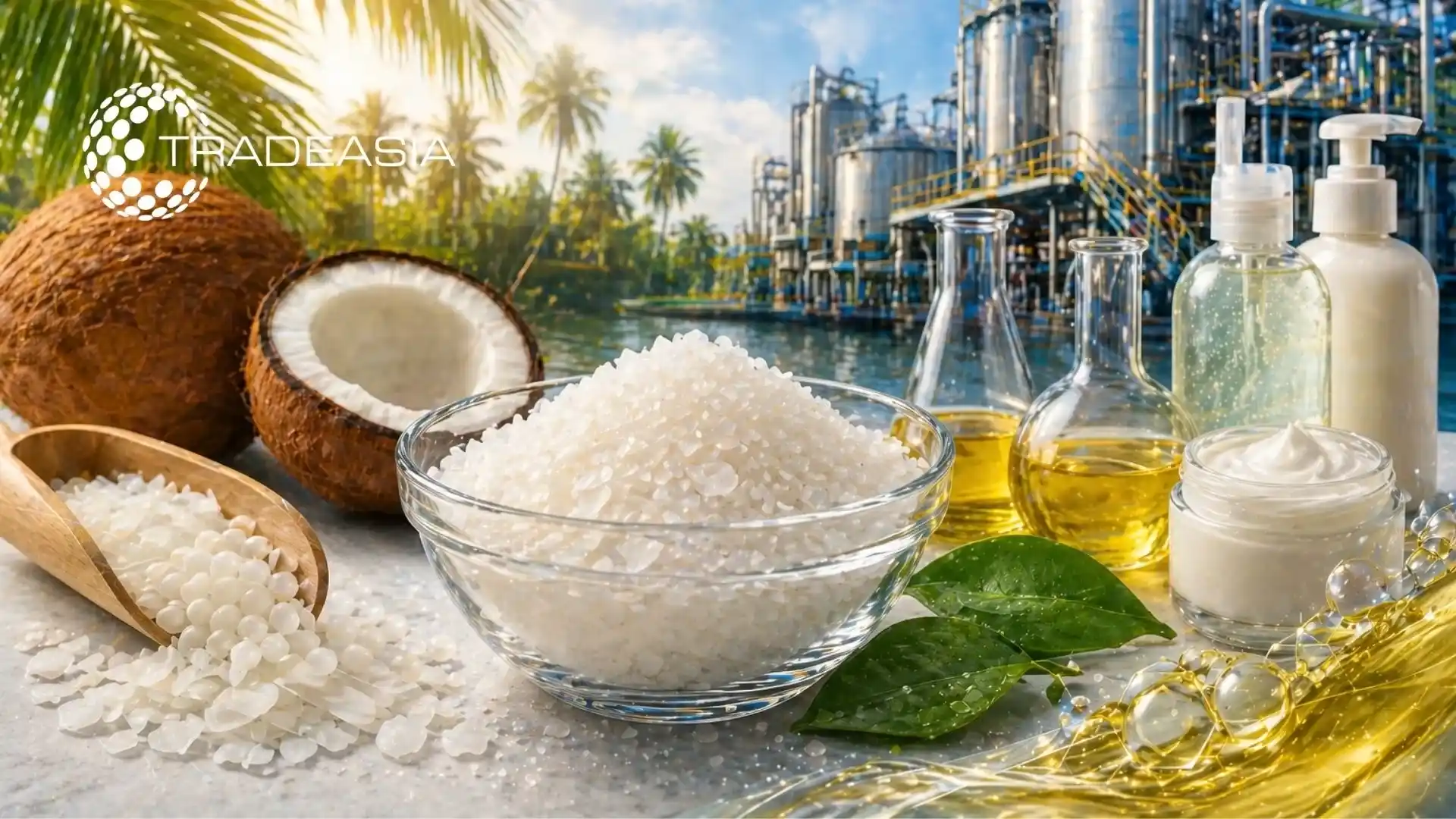
Lauric acid (dodecanoic acid, C12:0) is one of the most commercially important medium-chain fatty acids. Globally, the bulk of lauric acid is obtained by splitting and fractionating lauric-rich oils, particularly palm kernel oil and coconut oil. Southeast Asia, led by Indonesia and Malaysia, and to a lesser extent the Philippines, dominates production of these lauric oils. As a result, the global lauric acid supply chain is closely tied to developments in these producing countries, including plantation yields, weather patterns such as El Niño, and sustainability regulations.
The broader oleochemical market—which includes fatty acids, fatty alcohols, glycerin, and derivatives—has been expanding at an estimated compound annual growth rate (CAGR) of roughly 4–6% in the mid‑2020s, driven by substitution of petrochemical surfactants and plasticizers with bio-based alternatives. Within this sector, lauric and other medium-chain fatty acids are especially valued for their performance in detergency, foaming, and antimicrobial functions. By 2026, global demand for lauric-based derivatives is expected to be notably higher in segments like home care, personal care, and industrial cleaning, particularly in emerging markets in Asia-Pacific and Latin America.
From a buyer perspective, lauric acid is no longer seen simply as a commodity input. Large consumer goods companies, specialty chemical formulators, and even niche food producers are increasingly scrutinizing origin, traceability, and carbon footprint alongside price and quality. This is pushing the market toward more structured, long-term relationships between producers, distributors, and end users. Platforms and distributors such as chemtradeasia play a critical role here, aggregating volumes from certified producers, offering multiple grades, and providing documentation that aligns with global sustainability and regulatory expectations.
The versatility of lauric acid underpins its use across a wide spectrum of industries. One of the largest demand centers is the surfactant and detergent sector. Lauric acid is a key raw material for sodium lauryl sulfate (SLS), sodium lauryl ether sulfate (SLES, via lauryl alcohol), and other anionic surfactants used in household detergents, dishwashing liquids, shampoos, and industrial cleaners. Its C12 chain length provides an excellent balance between hydrophobicity and solubility, resulting in strong foaming, cleaning, and emulsification performance. As consumers increasingly prefer “coconut-based” or “plant-derived” surfactants, lauric acid’s role in formulating marketable, label-friendly products has strengthened.
Another important application is in personal care and cosmetics. Lauric acid and its esters (such as isopropyl laurate and ethyl laurate) function as emollients, texture modifiers, and co-emulsifiers in creams, lotions, soaps, and makeup. Lauric acid is also known for its inherent antimicrobial and anti-acne properties, which has driven its use in skin-care formulations. In soap manufacturing, lauric-rich fats contribute to hardness, quick lather, and good cleansing power; as a result, many premium toilet soaps and syndet bars are based on lauric-rich fatty acid blends.
Beyond surfactants and personal care, lauric acid finds significant use in food and industrial applications. In the food industry, lauric acid derivatives are used in confectionery fats, non-dairy creamers, and as intermediates for food-grade emulsifiers like mono- and diglycerides. Industrially, lauric acid serves as a building block for lubricants, plasticizers, and rubber processing aids, and as a component in metalworking fluids and textile auxiliaries. Its relatively high melting point and oxidative stability make it suitable for specialty waxes and molded products. Toward 2026, emerging applications in biolubricants, biodegradable plastics additives, and pharmaceutical excipients are expected to incrementally expand demand, particularly in high-value segments.
For lauric acid buyers, understanding product specifications and grade options is crucial to ensuring consistent performance in downstream applications. Commercial lauric acid is typically offered as a distilled fatty acid fraction with lauric (C12) as the predominant component, often 45–55% or higher, depending on the cut. High-purity grades can achieve lauric contents above 95%, but more commonly, buyers work with “lauric-rich” blends that also contain myristic (C14), capric (C10), and caprylic (C8) acids. Key specifications include acid value, iodine value (indicating saturation), color (Gardner or Lovibond), moisture content, titer (solidification point), and free glycerin or impurities, all of which affect processing behavior and product aesthetics.
Different industries require different grades. For example, food and pharmaceutical applications typically demand refined, bleached, and deodorized (RBD) quality with tight controls on contaminants, heavy metals, and residual solvents, often accompanied by certifications such as food-grade compliance, Kosher, or Halal. In contrast, industrial cleaners or metalworking fluids may accept broader specification ranges as long as functionality and cost targets are met. Cosmetic and personal care formulators often request cosmetic-grade lauric acid with low odor, low color, and documentation supporting REACH, IFRA, or other regional regulatory requirements.
Global distributors such as chemtradeasia streamline this complexity by offering multiple lauric acid grades from a network of vetted producers in Asia and beyond. Buyers can source standard industrial-grade lauric acid flakes or pastilles, high-purity fractions, and customized cuts tailored to specific formulations. Through consolidated logistics, multi-origin sourcing, and documentation support, including certificates of analysis (COA), safety data sheets (SDS), and, where applicable, sustainability certifications, chemtradeasia helps mitigate supply risk and simplify procurement for both large multinational manufacturers and small to mid-sized formulators entering lauric-based applications.
Looking ahead to 2026, several structural trends are likely to shape the global lauric acid and oleochemical markets. First, demand growth is expected to remain strongest in Asia-Pacific, driven by rising middle-class consumption of personal care, home care, and processed foods. At the same time, North America and Europe are seeing increased interest in bio-based surfactants and specialty chemicals that can help brand owners meet sustainability and ESG targets. This dual growth pattern suggests continued expansion in both volume and value-added lauric derivatives, though competition with alternative feedstocks and synthetic surfactants will persist.
Second, sustainability and regulatory pressures are reshaping sourcing strategies. The European Union’s deforestation-free regulations, corporate zero-deforestation commitments, and growing scrutiny from NGOs are pushing lauric acid buyers to prioritize traceable, certified supply chains. While coconut-based lauric sources are often perceived as more environmentally benign than palm derivatives, both are under pressure to demonstrate responsible land use, fair labor practices, and reduced carbon footprints. Buyers increasingly seek suppliers who can provide transparent chain-of-custody documentation and participate in certification schemes, and who can diversify origin to reduce geopolitical and climate risk.
In this evolving context, buyer strategies are shifting from spot purchasing to more integrated, risk-managed approaches. Many industrial users are exploring long-term offtake agreements, multi-supplier portfolios, and regional inventory hubs to buffer against price spikes and logistics disruptions. Partners like chemtradeasia can support these strategies by offering multi-origin sourcing, flexible contract structures, and market intelligence on lauric oil crops, freight conditions, and regulatory changes. By 2026, buyers that combine robust technical understanding of lauric acid grades with proactive supply risk management and sustainability alignment are likely to enjoy both cost advantages and stronger brand positioning.
Lauric acid has evolved from a relatively niche fatty acid to a strategic raw material in the global shift toward bio-based and sustainable oleochemicals. Its unique combination of surfactant performance, antimicrobial activity, and formulation versatility underpins critical applications in detergents, personal care, food, and industrial products. As demand grows and diversifies, the ability to match precise specifications, manage quality, and ensure reliable, responsible sourcing becomes central to competitiveness for lauric acid buyers worldwide.
Toward 2026, the lauric acid and oleochemicals market will be shaped by converging forces: rising consumption in emerging economies, tightening sustainability expectations, and the need for resilient supply chains in the face of climatic and geopolitical uncertainty. Buyers that cultivate strong relationships with experienced distributors and producers, invest in technical understanding of lauric-based systems, and integrate sustainability into procurement decisions will be best positioned to capture value. With its multi-origin network, documentation support, and focus on industrial customers, chemtradeasia is well placed to assist companies seeking to secure lauric acid supply and unlock new application opportunities in a changing market.
This article is provided solely for informational and market insight purposes and does not constitute technical, safety, regulatory, or professional advice. Readers should independently verify all information with qualified experts, consult official documentation such as MSDS/SDS and relevant regulations, and, where appropriate, contact our team or other professionals before making decisions on specific products, formulations, or applications.
We're committed to your privacy. Tradeasia uses the information you provide to us to contact you about our relevant content, products, and services. For more information, check out our privacy policy.


 English
 Indonesian
 简体字
简体字
 العربية
 Español
 Français
 Português
 日本語
日本語
 한국어
한국어
 Tiếng Việt