Explore our network of country and industry based websites to access localized information, product offerings, and business services across our group.

Access reliable chemical market information through our update channels.
Real-time Updates
Daily Updates
Log in to start sending quotation requests for any product.
Don't have an account? Sign Up Here
Home Africa's Emerging Role in Lauric Acid Feedstock Supply Chains
Trade Insights | Supply Chain | 16 April 2026
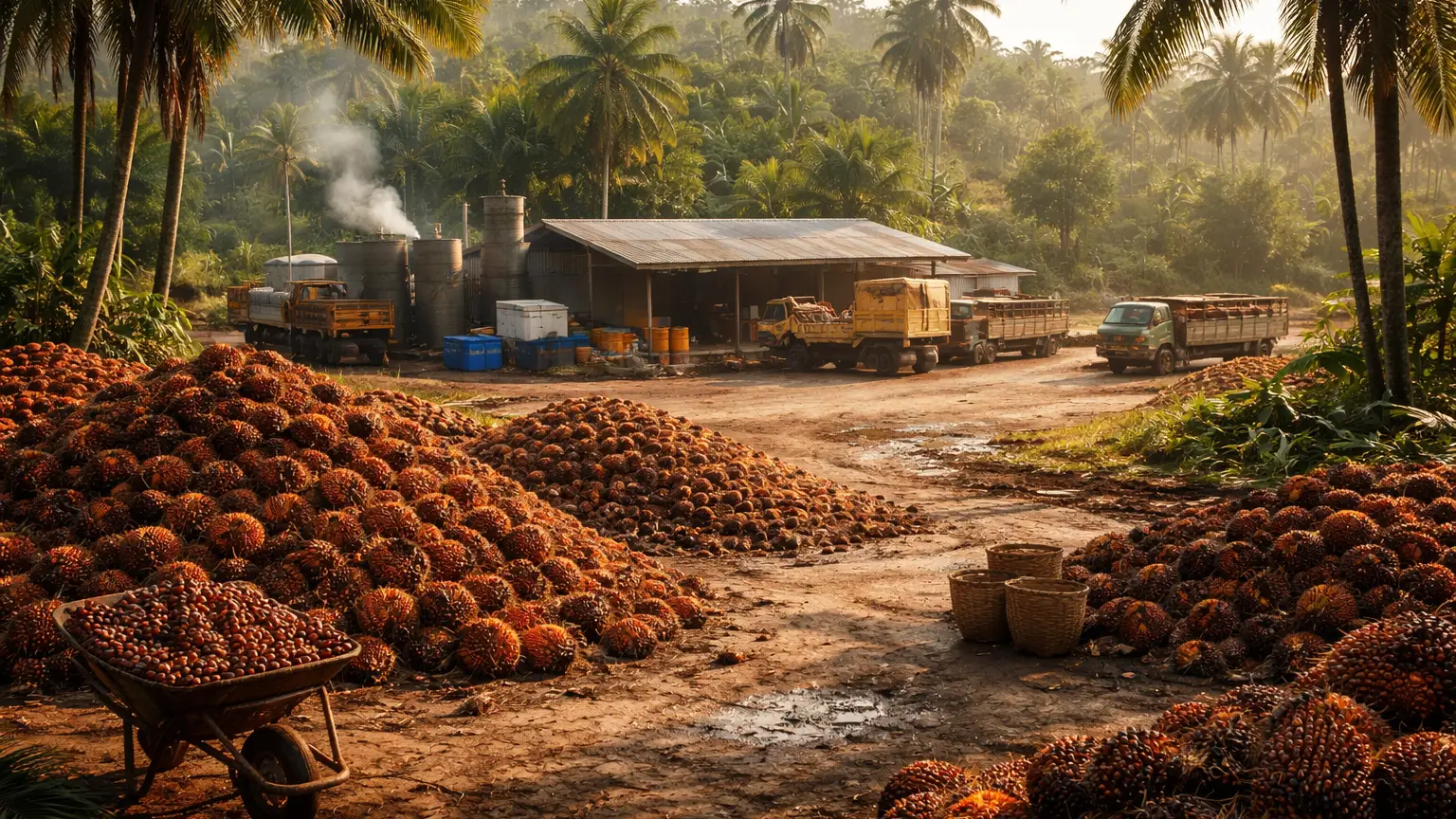
Africa — primarily Nigeria, Côte d'Ivoire, Ghana, and Cameroon — accounts for a meaningful but underutilised share of global palm kernel oil (PKO) production, the key feedstock for lauric acid (C12). While Indonesia and Malaysia dominate global PKO supply with a combined 85%-plus market share, African origins offer a differentiated sourcing option for buyers seeking feedstock diversification away from Southeast Asian concentration risk. The primary logistics corridor runs from West African ports (Abidjan, Douala, Lagos) to European oleochemical processors, with the continent's long-term potential constrained by smallholder processing fragmentation and limited RSPO certification coverage.
Lauric acid (C12:0) is a saturated fatty acid derived by splitting and fractionating either coconut oil or palm kernel oil. Approximately 62% of global lauric acid production originates from coconut oil and roughly 36% from palm kernel oil, according to industry estimates. The oleochemical chain is clear: coconut and PKO go into fatty acid fractionation units, producing lauric acid as a primary output used in surfactants, soaps, personal care, and antimicrobial formulations.
The global lauric acid market was valued at approximately USD 608 to 650 million in 2024 and is projected to reach USD 725 to 827 million by 2032 at a CAGR of roughly 2.4 to 2.6%. Over 65% of total output volume comes from Asia-Pacific. Indonesia and Malaysia together hold more than 85% of global PKO supply, making Southeast Asian origins the structural bedrock of the entire C12 supply chain.
Africa's position in this chain is not marginal — but it is underdeveloped. The continent is home to Elaeis guineensis, the African oil palm itself, whose natural range extends across the tropical belt from Liberia to Tanzania. West African countries produce palm kernel oil as a byproduct of palm oil milling, and several are significant raw material exporters to European oleochemical buyers. Understanding where Africa fits, where it falls short, and what is changing is now commercially relevant for any buyer aiming to reduce dependence on a two-country feedstock base.
Nigeria is the largest palm kernel oil producing country in Africa, accounting for approximately 38% of total African volume at around 160,000 tonnes annually, according to IndexBox market data. Smallholders are responsible for roughly 80% of national palm oil production, and most kernel processing still relies on traditional techniques rather than industrial screw-press or solvent-extraction mills. This fragmented processing base is the central supply constraint: the country has significant oil palm area, but post-harvest kernel-to-oil conversion efficiency remains below the levels achievable in Malaysian or Indonesian industrial mills.
Nigeria's domestic consumption also competes directly with export availability. Lagos is the primary loading port for PKO exports on FOB terms, with shipping time to European oleochemical hubs typically around 15 days for confirmed letters of credit. However, port congestion at Apapa (Lagos) is a recurring operational risk, adding 5 to 10 days to planned loading windows during peak seasons.
Despite ranking third in African production at approximately 14% of regional output, Côte d'Ivoire is consistently the continent's largest PKO exporter by value, holding around 51% of African export value according to IndexBox 2024 data. This reflects a more developed processing and logistics infrastructure anchored at the Port of Abidjan, West Africa's most significant trade gateway for agricultural commodities.
Abidjan handles a high and growing volume of commodity traffic. Côte d'Ivoire's government and its port operator — Africa Global Logistics, a subsidiary of Mediterranean Shipping Company — have committed to continued infrastructure investment, with plans to expand inland logistics hubs in Ferkessedougou, Bouaké, and San Pedro to decentralise cargo flows. Port traffic at Abidjan was projected to rise approximately 50% in 2025 to around 1.8 million TEUs, partly as larger vessels from Europe and Asia can now call directly, following the completion of a second container terminal in late 2022.
For PKO buyers, Côte d'Ivoire's developed agro-industrial corridor and relative port reliability make it the most commercially accessible African source origin at present. Smallholders manage 73% of oil palm land, but Abidjan-based processors provide a degree of quality standardisation before export.
Cameroon holds approximately 14% of African PKO export value, exporting through the Port of Douala (and the newer deep-water Port of Kribi). The country's PKO export volumes grew at a CAGR of approximately 45% between 2013 and 2024, reflecting both government investment in the palm sector and increasing uptake from European buyers seeking origin diversification. Cameroon is strategically positioned with borders shared with Nigeria, Chad, the Central African Republic, Gabon, and Equatorial Guinea, making it a potential hub for sub-regional feedstock aggregation.
Gabon, while a smaller producer, commands approximately 18% of African PKO export value on a per-tonne basis, indicating a higher-quality or more refined product mix relative to its volume. Sierra Leone has grown fastest of any African exporter at a CAGR of 56% from 2013 to 2024, albeit from a low base, with increasing engagement from development-finance-backed palm sector projects.
| Country | Role in African PKO Chain | Primary Export Port | Export Share (Value, 2024) | Export CAGR 2013–2024 |
|---|---|---|---|---|
| Côte d'Ivoire | Dominant exporter | Abidjan | ~51% | +1.7% |
| Gabon | High-value secondary | Libreville/Port-Gentil | ~18% | +39.7% |
| Cameroon | Growing mid-tier | Douala / Kribi | ~14% | +45.0% |
| Nigeria | Largest producer; lower export ratio | Lagos (Apapa) | N/A (primarily domestic) | — |
| Ghana | Declining exporter | Tema | ~16% (volume) | -7.2% |
| Sierra Leone | Fastest-growing small exporter | Freetown | ~3% | +56.0% |
The dominant trade corridor for African PKO is West Africa to North-West Europe, specifically to oleochemical processing hubs in the Netherlands (Rotterdam area), Germany, and Belgium. European processors, including BASF's oleochemicals business and Oleon (now part of Avril Group), have long sourced African PKO as a secondary origin alongside their primary Southeast Asian volumes.
African PKO typically moves in two configurations. Small parcel volumes (500 to 2,000 MT) ship in flexitanks or ISO tanks loaded into 20-foot containers at Abidjan, Douala, or Tema. Larger volumes from more industrialised processors move in bulk liquid parcels via product tanker, though deep-water tanker infrastructure at most West African ports is less developed than at Malaysian or Indonesian loading terminals.
Voyage duration from West African ports to Rotterdam averages 12 to 18 days, considerably shorter than the 25 to 30-day transit from Indonesian or Malaysian ports to North-West Europe. This transit time advantage is structurally underutilised because the volume of certified, mill-traceable African PKO available to European buyers remains small relative to Southeast Asian certified volumes.
Three logistics risks are specific to West African PKO procurement and must be built into any sourcing model:
Port congestion: Lagos/Apapa is chronically congested. Pre-booking vessels 4 to 6 weeks in advance of intended loading is standard practice for buyers using Nigerian origins, and demurrage exposure is higher than at Abidjan or Douala.
Rural infrastructure gaps: Most West African oil palm is grown by smallholders in areas with poor road networks. Transporting fresh fruit bunches to mills and kernels to pressing facilities results in free fatty acid (FFA) levels and moisture content that can exceed industrial specification limits. Quality control at origin must include FFA testing and moisture analysis at multiple points in the chain, not just at loading port.
Seasonal harvest patterns: Unlike the more consistent year-round production achievable at large-scale Southeast Asian plantations, West African PKO supply is more seasonal. The primary harvest in Nigeria, Ghana, and Cameroon runs from roughly March to June, with a secondary flush between August and October. Buyers relying on African PKO for just-in-time procurement face elevated availability risk during inter-harvest gaps.
Africa's structural underperformance as a PKO supplier is not a land availability problem. The continent has suitable oil palm growing conditions across a 6,000-kilometre belt. The constraint is at the processing layer.
In Ghana, smallholders manage approximately 81% of oil palm cultivation area, yet face low yields and limited access to formal markets, according to the 2025 Palm Oil Barometer produced by Solidaridad. In Nigeria, smallholders similarly account for 80% of national palm oil output and continue to rely on outdated processing equipment, with post-harvest losses from inadequate storage exceeding 3% annually across African producing regions.
Industrial-scale palm kernel oil processing requires continuous mechanical presses, efficient kernel-cracking units, and oil storage infrastructure. Most African smallholder operations use manual or small motorised equipment that results in higher FFA content in the crude PKO, reducing its suitability for oleochemical-grade fractionation without additional processing steps. This is not a permanent constraint: Ghana's Redgold Oil Palm Plantation Project (a USD 50 million initiative) aims to cultivate 10,000 hectares and build integrated processing infrastructure. Nigeria has announced plans for 1.5 million hectares of oil palm expansion with replanting initiatives targeting modernisation. But results from these programs will take five to ten years to materialise in export-grade PKO volumes.
For buyers sourcing today, the practical implication is that African PKO should be purchased with explicit specification requirements — including maximum FFA content, moisture, and impurity limits — incorporated into the purchase contract, rather than assumed to match the tighter specifications routinely achievable from Malaysian or Indonesian industrial refiners.
RSPO (Roundtable on Sustainable Palm Oil) certification is now the de facto entry requirement for PKO-derived lauric acid entering European personal care and consumer goods supply chains. BASF traced 96.7% of its global palm footprint to the oil mill level by end of 2024 and sourced 98.1% of its palm oil volumes on an RSPO-certified basis. Henkel sourced 97% of its palm oil and palm kernel oil demand as certified raw materials under RSPO's Mass Balance model in fiscal year 2024. For African PKO producers, this creates both a barrier and an opportunity.
The barrier is practical: RSPO certification requires documentation of traceability back to individual mills, implementation of no-deforestation commitments, and auditable social compliance systems. For smallholder-dominated supply chains in Nigeria, Ghana, and Cameroon, the upfront cost of certification has been estimated at USD 30 to 250 per farmer for groups of 2,000 producers, and in the first year post-certification, net income per hectare can decline by approximately 8% relative to pre-certification levels because compliance costs precede any price premium benefit.
The opportunity is the sustainability premium. Certified Sustainable PKO (CSPKO) from Southeast Asian origins commanded a premium of approximately USD 110 per tonne over conventional PKO in December 2024 according to Tradeasia International. Any African origin that achieves credible RSPO or ISCC certification at scale would command that same premium, potentially improving the commercial position of African producers significantly relative to their conventional-market pricing.
Sierra Leone and Liberia are two origins where development-finance institutions — including USAID's West Africa Trade and Investment Hub — have already backed RSPO-oriented programmes. 8 Degrees North, a Ghanaian palm oil processing company, received a USD 1.1 million co-investment grant to support organic certification and market access to the United States. These are early signals, not structural volume shifts, but they confirm that the certification pathway is being actively pursued in West Africa.
| Risk Factor | Rating | Trigger Scenario | Historical Precedent |
|---|---|---|---|
| Southeast Asian supply concentration | HIGH | Indonesia or Malaysia introduces palm-based export restrictions | Indonesia's 2022 CPO export ban disrupted global palm derivative markets within weeks |
| African PKO quality inconsistency | MEDIUM-HIGH | FFA content above 5% at loading renders parcels unsuitable for oleochemical-grade fractionation without rework | Routine occurrence from smallholder Nigerian and Ghanaian origins |
| Port congestion (Lagos) | MEDIUM | Vessel demurrage at Apapa; 10+ day delays during peak cargo seasons | Persistent; affects most vessel calls during Nigerian agricultural export season |
| RSPO certification gap | MEDIUM | European buyers restrict non-certified origins as EUDR (EU Deforestation Regulation) enforcement tightens | EUDR delayed to 2025–2026 but direction of travel is clear |
| Coconut oil price volatility feeding back into PKO demand | MEDIUM | CNO prices rose over 74% year-on-year in 2024, redirecting buyer demand toward PKO and tightening PKO supply | Occurred in 2024; price correlation between CNO and PKO is structurally high |
| Seasonal African PKO availability | LOW-MEDIUM | Inter-harvest gap (July–September) coincides with tight PKO global supply windows | Recurring annually; manageable with forward planning |
The EU Deforestation Regulation (EUDR), enforcement of which was delayed but remains on a 2025–2026 timeline for larger operators, requires that palm oil and its derivatives placed on the EU market be sourced from land that has not been subject to deforestation or forest degradation after December 31, 2020. For African PKO, this creates a documentation burden that smallholder supply chains in Nigeria, Ghana, and Cameroon are not yet equipped to meet at scale.
Buyers sourcing African PKO for European oleochemical processing must now include geolocation data requirements in their supplier contracts, covering plantation-level GPS coordinates, land-use history dating to the 2020 cut-off, and evidence that no primary forest conversion has occurred. Processors with established relationships with Côte d'Ivoire or Gabon-based exporters who already operate under some degree of traceability infrastructure are better placed to meet EUDR requirements. Nigerian small-farm origins, where individual plots may be less than 2 hectares and aggregated without mill-level traceability, present the most complex compliance risk profile.
Africa's contribution to the global lauric acid feedstock chain is real, growing, and structurally underrated. Nigeria holds approximately 38% of African PKO production but exports a fraction of its potential due to smallholder processing fragmentation and domestic consumption demand. Côte d'Ivoire is the most commercially accessible African source for European buyers, with the best port infrastructure and highest export value share. Cameroon, Gabon, and Sierra Leone are secondary but expanding origins.
The fundamental constraint is not land or climate — it is processing quality and certification coverage. Buyers who engage directly with established Abidjan- or Douala-based processors, specify clear FFA and moisture limits, and require RSPO documentation are best positioned to access African PKO at terms that work for oleochemical-grade lauric acid production. The structural case for African origin diversification strengthens further as EUDR enforcement approaches and Southeast Asian concentration risk remains unresolved.
For procurement teams building resilient lauric acid feedstock supply chains over a 3 to 5 year horizon, establishing at least one contracted African origin relationship now, before volume demand follows the market's sustainability agenda, is the lower-risk commercial posture.
Q: Which African countries produce the most palm kernel oil for lauric acid feedstock?
A: Nigeria is the largest African PKO producer at approximately 38% of regional volume, followed by Côte d'Ivoire at around 14% and Ghana in third place. However, Côte d'Ivoire is the dominant exporter by value, with approximately 51% of African PKO export revenues, due to more developed processing infrastructure at the Port of Abidjan. Cameroon and Gabon are secondary but fast-growing export origins.
Q: How is African palm kernel oil transported to lauric acid processors?
A: African PKO moves primarily by containerised flexitank or ISO tank from West African ports — Abidjan, Douala, and Lagos — to European oleochemical hubs in Rotterdam, Hamburg, and Antwerp. Voyage duration is 12 to 18 days to North-West Europe, significantly shorter than the 25 to 30-day transit from Indonesian or Malaysian origins. Larger bulk liquid parcels move by product tanker where port infrastructure permits.
Q: What quality risks are associated with African palm kernel oil as a lauric acid feedstock?
A: The primary quality risk is elevated free fatty acid (FFA) content, which typically results from delayed processing of fresh fruit bunches at smallholder-level mills and inadequate storage infrastructure. African PKO from smallholder origins can carry FFA levels of 5% or higher, which is outside the specification window for direct oleochemical-grade fractionation. Buyers should require pre-shipment CoA inspection and specify a maximum FFA of 3.5% and moisture below 0.1% in purchase contracts.
Q: Is African palm kernel oil RSPO certified for use in European lauric acid supply chains?
A: RSPO certification coverage for African PKO is currently limited compared to Southeast Asian volumes. Côte d'Ivoire and Gabon-based processors are the most advanced in traceability, but the smallholder-dominated supply chains in Nigeria, Ghana, and Cameroon face significant compliance barriers. For European oleochemical supply chains, buyers should source RSPO Mass Balance or ISCC-certified African PKO and incorporate EUDR-compliant geolocation documentation requirements into supplier contracts.
Q: Why should buyers consider African palm kernel oil when Southeast Asia dominates global supply?
A: Indonesia and Malaysia together control over 85% of global PKO supply, creating structural concentration risk in the entire lauric acid feedstock chain. Indonesia demonstrated this vulnerability in 2022 when its CPO export restrictions disrupted global palm derivative markets within weeks. African PKO offers a geographically distinct origin with shorter transit times to European buyers, competitive pricing for conventional-grade material, and a growing sustainability certification trajectory. Buyers should treat African origins as a 10 to 20% diversification layer in a balanced feedstock portfolio, not as a primary replacement.
We're committed to your privacy. Tradeasia uses the information you provide to us to contact you about our relevant content, products, and services. For more information, check out our privacy policy.


 English
 Indonesian
 简体字
简体字
 العربية
 Español
 Français
 Português
 日本語
日本語
 한국어
한국어
 Tiếng Việt



















