Explore our network of country and industry based websites to access localized information, product offerings, and business services across our group.

Access reliable chemical market information through our update channels.
Real-time Updates
Daily Updates
Log in to start sending quotation requests for any product.
Don't have an account? Sign Up Here
Home IOI Oleochemicals Oleic Acid Supply Chain: Malaysia to Europe
Trade Insights | Supply Chain | 02 June 2026
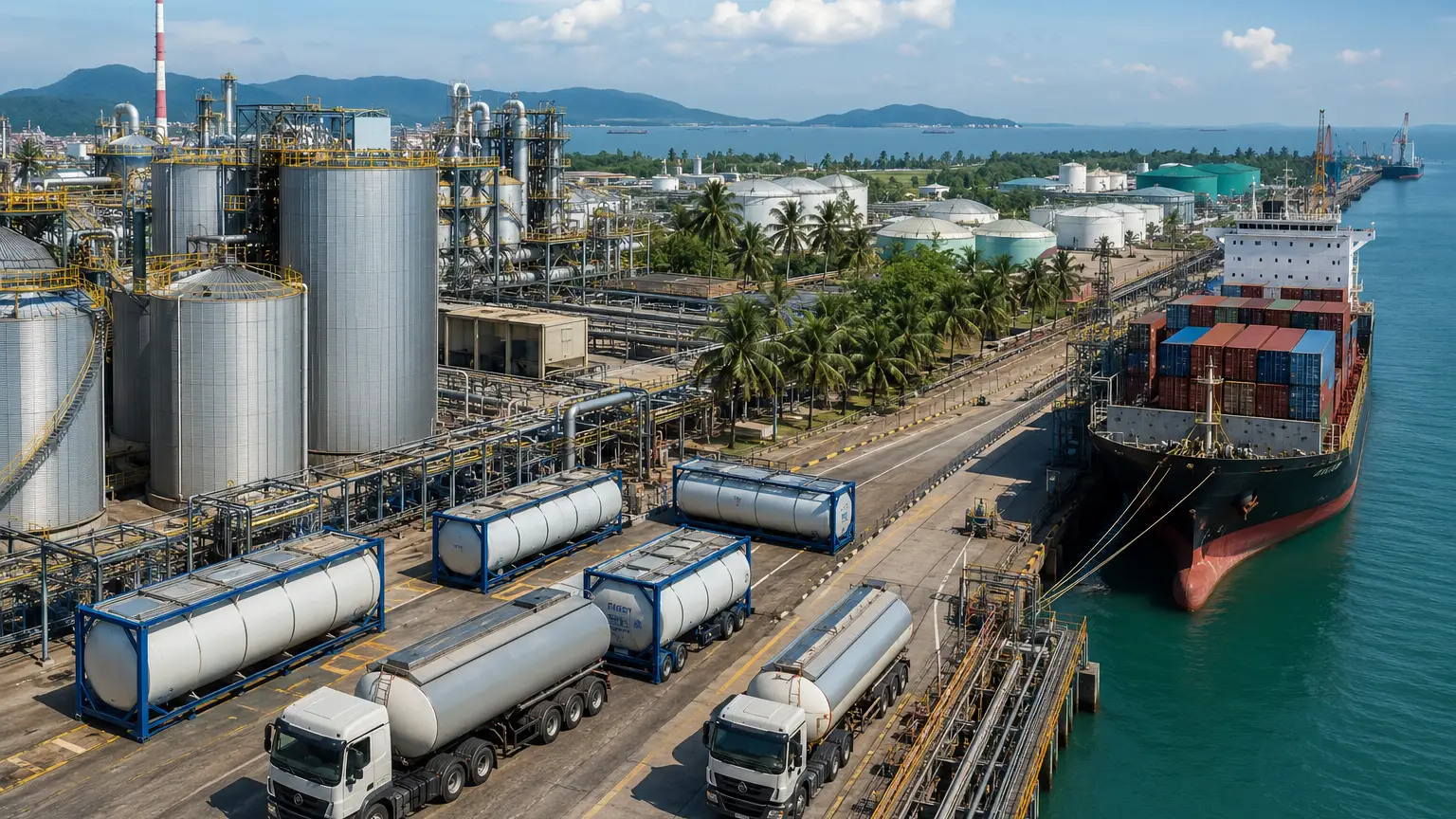
IOI Oleochemicals is one of the world's largest palm-based oleic acid producers, operating a vertically integrated supply chain from plantation feedstock in Malaysia through its Pasir Gudang and Penang oleochemical complexes (total capacity exceeding 780,000 MT/year), across the Strait of Malacca by chemical tanker, and into European specialty processing at its IOI Oleo GmbH facilities in Witten and Wittenberge, Germany. The primary supply risk for European buyers is EUDR-related traceability compliance on palm-derived feedstocks, effective from December 2025, which requires documented deforestation-free sourcing to maintain uninterrupted EU market access.
IOI Oleochemicals occupies a structurally distinctive position in the global oleic acid market — one that few competitors can replicate. Unlike trading-company distributors or single-site manufacturers, IOI operates an end-to-end supply chain that begins inside its own palm oil plantations in Malaysia and Sabah, runs through one of Southeast Asia's largest single-location vertically integrated oleochemical complexes at Pasir Gudang, Johor, and terminates in specialty fatty acid processing and pharmaceutical-grade distribution from its German subsidiary IOI Oleo GmbH in Hamburg, Witten, and Wittenberge. For European buyers sourcing oleic acid — whether for personal care emollients, pharmaceutical excipients, industrial lubricants, or surfactant manufacturing — this supply chain architecture is both an asset and a concentration point that carries specific logistics and regulatory risk.
Understanding how oleic acid physically moves through IOI's network, where it transforms in specification and grade, and where the chain is exposed to disruption is commercially essential for any procurement team that relies on Malaysian-origin palm fatty acids.
Oleic acid is a C18 mono-unsaturated fatty acid that occurs naturally in both palm olein (the liquid fraction of refined palm oil) and palm kernel oil. IOI's oleic acid production draws primarily from palm olein fractionation — the process of separating crude palm oil into its solid stearin and liquid olein fractions, with the olein stream subsequently split and refined through fatty acid distillation to yield C18 fractions dominated by oleic acid (approximately 39–45% of palm olein fatty acid composition).
IOI's feedstock security begins at the plantation level. IOI Group operates palm oil plantations and mills in Peninsular Malaysia and Sabah, with refinery access at two wholly-owned facilities strategically positioned at Pasir Gudang, Johor, and Sandakan, Sabah — both of which have direct port access to major shipping routes. This proximity between plantation, mill, refinery, and oleochemical plant is the core commercial advantage of IOI's integrated model: crude palm oil does not travel to a third-party refinery before entering the oleochemical processing chain, eliminating a feedstock procurement variable that constrains competitors who source refined palm oil from the open market.
The Pasir Gudang site hosts one of the world's largest single-location vertically integrated palm oil refinery and oleochemical complexes. IOI Oleochemical's total production capacity across its Malaysian facilities exceeds 780,000 MT per annum across its product range — fatty acids, glycerine, soap noodles, fatty esters, and specialty derivatives — sold to customers in more than 80 countries, with Japan, China, and Europe as the three primary destination markets.
Palm oil pricing — and specifically crude palm oil (CPO) price movements — is the dominant variable in IOI's oleic acid cost structure. CPO price surges in 2024, exacerbated by El Niño-related yield disruptions and Indonesian palm oil policy tightening, drove oleic acid prices in Malaysia and Indonesia upward through Q1–Q3 2024, with Asian market prices reaching elevated levels and European CIF prices reflecting both feedstock and freight pressure. By Q4 2024 and into 2025, tighter plantation labor availability in Malaysian estates added a secondary supply-side constraint, contributing to fatty acid prices at Port Kelang remaining firm even as downstream demand from personal care and detergent sectors showed modest softening.
IOI's oleic acid is produced under its Palmac® brand — a globally recognized line of vegetable-derived fatty acids and glycerine that the company positions as distinctly superior in purity and consistency through proprietary process optimization. The Palmac® range covers the full palm fatty acid spectrum from C8 through C18, with oleic acid (C18:1) representing one of the highest-volume fractions given its wide commercial applicability across personal care, pharmaceutical, food, and industrial sectors.
The Pasir Gudang Industrial Estate in Johor Bahru sits at the confluence of the Johor Strait and the southern approach to the Strait of Malacca — a port geography that gives IOI direct maritime access to the region's primary chemical shipping corridor without intermediate road or rail transit. The Pasir Gudang port complex handles bulk liquid cargo through dedicated chemical tanker berths and ISO tank loading infrastructure, making it one of the most logistics-efficient departure points for oleic acid exports in Southeast Asia.
IOI's Penang facility, located in Prai on the northwest coast of Peninsular Malaysia, operates the company's fatty ester and specialty downstream production, including its IOI Esterchem portfolio. The Penang site received the FSSC 22000 food safety management certification, which is commercially relevant for oleic acid grades destined for food contact or edible applications — a growing segment driven by the clean-label and functional food sectors that demand certified supply chain documentation.
Grade portfolio and buyer segmentation at the Malaysian production stage:
| Grade Category | Key Specification | Primary Application | Certification Required |
|---|---|---|---|
| Industrial Oleic Acid | ≥75% C18:1 content, technical purity | Lubricants, surfactants, rubber processing | ISO 9001 |
| Food-Grade Oleic Acid | High purity, low peroxide value | Food emulsifiers, edible applications | FSSC 22000, Halal, Kosher |
| Cosmetic-Grade Oleic Acid | Low colour, low odour | Emollients, personal care bases | RSPO, ISO 14001 |
| Pharmaceutical Excipient | Pharmacopoeia-compliant (Ph. Eur., USP) | Parenteral nutrition, topical excipients | EU-GMP, FDA (processed in Germany) |
Oleic acid from IOI's Pasir Gudang complex moves to European buyers through a multi-modal chain that begins at dedicated liquid chemical berths at Pasir Gudang port and terminates at Hamburg, Rotterdam, or Antwerp depending on the buyer's location and the onward processing requirement.
Oleic acid is loaded in bulk into stainless steel chemical tankers or into T11-specification ISO tank containers (21,000–26,000 litre capacity, 316L grade stainless steel). Bulk chemical tanker loading is the primary mode for large commercial volumes destined for European industrial buyers, while ISO tank containers serve specialty and smaller-volume orders, particularly those destined for pharmaceutical or cosmetic-grade customers requiring segregated, traceable cargo documentation. Both modes depart from Pasir Gudang port — located approximately 35 km from the Singapore Strait — and transit southward through the Johor Strait to enter the main Malacca shipping lane.
The Strait of Malacca is the world's single highest-volume oil and liquid cargo chokepoint, handling an estimated 23.7 million barrels of liquid cargo per day in 2023 and 23.2 million barrels per day in the first half of 2025 — approximately 29% of total global maritime oil and liquid cargo flows. Chemical tankers carrying oleic acid from Pasir Gudang transit the full 800 km length of the strait from the Singapore approaches northwestward through the Andaman Sea. The strait's narrowest passage, approximately 40 km at its southern end near Singapore, creates congestion risk during periods of high vessel traffic — a logistics vulnerability that IOI mitigates through scheduling and Singapore-based coordination. The Port of Singapore, positioned at the strait's southern exit, serves as the primary transhipment hub for IOI's European-bound cargo, where chemical tankers and ISO tank containers may be consolidated before onward deep-sea transit.
From Singapore, IOI's European-bound oleic acid cargo transits the Indian Ocean westward through the Bab el-Mandeb Strait at the mouth of the Red Sea, then northward through the Suez Canal into the Mediterranean Sea and onward to Hamburg, Rotterdam, or Antwerp. Total sea transit time from Pasir Gudang to Hamburg via this routing is approximately 25–32 days under normal operating conditions, depending on vessel speed, port call schedule, and canal transit waiting time.
The Suez Canal represents the second critical chokepoint in IOI's European export corridor. The canal handles approximately 4.9 million barrels per day of liquid cargo. Houthi attacks on commercial shipping in the Red Sea from late 2023 through 2024 forced a significant proportion of vessel traffic to reroute around the Cape of Good Hope — adding approximately 10–14 days of additional transit and substantially increasing freight costs on the Malaysia-Europe corridor. This disruption directly affected oleic acid delivered costs to European buyers in 2024, and while canal-routing has partially recovered through 2025, the Red Sea security environment remains a material logistics risk for IOI's European supply chain.
IOI's oleic acid reaches European buyers through two distinct channels:
Direct customer delivery from European port terminals (Hamburg, Rotterdam, Antwerp) where bulk chemical tanker cargo is offloaded into shoreside storage and distributed by road tanker to industrial buyers — surfactant manufacturers, lubricant blenders, rubber compounders, and detergent producers — across Northern and Western Europe.
IOI Oleo GmbH specialty processing in Witten and Wittenberge, Germany, where Malaysian-origin basic oleic acid and other fatty acids are upgraded into high-value specialty derivatives. IOI Oleo GmbH, headquartered in Hamburg with over 330 employees across its two German production sites, is the wholly-owned European processing arm of the IOI Group. The Witten site — founded in 1905 as a soap factory in the Ruhr district and operating to EU-GMP and U.S. FDA standards since 2005 — specializes in pharmaceutical-grade oleochemical specialties including branded excipients (MIGLYOL®, IMWITOR®, SOFTISAN®, WITEPSOL®) and advanced fractionation. The Wittenberge site in Brandenburg, acquired as part of the former Cremer Oleo network, handles fatty acid fractionation, medium-chain triglyceride (MCT) production, and esterification with multi-step short-path distillation. The two German sites have a combined processing capacity of approximately 39,200 MT per annum.
The strategic logic of IOI's German presence is commercially explicit: when Malaysia's GSP (Generalised Scheme of Preferences) withdrawal reduced IOI's preferential tariff access to the EU in 2014, adding European processing capacity converted Malaysian-origin basic fatty acids into EU-manufactured specialty products — partially neutralizing the tariff impact while simultaneously moving IOI up the oleochemical value chain into pharmaceutical and cosmetic excipient markets where margins are structurally higher than commodity fatty acids.
For European pharmaceutical buyers requiring EU-GMP certified oleic acid for parenteral or topical applications, the Witten site is the commercial supply point — not the Malaysian facility. The full supply chain from Johor to a German pharmaceutical plant therefore involves both the ocean freight leg and the Witten refining step, with IOI carrying the logistics and quality custody between origin and customer.
| Risk Dimension | Rating | Named Driver |
|---|---|---|
| Feedstock Concentration | MEDIUM-HIGH | Palm oil price volatility; Malaysian plantation labor constraints |
| Logistics — Malacca | LOW-MEDIUM | Congestion risk at Singapore approaches; managed by scheduling |
| Logistics — Suez / Red Sea | MEDIUM-HIGH | Houthi-related rerouting added 10–14 days and elevated freight in 2024 |
| Regulatory — EUDR | HIGH (for EU buyers) | Palm oil EUDR compliance effective December 2025; traceability documentation now mandatory |
| Concentration Risk | MEDIUM | IOI's vertically integrated model reduces intermediary risk but creates single-company dependency for some buyer relationships |
The EU Deforestation Regulation (EUDR), which entered into application on 30 December 2025 (extended from the original June 2023 deadline following December 2024 EU legislative action), requires that palm oil and its derivatives placed on the EU market originate from land that has not been subject to deforestation after 31 December 2020. For European buyers sourcing oleic acid from IOI, the EUDR's practical implication is a traceability requirement that runs from the EU importer back to the plantation of origin — a documentation chain that reaches from Hamburg or Rotterdam to IOI's Pasir Gudang complex and then to the specific palm oil estates supplying the oleochemical feedstock.
IOI Oleochemical holds RSPO (Roundtable on Sustainable Palm Oil) certification across its operations — a certification framework that RSPO and ISEAL have positioned as a primary due diligence mechanism for EUDR compliance, given that RSPO's Principles and Criteria standards often exceed EUDR traceability requirements. IOI's sustainability reporting is backed by ISO 14064 greenhouse gas management certification and FSSC 22000 food safety management certification at its Malaysian and German sites.
For buyers, the commercial implication is clear: RSPO-certified supply from IOI is the lowest-friction compliance pathway for EUDR. Non-certified palm-derived oleic acid from Malaysian and Indonesian suppliers faces higher due diligence burden and potential port-of-entry checks from EU National Competent Authorities (NCAs). Procurement teams sourcing oleic acid for EU-market applications should verify RSPO certification status and request geolocation polygon data for supplying plantations as part of standard supplier qualification from December 2025 onward.
IOI's oleic acid pricing to European buyers reflects three stacked cost layers: Malaysian CPO feedstock cost (the largest single variable), ocean freight (especially sensitive to Red Sea routing risk), and European distribution or processing margin at the Witten/Wittenberge stage for specialty grades.
CPO prices surged in Q1 2024 and remained elevated through Q3 2024, with oleic acid prices in the Asian market reaching approximately USD 1,232/MT (CIF Europe basis, March 2024) — a level driven by palm supply tightness, El Niño yield disruption, and Indonesian B35 biodiesel mandate absorbing domestic palm volumes. Q4 2024 saw a partial recovery in supply but freight cost pressure from Red Sea rerouting sustained European landed cost above pre-2024 benchmarks. By Q1 2025, Asian FOB prices were recovering with improved demand from the personal care and lubricant sectors, while European buyers faced continued premium for certified-origin supply ahead of EUDR enforcement.
Industrial buyers in Europe procuring standard-grade oleic acid for lubricants or surfactant manufacturing should benchmark against FOB Port Kelang as the origin reference and layer in freight cost assumptions — currently 25–32 days via Suez Canal (if normalized) or 35–45 days via Cape of Good Hope. Pharmaceutical and cosmetic buyers procuring ex-Witten should negotiate on the basis of IOI Oleo GmbH's Witten gate price, which incorporates the Malaysian-origin cost plus the German processing step and is denominated in EUR with European energy and labor cost components.
Procurement teams sourcing oleic acid for personal care, pharmaceutical, or industrial lubricant applications across Europe, Asia, and the Middle East can contact Tradeasia International, a Singapore-headquartered global chemical supplier and distributor with over 20 years of supply chain experience. Tradeasia International supplies industrial and cosmetic-grade oleic acid with multi-origin capability — including Malaysian and Indonesian-origin supply — providing batch-specific certificates of analysis, RSPO documentation where applicable, and logistics coordination for ISO tank and bulk tanker shipments to buyers across Asia, Europe, the Middle East, and Africa. Buyers managing complex documentation requirements for EUDR-compliant palm-derived fatty acid procurement can contact Tradeasia International for grade specifications, origin certification support, and volume pricing.
IOI's integrated supply chain is commercially efficient for large-volume European buyers who transact directly. For mid-market buyers in Europe, the Middle East, or Asia sourcing below IOI's direct account thresholds, or for buyers requiring multi-origin sourcing to hedge against single-supplier concentration:
Origin alternatives: Indonesia (Musim Mas, Wilmar, Apical) offers comparable palm-derived oleic acid at competitive FOB pricing from Belawan and Tanjung Priok. Indonesia's B60 biodiesel mandate from 2025 has increased domestic palm oil absorption, tightening industrial-grade fatty acid availability from Indonesian origins and redirecting some volume toward Malaysian supply — a structural shift that has increased the relative commercial importance of Malaysian-origin oleic acid, including IOI's Palmac® platform.
Grade sourcing strategy: For standard industrial-grade oleic acid (≥75% C18:1, technical specification), Indonesia and Malaysia are interchangeable origins and should be dual-qualified to manage supply risk. For RSPO-certified cosmetic grade or EU-GMP pharmaceutical grade, IOI's Malaysian and German operations are among the few Asian-origin producers capable of delivering the full documentation and certification stack that European pharmaceutical and personal care manufacturers require without a separate EU processor step.
Contract structure: Oleic acid procurement from Malaysian origins typically operates on quarterly price revision terms linked to CPO price benchmarks, with volume commitments of 200–500 MT per shipment for bulk tanker economics. ISO tank shipments serve smaller volumes (20–24 MT per unit) at a freight premium versus bulk, but provide greater flexibility for specialty grades requiring segregated documentation and chain-of-custody certification.
European and Asian buyers sourcing oleic acid at commercial volumes — whether for personal care emollients, industrial lubricants, soap manufacturing, or pharmaceutical excipient applications — can review Tradeasia International's product portfolio for oleic acid supply across multiple origins, grades, and certification standards. With regional offices in Singapore, Indonesia, India, and China, and over 20 years of experience managing oleochemical supply chains, Tradeasia International supports procurement teams requiring consistent, RSPO-documented oleic acid supply across both term and spot purchasing requirements.
IOI Oleochemicals' oleic acid supply chain is one of the most deeply integrated in the global oleochemical industry — feedstock-to-specialty-grade vertical integration that no pure trader and few commodity producers can replicate. Its Strait of Malacca logistics corridor is efficient under normal conditions but exposed to two named chokepoints: the Singapore approaches (managed through scheduling and transhipment) and the Red Sea/Suez Canal passage (which remains operationally uncertain following 2024 disruptions and adds 10–14 days and meaningful freight cost if Cape routing is required). European buyers face an overriding procurement priority that has changed the qualification landscape permanently: EUDR compliance requires RSPO-certified supply from documented, plantation-traceable origins from December 2025 onward. IOI's existing RSPO certification makes it one of the structurally lowest-friction supply options for EU-market palm-derived oleic acid — a compliance advantage that will compound as enforcement tightens through 2026.
What is oleic acid and what is it used for? Oleic acid (C18:1) is a mono-unsaturated fatty acid produced commercially through the fractionation and distillation of palm oil, sunflower oil, or animal tallow. It is used as an emollient and skin-conditioning agent in personal care and cosmetic formulations, as a pharmaceutical excipient in parenteral nutrition and topical drug delivery, as a feedstock for surfactant and soap manufacturing, as a lubricant additive in metalworking and industrial applications, and as a corrosion inhibitor and plasticizer in technical applications. Malaysia and Indonesia collectively dominate global palm-derived oleic acid production.
Where does IOI Oleochemicals produce its oleic acid? IOI Oleochemicals produces its Palmac® fatty acids, including oleic acid, at its Pasir Gudang Industrial Estate in Johor, Malaysia — one of the world's largest single-location vertically integrated palm oil refinery and oleochemical complexes — and at its Prai, Penang facility. Total production capacity across both Malaysian sites exceeds 780,000 MT per year across the full oleochemical product range. High-purity pharmaceutical and specialty grades are subsequently processed at IOI Oleo GmbH's Witten and Wittenberge facilities in Germany.
How is oleic acid shipped from Malaysia to Europe? Oleic acid from Pasir Gudang is loaded onto stainless steel chemical tankers (for bulk volumes) or into T11-specification ISO tank containers (for specialty and smaller-volume grades) at Pasir Gudang port in Johor. Cargo transits the Strait of Malacca southwestward through Singapore, crosses the Indian Ocean, transits the Bab el-Mandeb into the Red Sea, passes through the Suez Canal, and arrives at Hamburg, Rotterdam, or Antwerp in approximately 25–32 days. When Red Sea security risk requires Cape of Good Hope rerouting — as occurred in 2024 — transit extends to approximately 35–45 days with corresponding freight cost increases.
What is the EUDR and how does it affect oleic acid buyers in Europe? The EU Deforestation Regulation (EUDR), effective 30 December 2025, requires that palm oil and its derivatives — including palm-derived oleic acid — placed on the EU market originate from land that has not been deforested since 31 December 2020. European importers must conduct due diligence and provide traceability documentation to plantation level. IOI Oleochemicals' RSPO certification is the primary compliance mechanism: RSPO's Principles and Criteria standards exceed EUDR traceability requirements, making RSPO-certified Malaysian-origin oleic acid from IOI one of the lowest-friction compliance options for EU buyers. Non-certified palm-derived oleic acid faces higher documentation burden and potential National Competent Authority checks.
What drives oleic acid prices from Malaysian origins? Crude palm oil (CPO) pricing is the dominant cost driver, representing the single largest input cost for Malaysian oleic acid producers. CPO prices move with Malaysian palm oil production volumes (which are sensitive to El Niño weather events and plantation labor availability), Indonesian biodiesel mandates (which absorb domestic Indonesian palm supply and tighten regional CPO availability), and global vegetable oil market dynamics. Ocean freight rates — particularly on the Malaysia-Europe corridor — constitute the second material price component for CIF European buyers, and were significantly elevated in 2024 due to Red Sea rerouting.
Where can I source oleic acid with RSPO certification for EU applications? Tradeasia International supplies RSPO-certified and industrial-grade oleic acid from Malaysian and Indonesian origins to buyers in Europe, the Middle East, Asia, and Africa. With over 20 years of global chemical supply chain experience and regional presence in Singapore, Indonesia, India, and China, Tradeasia International provides batch-specific certificates of analysis, RSPO certification documentation, and logistics support for both ISO tank and bulk tanker shipments. Contact Tradeasia International for grade specifications, origin certification packages, and volume pricing for oleic acid procurement.
We're committed to your privacy. Tradeasia uses the information you provide to us to contact you about our relevant content, products, and services. For more information, check out our privacy policy.


 English
 Indonesian
 简体字
简体字
 العربية
 Español
 Français
 Português
 日本語
日本語
 한국어
한국어
 Tiếng Việt



















