Explore our network of country and industry based websites to access localized information, product offerings, and business services across our group.

Access reliable chemical market information through our update channels.
Real-time Updates
Daily Updates
Log in to start sending quotation requests for any product.
Don't have an account? Sign Up Here
Home Why Lauric Acid Is Becoming a Strategic Oleochemical Feedstock in 2026
Trade Insights | Supply Chain | 20 May 2026
Introduction Lauric Acid
Global Lauric Acid Supply Chain Overview
Industrial Lauric Acid in Oleochemicals: Features and Applications
2026 Market Outlook and Key Trends for Lauric Acid
Strategic Sourcing and the Role of chemtradeasia
Conclusion
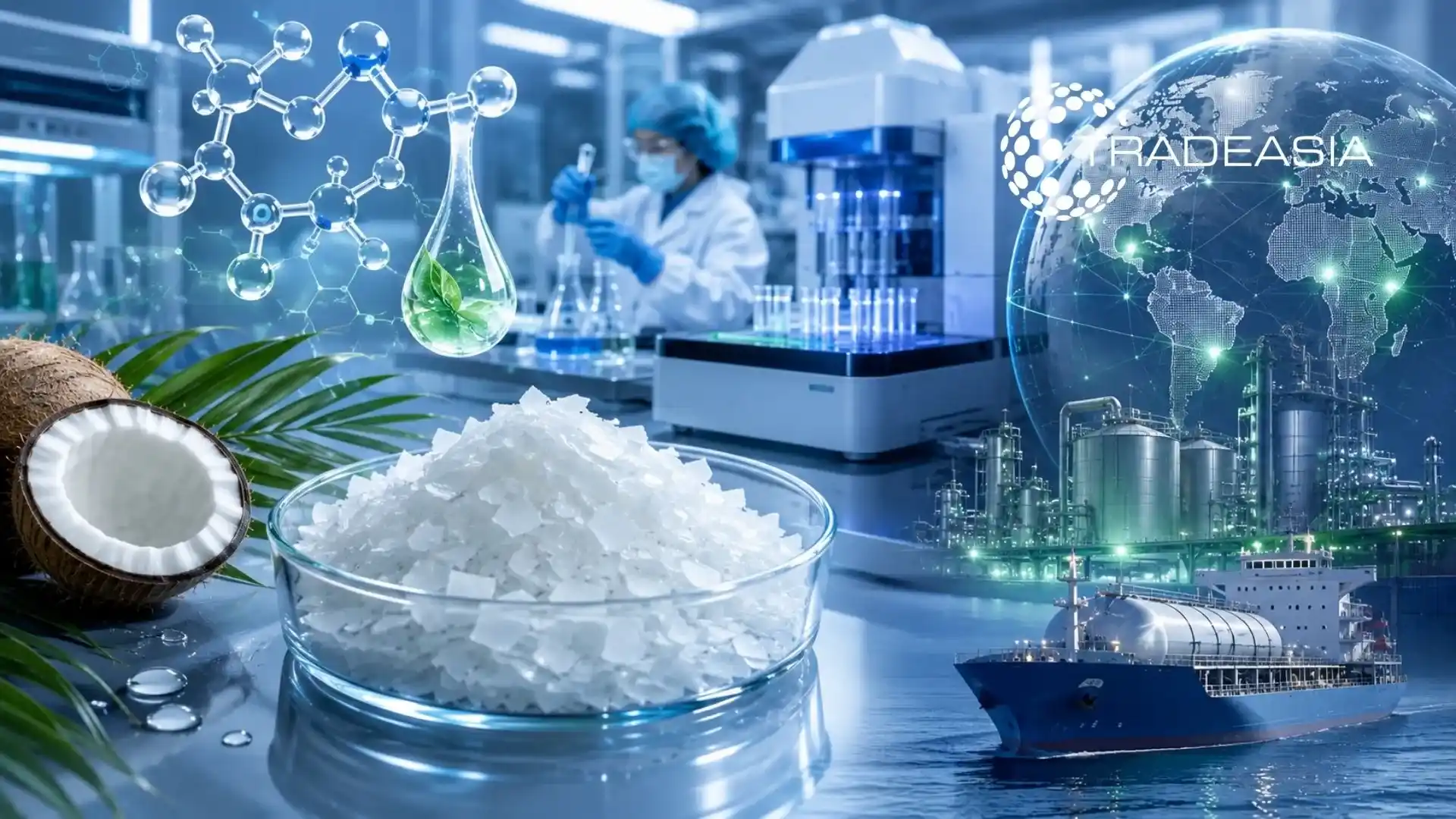
The global oleochemical industry is undergoing a structural shift as manufacturers, brand owners, and regulators converge on the need for more sustainable, bio-based raw materials. At the center of this transition is lauric acid, a C12 saturated fatty acid derived mainly from coconut oil and palm kernel oil. Its unique performance profile in surfactants, personal care formulations, lubricants, and food applications makes it one of the most strategic feedstocks in the broader oleochemicals value chain.
Between 2023 and 2026, the lauric acid market is expected to expand steadily, underpinned by rising demand for biodegradable surfactants, natural personal care products, and eco-friendly industrial cleaners. Industry estimates suggest that global lauric acid demand has been growing at roughly 4–5% CAGR, with Asia-Pacific accounting for more than half of consumption due to its strong base of oleochemical, detergent, and personal care manufacturers. This growth trajectory is reshaping supply chain strategies, from feedstock sourcing to logistics and supplier partnerships.
In this context, supply chain resilience, traceability, and cost optimization are becoming as critical as product performance. International distributors and solution providers such as chemtradeasia are playing a larger role in connecting producers in Southeast Asia and other origin markets with downstream users worldwide. Understanding how lauric acid supply chains will evolve toward 2026 is therefore essential for procurement managers, formulators, and business strategists across the chemicals and oleochemicals sectors.
The supply chain for industrial lauric acid begins with agricultural production, primarily of coconut and oil palm. Coconut oil and palm kernel oil are the main lauric-rich oils, typically containing 45–55% lauric acid. Major producing countries include Indonesia, the Philippines, and Malaysia for coconut and palm kernel oil, with emerging contributions from India, Vietnam, and parts of Africa. Fluctuations in weather patterns, labor availability, and land-use regulations in these regions have a direct impact on lauric acid availability and pricing.
Once harvested, the oils are processed in crushing and refining facilities before being sent to oleochemical plants for splitting and fractionation. In these facilities, triglycerides are hydrolyzed into free fatty acids and glycerin, and then distilled into specific cuts such as C8–C10, C12 lauric acid, and longer-chain fractions. Leading oleochemical producers in Southeast Asia, Europe, and China operate integrated complexes that supply lauric acid flakes, prills, and liquid forms to downstream formulators. Efficient coordination between plantations, crushers, refiners, and oleochemical plants is crucial to maintaining consistent quality and lead times.
From production hubs, lauric acid moves through a network of traders, distributors, and logistics providers via bulk tankers, ISO tanks, flexi-bags, and containerized solid forms. Supply chain complexity arises from the need to match specific grades, such as food grade, cosmetic grade, and technical grade—to regulatory requirements in different end markets. Multinational distributors like chemtradeasia aggregate volumes from multiple producers, manage quality documentation, and provide localized warehousing to reduce lead times for customers in regions such as Europe, North America, the Middle East, and Latin America.
Lauric acid is prized in oleochemical applications for its balance of chain length, melting behavior, and reactivity. Typically, industrial lauric acid has a carbon chain length of C12, a melting point around 43–46°C, and an iodine value close to zero, indicating full saturation. It exhibits good stability against oxidation and rancidity, making it suitable for long-shelf-life formulations. Acid values generally range from 280–290 mg KOH/g, and purity levels can exceed 99% for refined grades. These specifications are crucial for manufacturers of surfactants, esters, and specialty chemicals who require tight consistency from batch to batch.
In the oleochemical sector, lauric acid is a primary building block for the synthesis of fatty alcohols (such as C12–C14 alcohols), fatty acid methyl esters, and a variety of surfactants including sodium lauryl sulfate (SLS) and sodium lauryl ether sulfate (SLES). These derivatives are widely used in detergents, shampoos, dishwashing liquids, and industrial cleaners due to their strong foaming, emulsifying, and cleaning performance. Lauric-based surfactants often provide a desirable combination of mildness to skin and high detergency, which explains their prevalence in personal care and home care formulations.
Beyond surfactants, lauric acid plays an important role in food and pharmaceutical oleochemicals. It is used in the production of laurate esters for emulsifiers, release agents, and medium-chain triglycerides (MCTs) that are valued for quick energy release and specific nutritional applications. In industrial markets, lauric acid derivatives are employed in metalworking fluids, lubricants, plasticizers, and rubber processing aids. Compared with longer-chain fatty acids like stearic acid, lauric acid offers lower viscosity and better cold-flow properties in many ester systems, making it advantageous for applications that require quick spreading, rapid absorption, or performance at lower temperatures.
Looking ahead to 2026, several macro trends are shaping the market outlook for lauric acid in oleochemicals. First, the global shift toward sustainable and bio-based chemicals is expected to sustain demand, particularly in home and personal care, where consumers increasingly favor plant-derived ingredients and transparent supply chains. Regulatory initiatives in the European Union, such as the Green Deal and restrictions on certain petrochemical-based surfactants, are encouraging formulators to adopt lauric-based alternatives that offer biodegradability and lower environmental impact.
Second, volatility in upstream feedstock markets will remain a critical factor. Palm and coconut supply can be affected by El Niño and La Niña weather patterns, as well as by evolving land-use and deforestation policies. As governments and certification bodies tighten sustainability criteria, such as RSPO (Roundtable on Sustainable Palm Oil) and similar schemes for coconut, producers and buyers of lauric acid will need to invest in traceability systems and certified supply. Stakeholders increasingly expect lauric acid suppliers to demonstrate compliance with environmental, social, and governance (ESG) standards, which may add cost but also create differentiation opportunities.
Third, regional demand patterns are evolving. Asia-Pacific will likely continue to dominate lauric acid consumption due to its large detergent and personal care manufacturing base, but incremental growth is also expected in Africa and Latin America as urbanization and disposable incomes rise. Meanwhile, Europe and North America will focus more on high-value, specialty applications such as natural cosmetics, nutraceuticals, and high-performance industrial lubricants. For 2026, market analysts anticipate that specialty-grade lauric acid and its derivatives will outpace commodity growth, incentivizing producers and distributors like chemtradeasia to expand their portfolios of value-added grades and customized packaging solutions.
As supply chains become more complex, strategic sourcing of industrial lauric acid requires a careful balance of cost, reliability, quality, and sustainability. Procurement teams are moving beyond spot purchases to multi-year contracts, diversified supplier bases, and risk-sharing arrangements. A key strategy is to secure lauric acid from multiple origin countries and producers, thereby reducing exposure to localized disruptions. Another strategy is to work with global distributors who can consolidate volumes, provide buffer stocks, and manage logistics across multiple shipping lanes and regulatory regimes.
chemtradeasia is an example of a supply chain partner that operates at the intersection of producers and end-users in the lauric acid and oleochemicals markets. By sourcing from established manufacturers in Southeast Asia, India, and other regions, chemtradeasia can offer a range of lauric acid grades—technical, cosmetic, and food grade—to match diverse application requirements. The company’s role extends beyond simple trading: it coordinates quality control, documentation such as COAs and MSDS/SDS, and compliance with local import regulations, which is particularly valuable for small and mid-sized formulators entering new markets.
In practical terms, partnering with chemtradeasia can help buyers optimize inventory and working capital. Regional warehouses and just-in-time delivery models reduce the need for large on-site stocks, while flexible packaging, from bulk tankers and IBCs to 25 kg bags or jumbo bags, allows customers to align procurement with their production scales. Additionally, chemtradeasia’s market insight across multiple chemical categories enables procurement teams to benchmark lauric acid pricing, assess substitution options with other fatty acids, and make more informed decisions about long-term contracts versus spot purchases, particularly as the market approaches 2026.
Lauric acid’s central role in the oleochemical industry is set to strengthen as global markets prioritize sustainable, bio-based, and high-performance chemical ingredients. Its versatile performance in surfactants, esters, lubricants, and food-related applications ensures that demand will continue to grow across both developed and emerging economies. At the same time, supply chain dynamics—from agricultural production and certification requirements to logistics and regulatory compliance, will become more intricate, requiring closer collaboration among producers, distributors, and end-users.
By 2026, companies that proactively manage lauric acid sourcing, invest in traceability, and align formulations with evolving environmental and consumer expectations will be best positioned to capture value. Working with experienced supply chain partners such as chemtradeasia can provide the market intelligence, logistical flexibility, and product range needed to navigate volatility while maintaining consistent quality and competitive pricing. As the global oleochemicals landscape evolves, lauric acid will remain a cornerstone raw material, and strategic supply chain decisions taken today will have long-lasting implications for performance, cost, and sustainability.
This article is provided solely for informational and market insight purposes and does not constitute technical, safety, regulatory, or professional advice. Readers should independently verify all information with qualified experts, consult official documentation such as MSDS/SDS and applicable regulations, and contact our team or other competent professionals for guidance on specific products, processes, or applications.
We're committed to your privacy. Tradeasia uses the information you provide to us to contact you about our relevant content, products, and services. For more information, check out our privacy policy.


 English
 Indonesian
 简体字
简体字
 العربية
 Español
 Français
 Português
 日本語
日本語
 한국어
한국어
 Tiếng Việt