Explore our network of country and industry based websites to access localized information, product offerings, and business services across our group.

Access reliable chemical market information through our update channels.
Real-time Updates
Daily Updates
Log in to start sending quotation requests for any product.
Don't have an account? Sign Up Here
Home Palm Olein Supply Chain: Can It Meet Global ESG Standards in 2026?
Trade Insights | Supply Chain | 05 May 2026
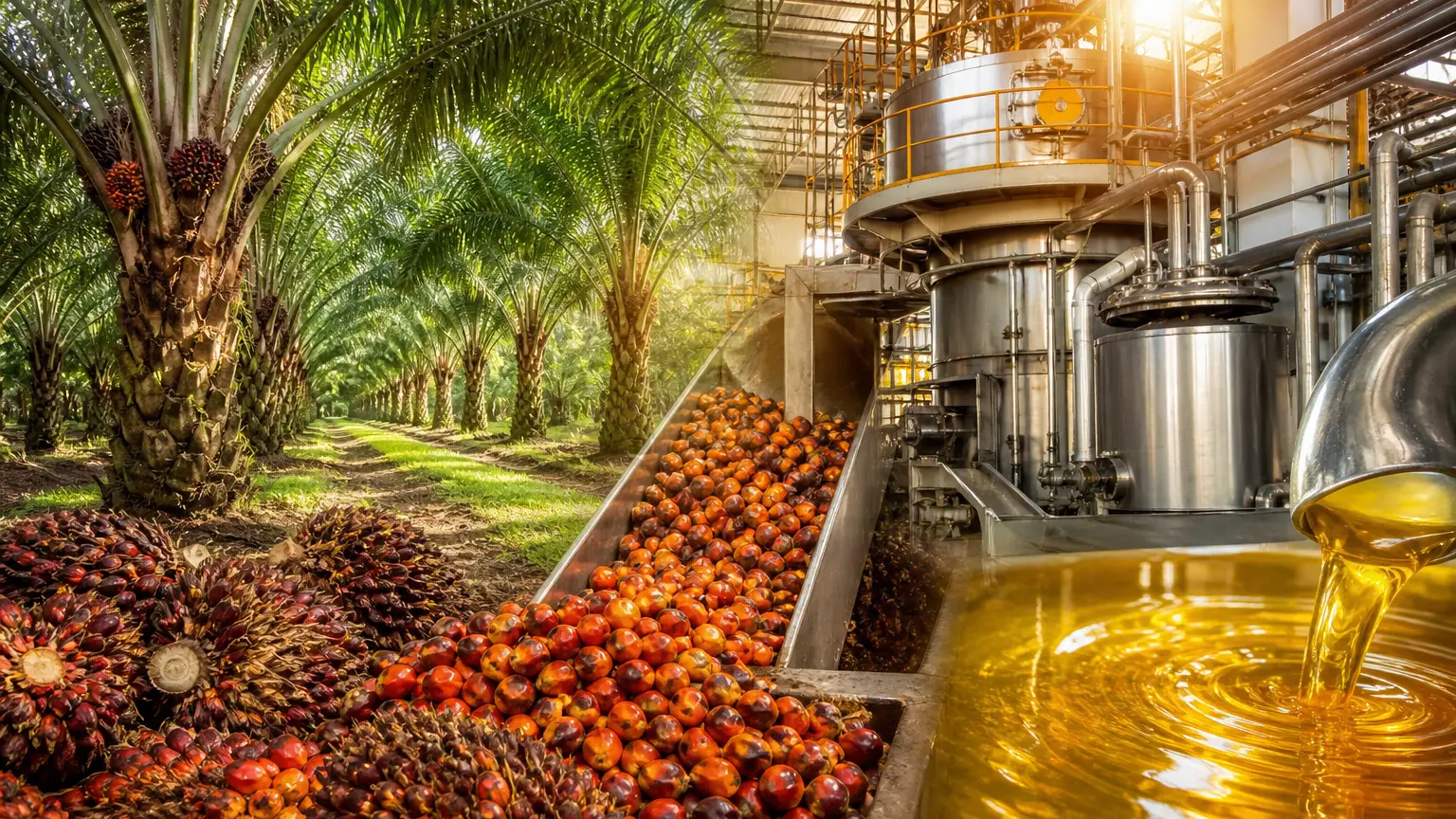
Palm olein is produced predominantly in Indonesia (~59% of global crude palm oil output) and Malaysia (~24%), which together control roughly 85% of the world's supply. In 2026, the critical barrier to ESG compliance is not mill-level certification but plantation-level traceability, particularly for the millions of smallholders who remain unregistered in formal supply chain systems. Buyers sourcing into EU-regulated markets face the most acute exposure.
Palm olein is the liquid fraction produced through the fractionation of refined crude palm oil (CPO). Indonesia and Malaysia are the origin point for nearly all globally traded RBD (Refined, Bleached, Deodorized) Palm Olein, with key export hubs at Dumai and Belawan in Sumatra and Port Klang on Malaysia's west coast. This concentration means buyers worldwide whether in Germany, India, or Saudi Arabia draw from the same upstream base, and whatever ESG liability exists in those Sumatran or Bornean plantations travels downstream with every shipment.
Indonesia's CPO production is projected to recover by 1.5–2.0 million tonnes from 2024 levels, according to Fastmarkets, supported by improved weather and fertilizer application cycles. Malaysia, by contrast, faces structural constraints: stagnating oil palm area at approximately 5.6 million hectares, an aging tree base, and continued dependence on foreign harvest labor. Neither country is on a path of unrestricted supply expansion, which means ESG-compliant sourcing competes for a limited certified supply pool.
The commodity's ESG complexity is significant. Approximately 63% of all Land Use and Biodiversity Supply Chain incidents tracked in Sustainalytics' Controversies research as of late 2025 are linked to palm oil. In July 2025, Rainforest Action Network alleged that the palm oil supply chains of Wilmar, PepsiCo, Mondelez, and Nestlé could be connected to illegal land degradation in Indonesia's protected Rawa Singkil Wildlife Reserve. For palm olein buyers, this is not a peripheral concern, it is the baseline reputational environment within which every procurement decision is made.
The EU Deforestation Regulation (EUDR) is the single most consequential regulatory shift affecting palm olein supply chains entering 2026. Its core requirement is absolute: palm-derived products placed on EU markets must be traceable to their exact cultivation site and must not originate from land deforested after December 31, 2020.
The European Commission proposed a second compliance deadline extension, now targeting December 30, 2026 for large and medium enterprises, and June 30, 2027 for smaller companies. This deferral creates short-term planning uncertainty, but the core obligations remain intact. Buyers who treat the delay as a reason to slow traceability investment are misreading the regulatory direction.
RSPO and MSPO certification alone is insufficient for EUDR compliance. As the Netherlands Food and Consumer Product Safety Authority's (NVWA) EUDR dry run highlighted, certifications support due diligence but do not replace an operator's legal obligation to demonstrate full supply chain compliance. The EUDR requires geo-location polygon data for every farm plot — and in the palm oil supply chain, the majority of smallholder farms are not yet mapped. Traders frequently receive only mill lists with no downstream farm-origin data attached.
For RBD Palm Olein specifically, Presidential Regulation No. 16/2025 in Indonesia extends ISPO's scope explicitly to the downstream supply chain, including refining and trading of palm olein. This means Indonesian exporters face mandatory ISPO compliance across the full value chain, not just at the plantation gate.
The most acute and underestimated ESG risk in palm olein supply chains in 2026 is the smallholder traceability gap. More than 40% of Indonesia's oil palm area is cultivated by independent smallholders, yet most remain outside formal certification and traceability systems. As of November 2025, only 39.8% of Indonesia's total palm area held mandatory ISPO certification, with independent smallholders accounting for approximately 1% of the certified area — roughly 67,000 hectares out of the national total.
This matters directly for palm olein procurement because CPO from certified large estates and CPO from uncertified smallholder plots frequently enters the same mill. Informal intermediaries collect fresh fruit bunches, combine them in a single batch, and deliver to mills that may themselves hold RSPO Mass Balance certification. The result: a certified supply chain label attached to a physically mixed feedstock. Buyers relying on Mass Balance certificates as their primary ESG evidence are carrying more uncertified exposure than they typically disclose.
Preparation costs for smallholder ISPO compliance are estimated at up to IDR 115 million per group — a prohibitive figure for most independent farmers without external support. Digital traceability platforms such as KoltiTrace and Satelligence (deployed by PepsiCo in 2024) are helping to integrate smallholders into traceable supply chains, but adoption remains uneven and concentrated among large corporate supply shed programs.
The practical implication for palm olein procurement: Segregated (SG) and Identity Preserved (IP) supply chains carry measurably lower ESG risk than Mass Balance contracts, but SG material is in limited supply. Buyers that require full plantation-level traceability must contract early, pay a sourcing premium, and work with refiners who operate direct plantation linkages.
| Risk Dimension | Rating | Primary Trigger |
|---|---|---|
| Concentration Risk | HIGH | Indonesia + Malaysia = ~85% of supply; limited origin diversification |
| Smallholder Traceability | HIGH | 40%+ of Indonesian area uncertified; EUDR plot-level mapping absent |
| Regulatory / Market Access | HIGH | EUDR December 2026 deadline; ISPO downstream scope expansion |
| Deforestation Linkage | MEDIUM–HIGH | July 2025 Leuser Ecosystem allegations; peatland conversion risk |
| Social / Labor | MEDIUM | Forced labor findings in select Indonesian and Malaysian supply chains |
The market is bifurcating. One track serves price-sensitive buyers in Asia and Africa who absorb conventional palm olein with minimal sustainability premiums. A second, increasingly segregated track serves regulated and consumer-conscious markets in Europe and North America, where CSPO certification and EUDR-compliant traceability are becoming baseline requirements for supplier qualification, not differentiators.
Major FMCG buyers — including Nestlé, Unilever, Mondelez, General Mills, and PepsiCo — have hardened their supplier scorecard requirements. Retailer-led sourcing policies increasingly make CSPO certification a mandatory condition for private-label supply contracts, not a voluntary signal. General Mills reported that 95% of its palm oil volume was traceable to the extraction mill and 90% traceable to the plantation level as of 2024 — but the remaining gap is where ESG liability concentrates.
For procurement teams, three actions distinguish leading ESG buyers in 2026. First, shift volume toward Segregated or Identity Preserved supply chains rather than Mass Balance, even at a CFR premium. Second, require suppliers to provide geo-referenced mill and plantation data as part of CoA documentation, not as an audit-only request. Third, build smallholder inclusion into supplier development programs, because traceable smallholder supply is the structural bottleneck for the entire certified market — no FMCG company will reach deforestation-free sourcing goals without solving it upstream.
The sustainable palm olein market enters 2026 as a compliance-driven segment transitioning toward a baseline expectation in Western markets. Buyers who have already invested in traceability infrastructure and certified supply agreements are better positioned to avoid supply disruption when EUDR enforcement tightens. Those still relying on RSPO credits or Mass Balance certificates as primary documentation face growing exposure — regulatory, reputational, and commercial.
Q: What is palm olein and how is it different from crude palm oil?
A: Palm olein is the liquid fraction produced when crude palm oil is refined and then fractionated using controlled cooling. The solid fraction becomes palm stearin. RBD Palm Olein is the form traded globally — refined, bleached, and deodorized — and is the primary ingredient in cooking oils, food frying, and downstream food manufacturing across Asia and the Middle East.
Q: Who are the largest palm olein producers and exporters?
A: Indonesia and Malaysia together account for approximately 85% of global palm oil output. Indonesia contributes roughly 46 million tonnes of CPO annually and Malaysia approximately 19–20 million tonnes. Both countries export significant volumes of RBD Palm Olein, primarily through Port Klang, Dumai, and Belawan, to major import markets in India, China, Pakistan, and the EU.
Q: What is the EUDR and how does it affect palm olein buyers?
A: The EU Deforestation Regulation (EUDR) prohibits palm oil and its derivatives from entering EU markets if linked to deforestation after December 31, 2020. It requires full farm-level traceability with geo-referenced polygon data. The compliance deadline for large companies is now targeted at December 30, 2026. Certification schemes like RSPO support compliance but do not replace an operator's legal due diligence obligation under the regulation.
Q: What is the smallholder traceability problem in palm olein supply chains?
A: More than 40% of Indonesia's oil palm land is managed by independent smallholders, most of whom remain unregistered and outside formal traceability systems. Their fresh fruit bunches frequently enter the same mills as certified estate CPO, making it difficult to trace specific palm olein shipments to their plantation of origin. As of late 2025, independent smallholders accounted for roughly 1% of Indonesia's ISPO-certified area.
Q: What procurement strategy best manages palm olein ESG risk in 2026?
A: Buyers targeting EU-regulated or ESG-sensitive markets should prioritize Segregated or Identity Preserved RSPO supply over Mass Balance contracts, contract supplier volume early given limited certified availability, require geo-referenced plantation data in supplier documentation, and support smallholder certification programs in their supplier development activities.
We're committed to your privacy. Tradeasia uses the information you provide to us to contact you about our relevant content, products, and services. For more information, check out our privacy policy.


 English
 Indonesian
 简体字
简体字
 العربية
 Español
 Français
 Português
 日本語
日本語
 한국어
한국어
 Tiếng Việt



















