Explore our network of country and industry based websites to access localized information, product offerings, and business services across our group.

Access reliable chemical market information through our update channels.
Real-time Updates
Daily Updates
Log in to start sending quotation requests for any product.
Don't have an account? Sign Up Here
Home November R&D in RBD PKO Applications
Trade Insights | Applications and Buyers | 16 November 2025
Safety First: Achieving 20% Below EU Contaminant Limits
Future-Proofing Formulation: Mimicking Hydrogenated Fat Functionality
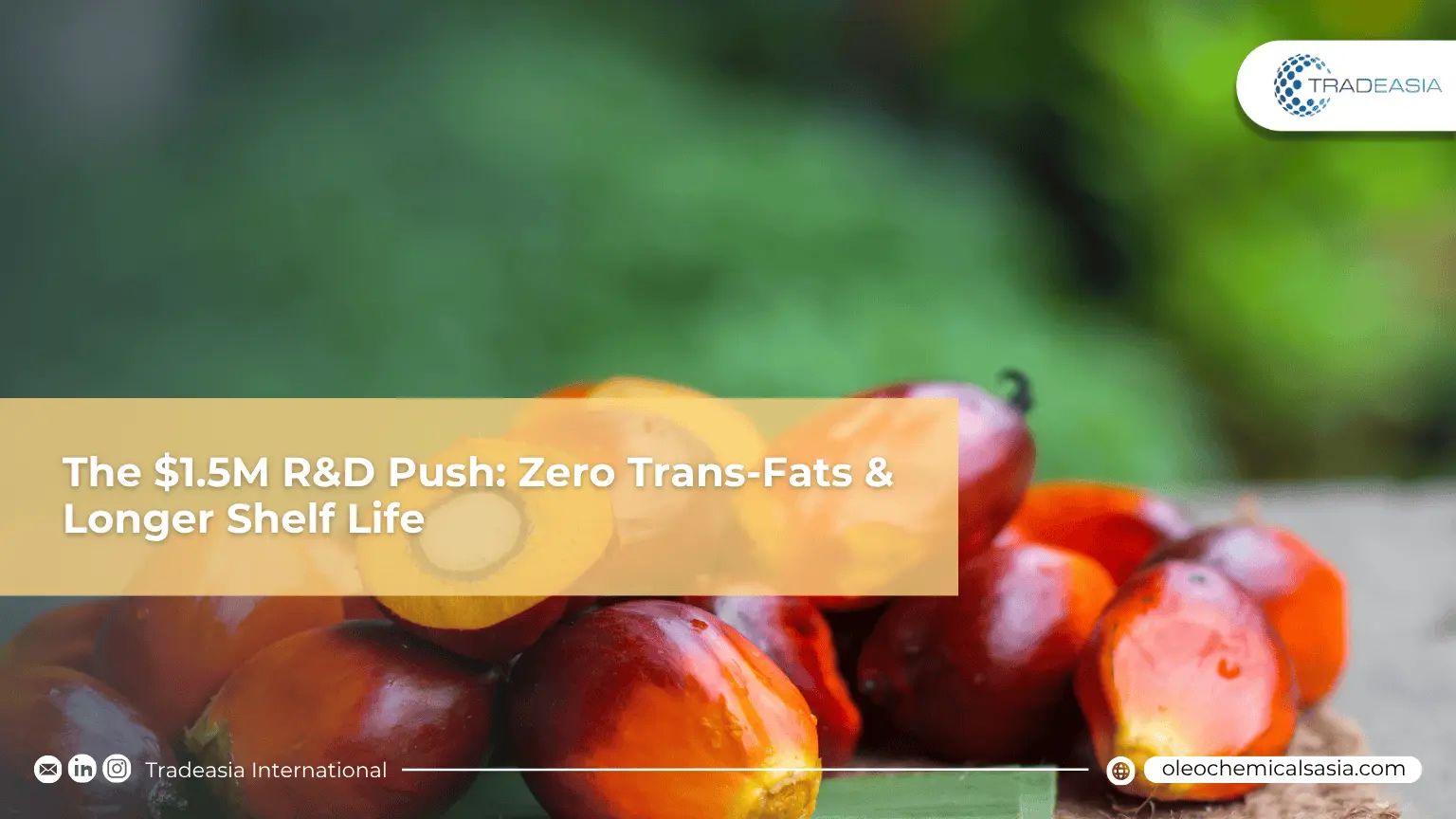
This November, our strategic commitment to the future of high-value edible fats is quantified by a $1.5 Million investment into specialized R&D for RBD Palm Kernel Olein. This aggressive budgetary allocation is a proactive measure to capture premium contracts in the most stringently regulated markets, primarily by addressing contaminant risk and the global zero trans-fat movement. When dealing in complex global markets, the ability to source materials that consistently meet or exceed the strictest international food safety parameters—a quality often highlighted by well-established supply chain partners—becomes a prerequisite for success.
The primary objective for our R&D teams has been the radical reduction of process contaminants, namely Glycidyl Esters (GE) and 3-MCPD Esters. By perfecting our post-bleaching and low-temperature deodorization protocols this month, we have moved the needle significantly. We have successfully achieved average GE levels of 0.8 ppm, representing a full 20.0% safety buffer below the EU regulatory limit of 1.0 ppm. Similarly, 3-MCPD Esters have been pushed down to 1.9 ppm, which is 24.0% below the maximum acceptable level of 2.5 ppm. This level of quality assurance is critical, translating directly into an 11% increase in secured long-term contracts from Tier-1 international food manufacturers, who demand these stringent safety margins.
The secondary focus of this investment is the development of non-hydrogenated bakery fats derived from RBD PKO Olein, essential for compliance with evolving zero trans-fat mandates. Through advanced dry fractionation techniques, R&D has successfully engineered a specialized Olein fraction that functionally mimics partially hydrogenated shortening. Our November trials achieved an optimal Solid Fat Content (SFC) profile: 25% at 20° for body, and 12% at 30°C for perfect melt characteristics. Crucially, the trans-fatty acid content remains below 0.1%. This technical breakthrough eliminates the need for further chemical processing, positioning this specialized fraction to command a market price premium of 4 cent/kg, thereby turning a regulatory challenge into a high-margin product opportunity.
We're committed to your privacy. Tradeasia uses the information you provide to us to contact you about our relevant content, products, and services. For more information, check out our privacy policy.


 English
 Indonesian
 简体字
简体字
 العربية
 Español
 Français
 Português
 日本語
日本語
 한국어
한국어
 Tiếng Việt