Explore our network of country and industry based websites to access localized information, product offerings, and business services across our group.

Access reliable chemical market information through our update channels.
Real-time Updates
Daily Updates
Log in to start sending quotation requests for any product.
Don't have an account? Sign Up Here
Home Why FMCG Giants are Redrawing the Lauric Acid Procurement Map in 2026
Trade Insights | Applications and Buyers | 30 March 2026
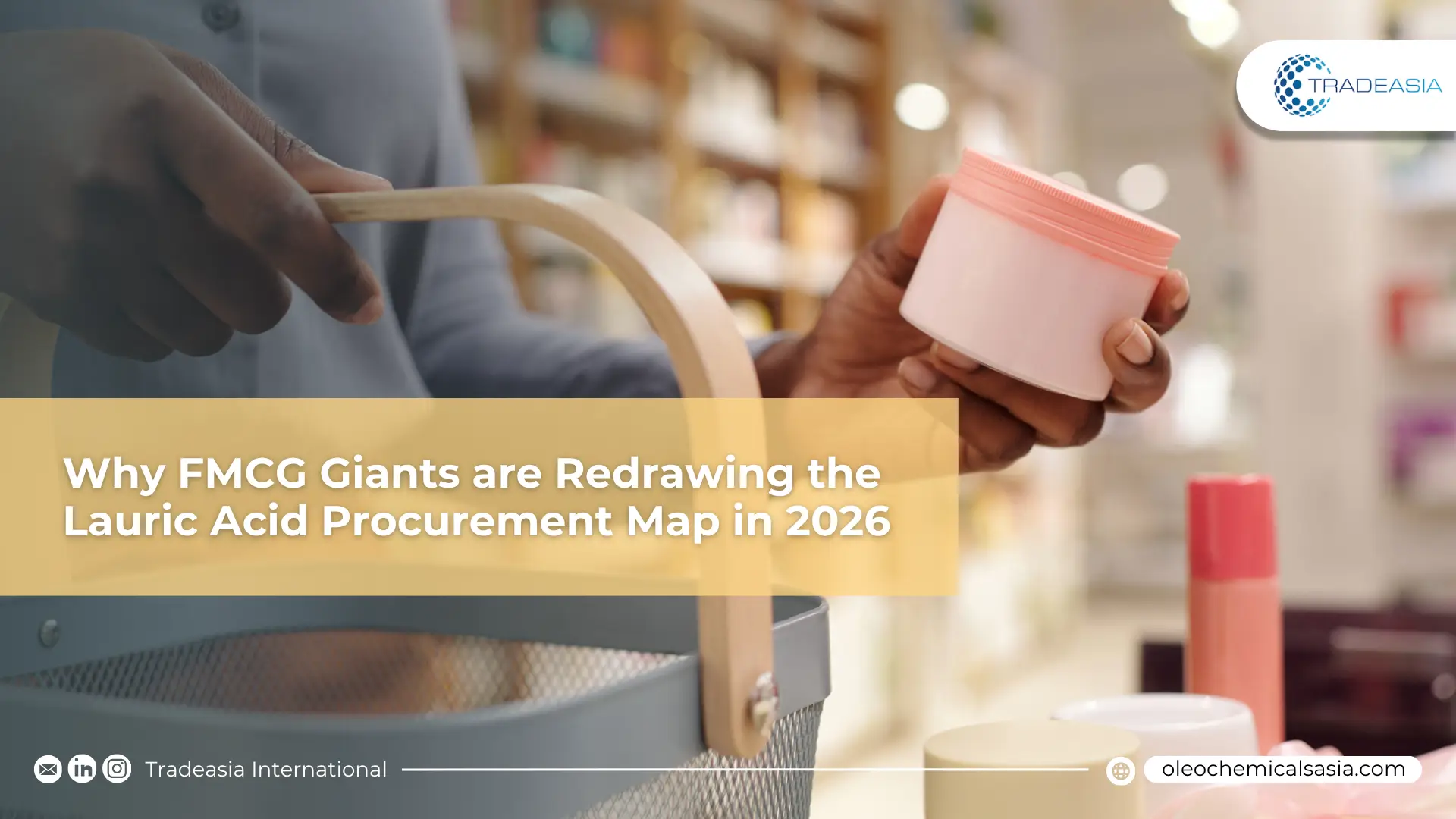
The procurement landscape for Lauric Acid has shifted from a simple volume-and-price exercise into a complex strategic maneuver centered on "Green Chemistry" credentials. As we move through 2026, the traditional transactional relationship between Southeast Asian oleochemical producers and global Consumer Packaged Goods entities has been replaced by long-term, transparency-heavy partnerships. Large-scale buyers in the personal care and pharmaceutical sectors are no longer just looking for a C12 fraction; they are seeking a carbon-neutral feedstock that facilitates their transition toward 100% bio-based formulations. This shift is driven by a combination of consumer pressure and tightening environmental regulations in the EU and North America, forcing a restructuring of how high-purity Lauric Acid is sourced and utilized in the global market.
One of the most significant trends observed this year is the massive transition toward bio-surfactants, where Lauric Acid serves as a foundational building block. Major FMCG players have accelerated their phase-out of petroleum-derived surfactants, leading to a surge in demand for sodium lauryl sulfate and sodium laureth sulfate derived exclusively from plant-based C12. In early 2026, market data indicates that the demand for high-purity Lauric Acid for surfactant applications has grown by 12% year-on-year. This is not merely a replacement of old ingredients but a redesign of product performance, where eco-surfactants are expected to provide superior mildness and biodegradability. Producers in Indonesia and Malaysia are seeing a shift where buyers are willing to pay a premium for "low-carbon footprint" batches, often verified through real-time lifecycle assessment data provided at the point of sale.
The pharmaceutical and high-end cosmetic sectors are carving out a specialized niche for ultra-high-purity Lauric Acid, particularly in the development of eco-emollients and drug delivery systems. We are seeing a 2026 market reality where pharmaceutical-grade Lauric Acid is trading at a significant markup compared to industrial grades, often exceeding 1,600 USD per Metric Ton. These buyers are focused on the stability and sensory profiles of their final products, requiring a C12 chain that is free from cross-contamination and boasts a narrow carbon distribution. The growth in "clean beauty" has turned Lauric Acid into a star ingredient for esterification, creating bio-based emollients that mimic the skin-feel of synthetic silicones without the environmental baggage. This specific application is expected to see a compound annual growth rate of 8.5% over the next three years, particularly as regional markets in Asia-Pacific increase their domestic consumption of premium skincare.
Procurement teams at major multinationals are no longer operating on a quarterly spot-buying basis but are instead locking in multi-year supply agreements that include strict ESG clauses. By mid-2026, the "Green Chemistry" mandate has become a non-negotiable prerequisite for entering the supply chains of the world’s top twenty FMCG companies. This has led to a bifurcation of the Lauric Acid market: a premium tier that is fully traceable and a secondary tier for less regulated markets. To ensure continuity, buyers are increasingly investing in joint ventures with Southeast Asian mills to secure "first-right" access to sustainable kernels. This vertical integration is a direct response to the supply tightness seen in late 2025, where those without dedicated supply lines were forced to pay exorbitant spot prices or face production halts.
Beyond the bathroom cabinet and the medicine chest, 2026 has seen Lauric Acid penetrate deeper into industrial sectors that were previously dominated by synthetics. We are witnessing the expansion of Lauric-based metallic soaps and lubricants that cater to the automotive and plastics industries. As these sectors face their own "green" pressure, they are turning to the C12 chain for its unique lubricating properties and thermal stability. While the volumes here are currently lower than in the detergent sector, the growth trajectory is steep. Companies are finding that Lauric Acid derivatives offer a renewable alternative that doesn't sacrifice technical performance, proving that sustainability and industrial efficiency are not mutually exclusive. This diversification of the buyer base is providing a much-needed hedge for producers against the cyclicality of the household cleaning market.
As we look toward the end of 2026, the most successful Lauric Acid buyers are those who treat their suppliers as innovation partners rather than just vendors. This collaborative approach involves sharing R&D roadmaps to ensure that the oleochemical refineries can adjust their fractionation processes to meet future specification needs. For instance, the demand for specific Lauric Acid blends that optimize foaming in cold-water laundry detergents is a direct result of such partnerships. By aligning technical requirements with agricultural realities in Southeast Asia, the industry is creating a more resilient and responsive ecosystem. This evolution marks the end of the "commodity era" for Lauric Acid, ushering in a period where the value is defined by the environmental and functional intelligence embedded within every Metric Ton shipped.
Sources:
We're committed to your privacy. Tradeasia uses the information you provide to us to contact you about our relevant content, products, and services. For more information, check out our privacy policy.


 English
 Indonesian
 简体字
简体字
 العربية
 Español
 Français
 Português
 日本語
日本語
 한국어
한국어
 Tiếng Việt



















