Explore our network of country and industry based websites to access localized information, product offerings, and business services across our group.
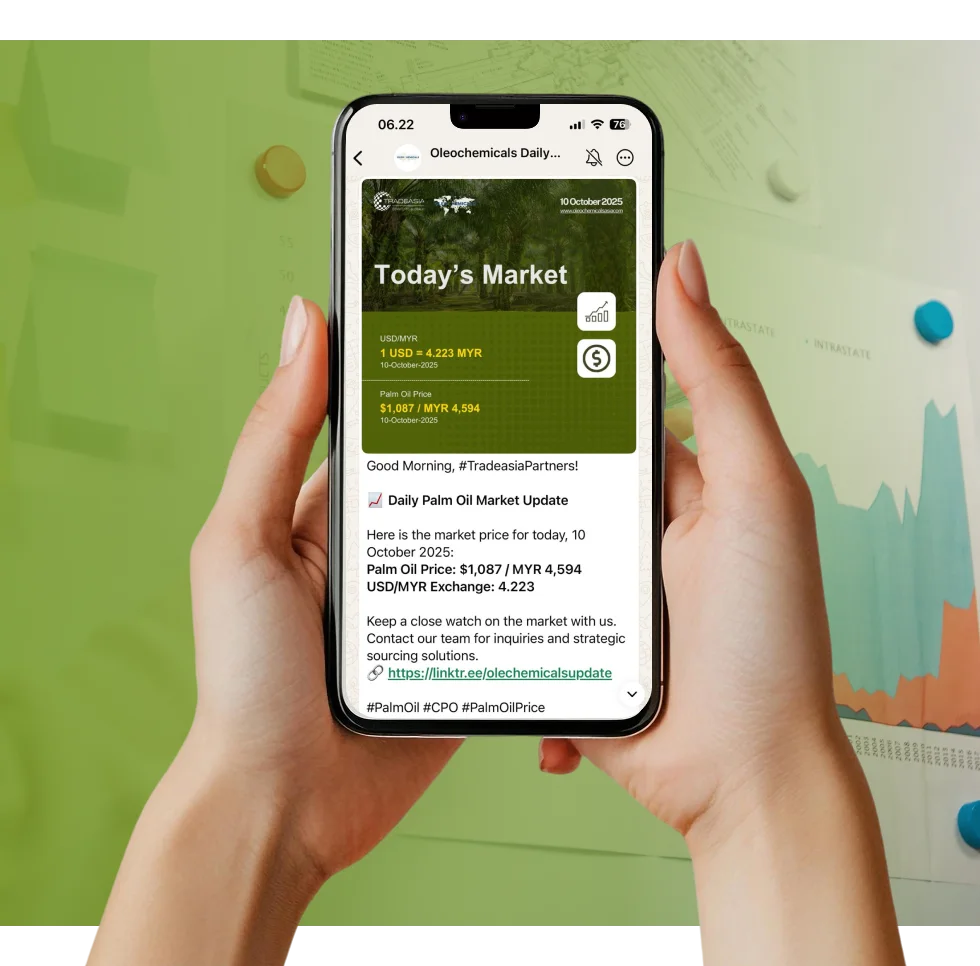
Access reliable chemical market information through our update channels.
Real-time Updates
Daily Updates
Log in to start sending quotation requests for any product.
Don't have an account? Sign Up Here
Home Certified Palm: The Key to Sustainable SLES
Trade Insights | Regulatory and Compliance | 02 October 2025
From a Bio-Based Edge to a Business Imperative
From Commodity to Corporate Responsibility
In the forward-thinking landscape of late 2025, the conversation around the sustainability of Sodium Lauryl Ether Sulphate (SLES) has matured. The question is no longer if it can be sustainable, but how its green credentials are verified, a conversation that begins and ends at the source of its primary raw material. For companies committed to credible environmental reporting, a traceable and certified supply chain is non-negotiable. At Tradeasia International, we are dedicated to building that chain, connecting our clients with the certified sustainable palm oleochemicals that are foundational to the next generation of green chemistry.
The case for using a bio-based feedstock is built on irrefutable data. Fatty alcohol derived from certified sustainable palm sources boasts a 50-75% lower carbon footprint than its petroleum-based equivalent, a massive advantage driven by palm's unparalleled land-use efficiency—producing 4 to 10 times more oil per hectare than other oilseeds. This bio-based edge is now a business imperative. With the traceable supply of certified sustainable palm oil (CSPO) now exceeding 20% of total global production, and over 90% of the world's top consumer goods companies committed to 100% certified sourcing, the market has spoken.
This corporate-led demand is the engine behind the entire $15 billion bio-surfactants market. As one supply chain expert aptly put it, "in this new era, your sustainability claim is only as strong as your most transparently sourced ingredient." For SLES, this means its future as a leading sustainable surfactant is intrinsically linked to the integrity of its palm source. It’s a connection that transforms a simple commodity into a verifiable statement of corporate responsibility.
We're committed to your privacy. Tradeasia uses the information you provide to us to contact you about our relevant content, products, and services. For more information, check out our privacy policy.


 English
 Indonesian
 简体字
简体字
 العربية
 Español
 Français
 Português
 日本語
日本語
 한국어
한국어
 Tiếng Việt



















