Explore our network of country and industry based websites to access localized information, product offerings, and business services across our group.

Access reliable chemical market information through our update channels.
Real-time Updates
Daily Updates
Log in to start sending quotation requests for any product.
Don't have an account? Sign Up Here
Home Oleic Acid Sourcing Outlook June 2026
Trade Insights | Supply Chain | 12 June 2026
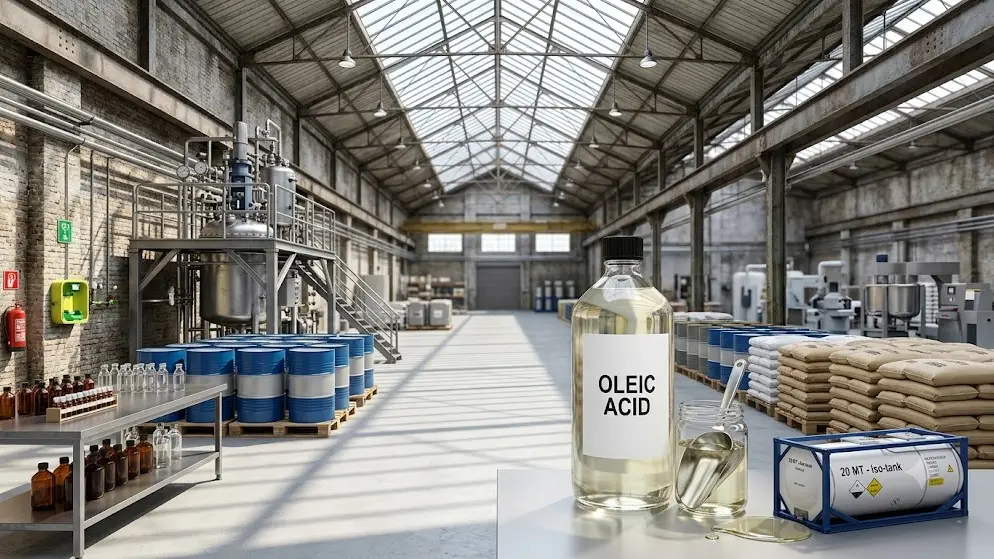
Oleic Acid Market Positioning in Week 2 June 2026
Vegetable Oil Feedstock and Procurement Exposure
Oleochemical Production Hubs and Trade Flow
Downstream Demand from Personal Care and Lubricants
Specification, Grade, and Fatty-Acid Composition
Packaging, Shipment Route, and Logistics Reliability
Supplier Documentation and Landed-Cost Control
Strategic Outlook for Oleic Acid Buyers
In week 2 of June 2026, the oleic acid supply chain should be assessed through vegetable-oil feedstock availability, oleochemical production capacity, regional export competitiveness, and buyer demand from industrial formulation sectors. According to FAO-linked reporting on May 2026 food commodity prices, the vegetable oil price index declined by 4.6% from April, mainly because palm and soybean oil prices softened. For oleic acid buyers, this creates negotiation space, but it does not remove the need to monitor origin, specification, shipment route, and supplier reliability.
Oleic acid sourcing depends on the availability and economics of vegetable oils such as palm oil, sunflower oil, olive oil, and other high-oleic oil streams. A weaker vegetable-oil index can improve cost sentiment for fatty-acid buyers, but the actual offer still depends on local stock, fatty-acid split, processing cost, logistics, and export timing. Buyers evaluating Oleic Acid 75% Min Malaysia should therefore compare origin strength, packaging, and shipment readiness instead of using feedstock price movement as the only signal.
The strongest oleic acid procurement strategy in June 2026 should focus on total delivered value. Spot price comparison is useful, but it can hide differences in oleic content, linoleic level, appearance, packaging, freight mode, and supplier response time. Importers, distributors, cosmetic manufacturers, lubricant producers, surfactant formulators, and chemical procurement teams need to align technical suitability with commercial timing before confirming volume.
The commercial implication for week 2 of June 2026 is that oleic acid product availability may improve when vegetable oil prices soften, but availability still depends on regional stock and production flow. Buyers should not assume that a broad feedstock decline automatically creates immediate delivered-cost savings. In the oleic acid oleochemical market, the winning sourcing approach is to combine feedstock monitoring with supplier qualification, logistics planning, and landed-cost discipline.
Oleic acid is closely tied to vegetable-oil availability because it is a fatty acid naturally present in many plant and animal fats and oils. According to scientific and industrial references on oleic acid, it is a monounsaturated omega-9 fatty acid found in vegetable oil streams and used in foods, soaps, cosmetics, pharmaceuticals, and emulsifying systems. For B2B buyers, this means oleic acid sourcing should be reviewed as part of the broader vegetable-oil and oleochemical value chain.
FAO-linked reporting for May 2026 showed that vegetable oil prices declined mainly because palm and soybean oil markets softened. This gives oleic acid buyers a useful procurement signal because palm-based fatty-acid supply is a major part of Asian oleochemical trade. However, buyers should still monitor whether lower feedstock values are reflected in supplier offers, because conversion cost, plant allocation, and freight can slow the pass-through from vegetable oil to finished fatty acid.
Different vegetable oil origins can influence the fatty-acid composition and commercial positioning of oleic acid. Palm-based oleochemical flow is important for Asian supply, while sunflower, olive, canola, and other high-oleic streams can matter for certain formulation needs or regional preferences. Buyers comparing Oleic Acid 72% Min should assess whether the specification fits the intended application rather than assuming all oleic acid grades perform the same way.
A softer vegetable-oil index may improve negotiation space, but feedstock volatility still creates quotation risk. If palm or soybean oil prices move again after a buyer delays confirmation, suppliers may adjust offer validity or revise shipment terms. In June 2026, procurement teams should treat vegetable-oil movement as a timing indicator for negotiation, not as a guarantee of stable oleic acid pricing.
The oleic acid trade flow is strongly influenced by oleochemical production hubs in Asia, especially where palm oil refining, fatty-acid splitting, distillation, and downstream derivative production are concentrated. According to oleochemical industry references, triglyceride splitting and fatty-acid processing are core routes for producing fatty acids used in detergents, personal care, lubricants, solvents, and biobased materials. This makes regional production capability a key factor in oleic acid product availability.
Southeast Asian oleochemical production benefits from proximity to palm oil and palm-based feedstock streams. Malaysia and Indonesia remain important to the broader palm and oleochemical value chain, creating strong regional relevance for oleic acid buyers in Asia, the Middle East, Africa, and other import-dependent markets. Buyers that rely on oleic acid import export flows should therefore monitor regional export competitiveness, port schedules, and supplier allocation before confirming purchase orders.
Oleochemical producers may allocate fatty-acid output based on feedstock economics, customer commitments, tank availability, and derivative demand. If downstream demand rises from personal care, surfactants, lubricants, or coatings, available spot volume can tighten even when feedstock prices are softer. Buyers reviewing Oleic Acid 75% Min should confirm whether the offered stock is ready for shipment, pending production, or dependent on the next available loading cycle.
Oleic acid buyers compete not only by price but also by destination, lead time, payment readiness, and specification clarity. Importers and distributors with complete inquiry details often receive more practical offers because suppliers can evaluate volume, packaging, route, and document requirements more quickly. In June 2026, regional stock availability may become a stronger advantage than waiting for a slightly lower price that cannot be delivered on time.
Oleic acid demand remains supported by personal care, lubricants, surfactants, coatings, resins, plasticizers, food processing, and chemical manufacturing. According to market commentary from IMARC, demand growth from personal care, food processing, lubricants, and chemical manufacturing is a key driver for oleic acid. This demand base keeps oleic acid buyers exposed to both consumer-facing formulation trends and industrial manufacturing cycles.
Personal care manufacturers use oleic acid and oleate derivatives for emollient, emulsifying, conditioning, and formulation-support functions. When cosmetic and skincare demand remains stable, buyers need consistent oleic acid grade, appearance, odor profile, and technical documentation. A lower price is not enough for this segment if the supplier cannot support repeat quality and formulation compatibility.
Lubricant producers and surfactant formulators use oleic acid because its fatty-acid structure supports derivative chemistry, surface activity, and performance modification. In cleaning and industrial formulation systems, oleic acid can support emulsifying, dispersing, or surface-tension-related functions through oleate chemistry. For these oleic acid buyers, procurement risk is tied to specification consistency and supplier reliability because small formulation changes can affect finished-product performance.
Coatings, resins, and plasticizer producers use fatty-acid chemistry as part of broader formulation and processing systems. When industrial manufacturing demand improves, these sectors can add volume pressure to oleic acid sourcing. This means procurement teams should follow not only vegetable oil prices but also downstream production signals from coatings, resins, plasticizers, and chemical intermediates.
Oleic acid specification is central to procurement because buyers may need different grades depending on formulation, processing, appearance, and application requirements. According to Chemtradeasia product information, oleic acid pages list identifiers such as CAS number 112-80-1, HS code 38231200 or 3823.12.00, formula C18H34O2, appearance, packaging, and technical document access. These details help connect commercial offers with quality, logistics, and application suitability.
Oleic content is not just a label; it determines how the material behaves in downstream applications. A 72% minimum grade and a 75% minimum grade can both be commercially useful, but they may serve different buyer priorities depending on linoleic acid level, stearic acid level, appearance, and formulation tolerance. Procurement teams should compare specification sheets before switching grade or origin.
Cosmetic buyers may prioritize appearance, odor, and emollient performance, while lubricant and industrial buyers may focus on acid value, iodine value, fatty-acid profile, and derivative suitability. Food processing and pharmaceutical-related users may require additional review depending on intended use and regulatory context. This makes oleic acid procurement strategy more technical than a simple commodity comparison.
Supplier quality control matters because inconsistent fatty-acid composition can affect production behavior. A buyer may accept a lower offer, but if the oleic acid does not match approved formulation parameters, the total cost can rise through rework, delay, or rejected batches. In June 2026, buyers should require specification clarity before confirming orders, especially when changing from one origin or supplier to another.
Oleic acid logistics can materially affect delivered value because packaging format, liquid handling, freight mode, and shipment route influence cost and execution risk. Based on Drewry’s 04 June 2026 World Container Index assessment, container spot rates rose sharply as early peak-season demand strengthened major trade lanes. Even when oleic acid uses isotank, flexibag, or drum movements rather than standard dry cargo, broader freight pressure still affects shipment planning and landed-cost expectations.
Packaging should match the buyer’s volume, storage, unloading capability, and consumption rate. Chemtradeasia product pages show examples such as 20 MT isotank packaging for Oleic Acid 75% Min Malaysia, 180 kg drums for Oleic Acid 72% Min, and flexibag loading for another 75% minimum grade. The right packaging decision can reduce handling cost, improve storage efficiency, and lower the risk of operational disruption.
Shipment route matters because oleic acid import export flows may involve different lead times, port charges, documentation steps, and local transport costs. A buyer with urgent demand may prefer a route with stronger delivery reliability, even if the base product price is slightly higher. In week 2 of June 2026, oleic acid logistics should be evaluated through shipment certainty and delivered cost, not just freight quotation.
A landed logistics review should include product price, packaging, local transport, export charges, ocean freight, insurance, destination handling, customs duty, taxes, warehouse cost, and financing impact. When vegetable oil prices soften, buyers may focus too much on product negotiation and underweight logistics exposure. This can weaken procurement outcomes if freight and handling costs absorb the expected feedstock-linked savings.
Supplier documentation is a core part of oleic acid sourcing because technical, quality, logistics, and safety teams need reliable product information before approval. According to Chemtradeasia product pages, oleic acid listings provide technical document access, product identity details, packaging information, and industry classification under oleochemicals. For B2B buyers, this documentation supports internal approval and reduces the risk of mismatch between purchase order and actual production use.
Procurement teams should review technical data and safety documentation before confirming a new supplier or grade. The Tradeasia Download Center supports access to TDS and MSDS resources that can help buyers evaluate product specification, handling, storage, and internal compliance needs. In June 2026, document readiness is especially important because faster market decisions still require quality and safety control.
A strong inquiry should include grade, target oleic content, destination, volume, packaging preference, incoterm, document requirements, and expected shipment month. Buyers can use Chemtradeasia’s oleic acid sourcing contact channel to discuss availability, specification, pricing, and logistics requirements with clearer commercial context. A complete inquiry helps suppliers return a practical offer rather than a generic price indication.
Landed-cost governance helps buyers compare Malaysia-origin, regional, and other available supply on a consistent basis. Procurement teams should calculate delivered cost per metric ton and assess whether packaging or logistics changes affect the effective value of the offer. This is particularly important in June 2026 because the market may offer feedstock-linked negotiation space while freight, storage, and handling costs remain active variables.
The June 2026 oleic acid outlook favors buyers that combine vegetable-oil market awareness with supplier qualification and logistics planning. FAO-linked reporting shows vegetable oil prices declined in May due to softer palm and soybean oil markets, while IMARC identifies demand from personal care, food processing, lubricants, and chemical manufacturing as key market drivers. For oleic acid buyers, the correct sourcing response is not to wait passively for lower prices, but to use the window to secure better terms with verified supply.
Buyers can compare Oleic Acid 75% Min Malaysia, Oleic Acid 72% Min, and Oleic Acid 75% Min based on fatty-acid profile, packaging, destination route, and application suitability. Cosmetic manufacturers, lubricant producers, surfactant formulators, coatings producers, and distributors should select the grade that supports formulation performance and supply continuity. The best procurement choice is the one that aligns product specification with delivered-cost reliability.
Before confirming June or early Q3 purchases, buyers should review technical information through the Tradeasia Download Center and discuss commercial requirements through Chemtradeasia’s contact channel. This sequence helps connect supplier quotation with internal quality, logistics, and finance review. It also reduces the risk of accepting an attractive spot offer that later fails on specification, packaging, or shipment execution.
Oleic acid sourcing in week 2 of June 2026 should focus on feedstock origin, oleochemical hub reliability, regional trade flow, specification control, logistics planning, and landed-cost calculation. Softer vegetable-oil prices may create negotiation room, but buyers still need to protect themselves against route delays, stock limitations, and inconsistent grade quality. In the current oleic acid supply chain, disciplined procurement can protect both formulation stability and margin performance.
We're committed to your privacy. Tradeasia uses the information you provide to us to contact you about our relevant content, products, and services. For more information, check out our privacy policy.


 English
 Indonesian
 简体字
简体字
 العربية
 Español
 Français
 Português
 日本語
日本語
 한국어
한국어
 Tiếng Việt