Explore our network of country and industry based websites to access localized information, product offerings, and business services across our group.

Access reliable chemical market information through our update channels.
Real-time Updates
Daily Updates
Log in to start sending quotation requests for any product.
Don't have an account? Sign Up Here
Home Soap Noodles Supply Chain Trends Shaping the Oleochemical Market in 2026
Trade Insights | Supply Chain | 10 June 2026
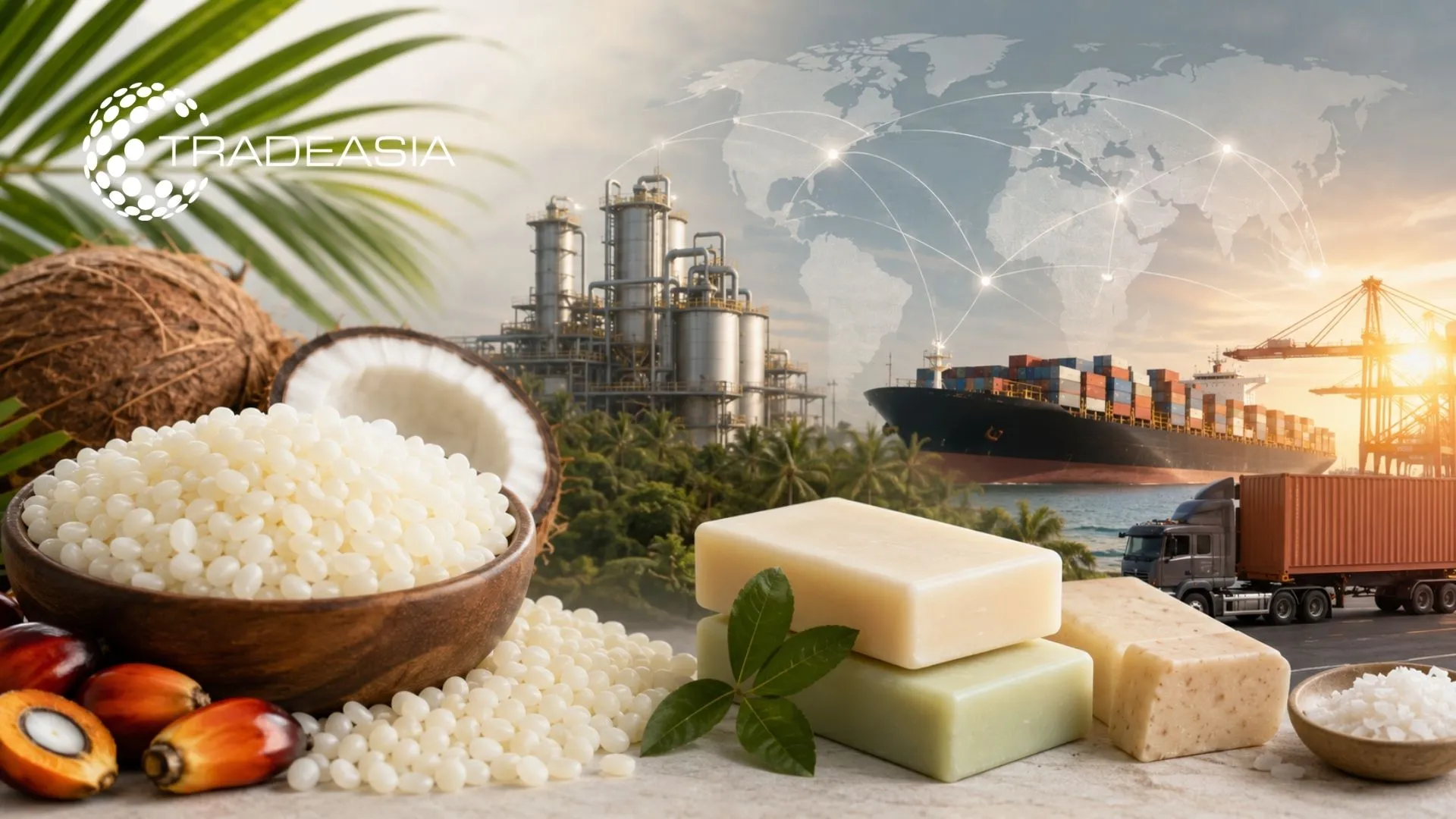
Introduction Soap Noodles
Global Oleochemical Landscape and Market Outlook to 2026
Soap Noodles: Specifications, Grades, and Industrial Applications
Supply Chain Dynamics for Soap Noodles in a Global Market
Strategic Sourcing, Risk Management, and the Role of chemtradeasia
Conclusion
The global oleochemical industry is entering a pivotal phase as it approaches 2026, driven by rising demand for sustainable surfactants, personal care products, and industrial cleaning formulations. At the center of this transformation lies soap noodles, a key intermediate derived largely from natural fats and oils. As manufacturers and brand owners increase their focus on traceability, cost optimization, and environmental performance, the robustness of the soap noodles supply chain has become a strategic priority.
Soap noodles are no longer treated as a simple commodity; they are a critical link connecting upstream palm, coconut, and other vegetable oil producers with downstream manufacturers of bar soaps, syndet bars, and multi-functional cleansing products. Supply disruptions during the COVID-19 pandemic and subsequent logistics bottlenecks have highlighted the vulnerability of global trade flows, making reliable partners and diversified sourcing essential. In this context, specialized distributors and supply chain integrators such as chemtradeasia are playing an increasingly important role in stabilizing flows and providing market intelligence.
This article provides an in-depth look at the global supply chain of soap noodles up to 2026, focusing on market dynamics, product specifications, logistics constraints, and strategic sourcing approaches for the oleochemical sector. It is designed for procurement professionals, supply chain managers, and business leaders seeking to understand how to secure reliable, cost-effective, and sustainable soap noodles supply in an increasingly complex global environment.
The oleochemical market has been expanding steadily, supported by the long-term shift from petrochemical-based surfactants toward bio-based alternatives. According to various industry analyses, the global oleochemicals market has been growing at a compound annual growth rate (CAGR) of around 5–7% in the early 2020s, with fatty acids, fatty alcohols, glycerin, and soap noodles being major product categories. By 2026, the market value for oleochemicals is projected to reach tens of billions of US dollars, driven by demand from personal care, home care, food, and industrial applications.
Asia-Pacific remains the dominant production hub for oleochemicals, primarily due to the availability of palm oil and palm kernel oil in Indonesia and Malaysia, and coconut oil in the Philippines and other Southeast Asian countries. These feedstocks are the backbone of soap noodles production, and any volatility in their prices or availability directly impacts the economics of soap manufacturing worldwide. At the same time, demand growth is increasingly global, with strong consumption in emerging markets in Africa, South Asia, and Latin America, and stable to moderate growth in Europe and North America.
By 2026, several structural trends are expected to shape the oleochemical landscape and, by extension, the soap noodles supply chain. Sustainability and certification (RSPO for palm oil, for example) will become standard expectations rather than differentiators. Regulatory pressure on certain synthetic surfactants and microplastics will continue to favor natural and biodegradable alternatives. In parallel, geopolitical tensions, freight rate volatility, and energy price fluctuations will continue to challenge supply chain planning. Companies that can combine diversified sourcing, strong logistics partnerships, and real-time market insight—such as those offered by chemtradeasia, will be better positioned to maintain continuity of supply and competitive pricing.
Soap noodles are the primary raw material for manufacturing solid bar soaps and certain syndet or combo bars. They are typically produced by the saponification of vegetable oils or animal fats with sodium hydroxide, followed by drying and forming into small, opaque pellets or noodles. These noodles are then blended with additives such as fragrances, colorants, fillers, and functional ingredients, and processed through milling, plodding, and stamping to produce finished bars.
From a technical perspective, soap noodles are characterized by several key specifications. Common grades include 80:20, 90:10, and 70:30 blends, which refer to the ratio of tallow (or palm-based equivalent) to coconut or palm kernel content. For example, an 80:20 grade might contain 80% palm-based fatty acids and 20% coconut or palm kernel fatty acids, balancing hardness, foam, and cost. Other critical parameters include total fatty matter (TFM), typically ranging from 72% to 78% for standard toilet soap bases; moisture content, usually controlled below 15%; and free caustic and free fatty acid levels, which influence mildness and processability. Color (Lovibond scale), odour, and salt content are also carefully monitored to ensure consistent performance.
Industrial applications for soap noodles extend beyond traditional toilet soaps. High-TFM and specialty grades are used in premium personal care bars, baby soaps, and dermatological cleansing bars, where mildness and skin compatibility are critical. Lower TFM or filled grades may be used in laundry bars and multipurpose household soaps, especially in developing markets where cost and cleaning performance are prioritized. In addition, certain formulations are tailored for institutional and industrial cleaning, such as workshop soaps or mechanic hand cleaners, where high detergency and soil removal are essential. Suppliers like chemtradeasia offer a range of soap noodles specifications to match these diverse end-use requirements, helping manufacturers optimize formulations for their target segments and geographies.
The soap noodles supply chain is a multi-stage network that begins with cultivation of oil-bearing crops and ends with distribution of finished soaps to retailers and institutional customers. Upstream, the availability and pricing of palm oil, palm kernel oil, coconut oil, and alternative fats are influenced by weather patterns, agricultural yields, land-use regulations, and sustainability certification requirements. For instance, El Niño events can reduce palm oil yields in Southeast Asia, tightening supply and raising feedstock prices, which in turn impact soap noodles pricing globally.
Midstream, soap noodles producers operate large-scale saponification and drying plants, often located close to feedstock sources in Indonesia, Malaysia, and other parts of Asia. These facilities rely on stable energy supplies, chemical inputs such as caustic soda, and efficient logistics for both inbound raw materials and outbound finished product. Production planning must account for varying product grades, customer-specific specifications, and the need to maintain quality across large batch sizes. Efficiency improvements, such as heat integration and process optimization, can significantly reduce unit costs and environmental footprint, making producers more competitive.
Downstream, international trade and logistics play a decisive role. Soap noodles are typically shipped in bulk, jumbo bags, or 25 kg bags in containers to regional converters and soap manufacturers. Freight rate volatility, port congestion, container shortages, and changes in customs regulations can all disrupt delivery schedules. The pandemic period demonstrated that even seemingly simple bulk commodities can face significant delays and cost spikes when global logistics systems are stressed. To mitigate these risks, many buyers are diversifying their supplier base, building strategic inventories, and partnering with distributors and trading houses that maintain multi-origin sourcing capabilities. Organizations like chemtradeasia, with networks across Asia, the Middle East, Africa, and other regions, can help balance supply and demand by reallocating volumes and optimizing shipping routes according to current market conditions.
For procurement and supply chain managers, securing reliable access to industrial soap noodles through 2026 requires a structured approach to strategic sourcing and risk management. Key considerations include supplier diversification, contract structures, quality assurance, and alignment with sustainability goals. Rather than relying on a single producer or origin, many companies are adopting multi-supplier strategies spanning Indonesia, Malaysia, China, and other manufacturing hubs. This approach reduces exposure to localized disruptions such as weather events, regulatory changes, or plant outages.
Contracting strategies are also evolving. Buyers are increasingly combining long-term framework agreements for base volumes with spot purchases to capitalize on favorable market conditions. Index-linked pricing tied to feedstock benchmarks can provide transparency and share risk between buyers and suppliers. Quality management remains critical: consistent TFM, color, and performance are essential for maintaining brand reputation, especially in personal care markets. This is why many manufacturers rely on partners who can provide not only product but also documentation, certificates of analysis, and technical support.
In this environment, specialized supply chain partners such as chemtradeasia add value beyond simple trading. With a portfolio that includes soap noodles and related oleochemicals, chemtradeasia can support customers with multi-product sourcing, consolidated shipments, and flexible logistics solutions. Their presence in key producing and consuming regions enables them to monitor market trends, anticipate disruptions, and advise customers on timing purchases or adjusting specifications. For example, when palm oil prices spike, buyers may consider adjusting blends (e.g., shifting between 80:20 and 90:10 grades) or exploring alternative feedstock-based noodles where feasible. Having a partner that understands both the technical and commercial implications of such changes helps companies maintain product performance while managing costs.
As the oleochemical industry moves toward 2026, soap noodles will remain a foundational ingredient for a broad spectrum of personal care and cleaning products worldwide. Market growth, sustainability expectations, and shifting consumer preferences will continue to drive demand for high-quality, traceable, and competitively priced soap noodles. At the same time, structural challenges—ranging from agricultural volatility to logistics constraints, will make supply chain resilience a central concern for manufacturers and brand owners.
To navigate this landscape effectively, companies must adopt an integrated sourcing strategy that combines technical understanding of industrial soap noodles specifications with robust risk management and strong supplier relationships. Leveraging partners such as chemtradeasia can help align feedstock availability, production capacity, and end-market requirements, ensuring that soap manufacturers can respond quickly to changes in demand and input costs. By investing in long-term partnerships, diversified sourcing, and continuous market monitoring, stakeholders in the oleochemical industry can position themselves to capture opportunities and mitigate risks in the global soap noodles supply chain through 2026 and beyond.
This article is intended solely for informational and market insight purposes and does not constitute technical, safety, or professional advice; readers should independently verify all information with qualified experts, consult official documentation such as MSDS/SDS, and, where appropriate, contact relevant suppliers or our team for guidance on specific formulations, regulatory requirements, and application decisions.
We're committed to your privacy. Tradeasia uses the information you provide to us to contact you about our relevant content, products, and services. For more information, check out our privacy policy.


 English
 Indonesian
 简体字
简体字
 العربية
 Español
 Français
 Português
 日本語
日本語
 한국어
한국어
 Tiếng Việt



















