How can we assist you?

Explore our network of country and industry based websites to access localized information, product offerings, and business services across our group.

Access reliable chemical market information through our update channels.
Real-time Updates
Daily Updates
Log in to start sending quotation requests for any product.
Don't have an account? Sign Up Here
Home The Feedstock Tug-of-War of Isopropyl Palmitate in Biofuel Surge
Market Insight | 01 January 2026
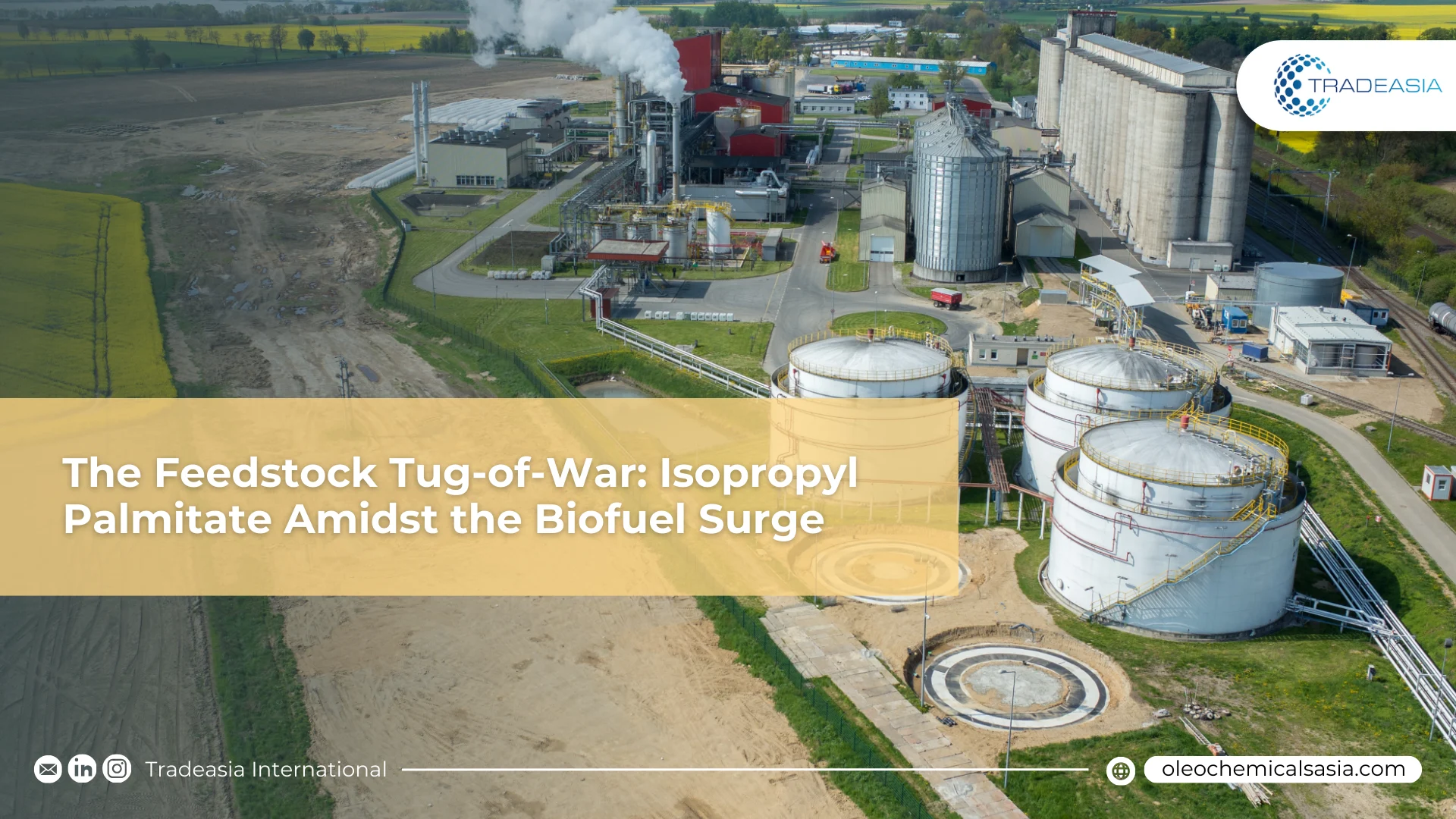
The global Isopropyl Palmitate market has entered 2025 under significant strain as the "food-and-formula vs. fuel" debate reaches a fever pitch. Indonesia’s recent implementation of the B40 biodiesel mandate, which took effect in early January, has effectively sequestered a massive volume of palm-based derivatives, creating a direct "feedstock squeeze" for oleochemical manufacturers. Palmitic acid, the primary precursor for IPP, is naturally abundant in palm oil (~44% composition), yet its availability for chemical esterification is being throttled by high energy-sector demand. As of mid-January, global IPP production volumes—estimated at approximately 280,000–300,000 MT—are feeling the pinch, even as the market is valued at approximately USD 700.1 million for 2025. With crude palm oil prices stabilizing at a high floor of roughly USD 1,040/MT, the cost of high-purity IPP is increasingly sensitive to the "POGO" (Palm Oil-Gas Oil) spread.
Navigating this supply-strained landscape requires a partner with deep regional roots and a robust logistics network. Tradeasia International stands at the forefront of this sector, providing seamless procurement solutions and consistent supply chains for palm derivatives and oleochemicals to global industrial buyers who cannot afford a break in their production cycles.
The immediate result of this feedstock diversion is a marked increase in spot pricing. In the Asia-Pacific region, which holds a 38% market share, IPP prices have firmed to the USD 1,350–1,500/MT range, depending on the grade and certification. This price escalation is occurring despite a healthy projected CAGR of 8.7% through 2034. Industrial consumers, particularly in the lower-tier cosmetics segment, are beginning to practice "demand rationing," searching for synthetic alternatives as the premium for natural-based esters continues to climb amidst the supply vacuum created by domestic Indonesian energy requirements.
Over the next twenty years, Isopropyl Palmitate will solidify its role as a premier platform chemical for the "clean beauty" and "green pharma" movements. By 2046, as petroleum-based emollients are phased out by global carbon taxes, IPP’s status as a biodegradable, renewable asset will be unquestioned. We anticipate its use will expand from topical cosmetics to advanced drug-delivery systems, maintaining its industrial relevance for two decades as refiners optimize the extraction of palmitic acid from non-food-competing palm waste streams and secondary residues.
Sources:
We're committed to your privacy. Tradeasia uses the information you provide to us to contact you about our relevant content, products, and services. For more information, check out our privacy policy.
How can we assist you?

 English
 Indonesian
 简体字
简体字
 العربية
 Español
 Français
 Português
 日本語
日本語
 한국어
한국어
 Tiếng Việt




















