Explore our network of country and industry based websites to access localized information, product offerings, and business services across our group.

Access reliable chemical market information through our update channels.
Real-time Updates
Daily Updates
Log in to start sending quotation requests for any product.
Don't have an account? Sign Up Here
Home Navigating the Storm: La Nina’s Impact on 2026 Octyl Decyl Alcohol Markets
Trade Insights | Supply Chain | 11 January 2026
Logistics Bottlenecks and Production Delays
Port Congestion and Shipping Volatility
Strategic Resilience in a Volatile Climate
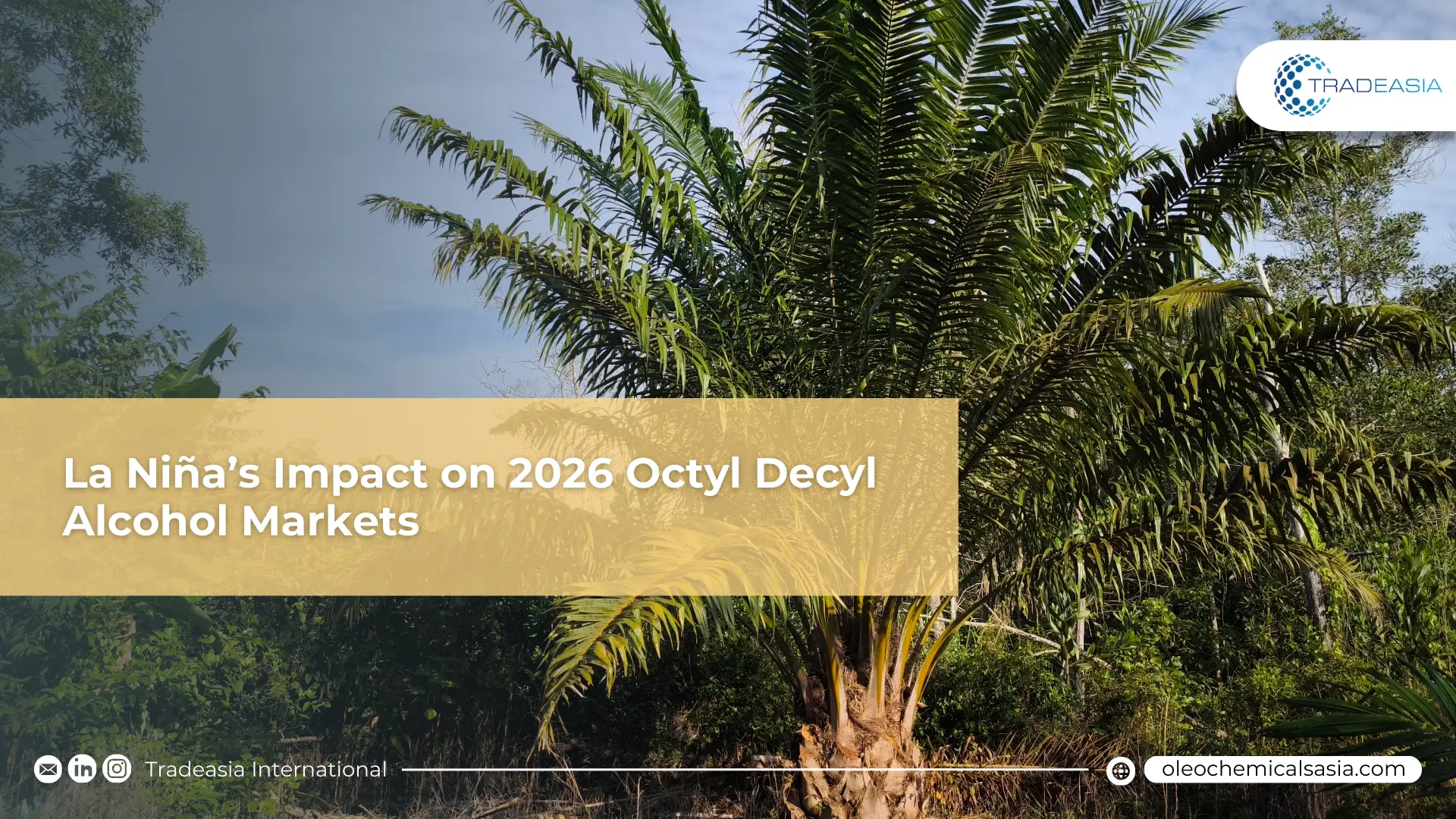
As the first quarter of 2026 unfolds, the oleochemical industry is facing a significant external challenge: a moderate to strong La Niña event. For the Octyl Decyl Alcohol market, which is heavily concentrated in Indonesia and Malaysia, weather is not just a background variable but a primary driver of price volatility and logistical risk. The increased rainfall patterns associated with La Niña are currently disrupting the primary stage of the supply chain, the harvesting and transportation of palm kernels. This disruption ripples through the refineries and eventually impacts the availability and cost of the C8 and C10 fractions that global manufacturers rely on for their essential chemical formulations.
The most immediate impact of the 2026 La Niña has been felt in the inland logistics of Sumatra and Kalimantan. Excessive rainfall has led to localized flooding, making many rural plantation roads impassable for the trucks that transport fresh fruit bunches to the crushing mills. While the trees themselves may benefit from the hydration in the long term, the short-term result is a "harvesting gap" that reduces the immediate supply of Palm Kernel Oil (PKO). In January 2026, several major Indonesian refineries reported a 10% to 15% reduction in feedstock throughput compared to the same period in 2025. This tightening of the upstream supply has caused a corresponding spike in Octyl Decyl Alcohol prices, with spot quotes rising from 2,400 USD to nearly 2,650 USD per Metric Ton in a matter of weeks.
Beyond the plantation gate, the weather event is also complicating the maritime leg of the supply chain. Heavy rains and increased storm activity in the Java Sea have led to intermittent closures of smaller feeder ports and slower loading rates at major hubs like Jakarta and Surabaya. For procurement officers, this means that "Expected Time of Arrival" (ETA) dates are becoming increasingly fluid. We have observed that average vessel delays for bulk oleochemical shipments have increased by four to six days in early 2026. To mitigate these risks, many savvy B2B buyers are shifting toward a "safety stock" strategy, increasing their on-site inventories of Octyl Decyl Alcohol to weather the period of highest climatic uncertainty. This surge in protective buying has further supported the upward price trend seen across the region.
The 2026 weather cycle underscores the importance of supply chain transparency and regional diversification. While the La Niña impact is widespread, it is not uniform; different provinces in Indonesia experience varying degrees of disruption. Analytical procurement requires working with suppliers who have multi-site production capabilities and robust contingency plans for power outages or transport interruptions caused by extreme weather. Looking ahead to the second quarter of 2026, market analysts expect a gradual stabilization of Octyl Decyl Alcohol prices as the La Niña effect weakens, yet the lesson remains clear: weather intelligence is now an inseparable part of market intelligence. Organizations that successfully integrated meteorological data into their 2026 sourcing strategies are finding themselves in a much stronger position to manage cost and ensure continuity of supply.
We're committed to your privacy. Tradeasia uses the information you provide to us to contact you about our relevant content, products, and services. For more information, check out our privacy policy.


 English
 Indonesian
 简体字
简体字
 العربية
 Español
 Français
 Português
 日本語
日本語
 한국어
한국어
 Tiếng Việt