How can we assist you?

Explore our network of country and industry based websites to access localized information, product offerings, and business services across our group.

Access reliable chemical market information through our update channels.
Real-time Updates
Daily Updates
Log in to start sending quotation requests for any product.
Don't have an account? Sign Up Here
Home LMA: Capacity Expansion vs. Supply Bottlenecks (2026-2040)
Market Insight | 11 December 2025
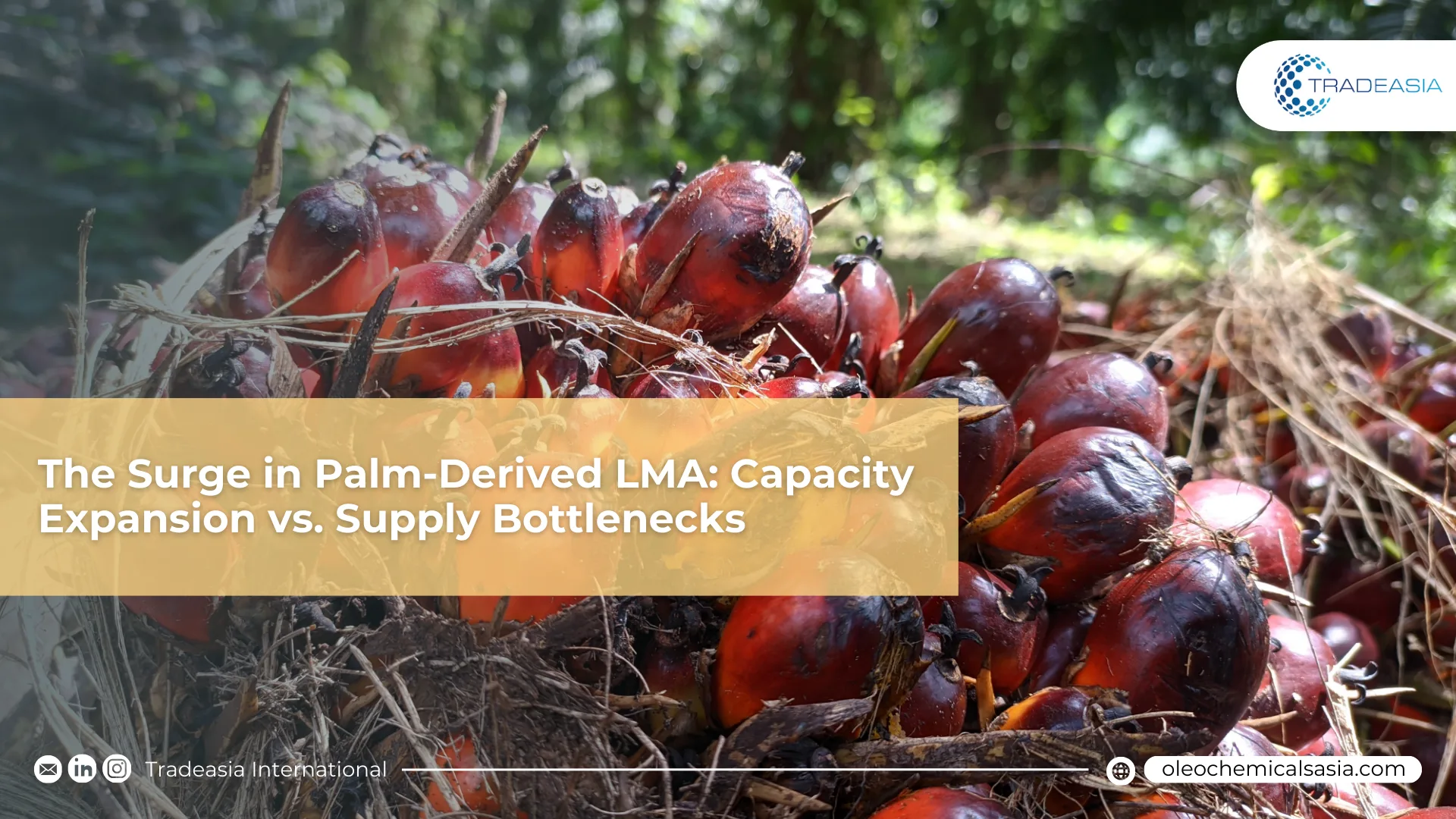
The global market for Lauryl Myristyl Alcohol (LMA), a workhorse intermediate in the oleochemical sector, is entering a dynamic, high-growth phase. As industries pivot towards natural-source ingredients, LMA demand is accelerating, demanding robust long-term planning from every player in the supply chain. For those navigating the complexities of sourcing and logistics, a partner with deep regional expertise is invaluable. At Tradeasia International, we see this expansion not just as growth, but as a commitment to sustainable sourcing.
The market is set for a substantial capacity ramp-up between 2026 and 2040. We project the global LMA production capacity to increase at a healthy Compound Annual Growth Rate (CAGR) of 4.1%, climbing from an estimated 2.8 million metric tons (MMT) in 2026 to a staggering 5.0 MMT by 2040. This expansion is heavily anchored in Asia, with Southeast Asia expected to contribute a dominant 78% of the world's LMA output by 2030. Producers are backing this growth with significant capital. Planned Capital Expenditure (CAPEX) on new oleochemical facilities across key producing nations is forecasted to inject an additional 950,000 metric tons per annum (MTPA) of mid-chain alcohol capacity by 2032, representing an estimated $3.5 billion in investment over the next decade. This underscores the necessity of having a partner who can provide transparent, long-term procurement visibility across these evolving supply corridors.
Despite the capacity surge, supply-side vulnerabilities will intensify. Our analysis shows global capacity utilization rates, currently stable at 85% in 2026, are projected to tighten significantly to 92% by 2035. This high utilization signals a growing potential for supply bottlenecks and price volatility, especially when coupled with fluctuations in the Palm Kernel Oil (PKO) feedstock market. Furthermore, sustainability is no longer a niche requirement; it's a market driver. The share of certified sustainable LMA (RSPO/ISCC-certified) is set to soar from 65% in 2026 to a near-universal 90% by 2040. This shift is already manifesting as a price factor, adding a structural 3% to 7% premium to average spot prices for certified material. To thrive, businesses must ensure their sourcing strategies are both aggressive in securing volume and compliant with increasingly strict global sustainability mandates.
We're committed to your privacy. Tradeasia uses the information you provide to us to contact you about our relevant content, products, and services. For more information, check out our privacy policy.
How can we assist you?

 English
 Indonesian
 简体字
简体字
 العربية
 Español
 Français
 Português
 日本語
日本語
 한국어
한국어
 Tiếng Việt