How can we assist you?

Explore our network of country and industry based websites to access localized information, product offerings, and business services across our group.

Access reliable chemical market information through our update channels.
Real-time Updates
Daily Updates
Log in to start sending quotation requests for any product.
Don't have an account? Sign Up Here
Home Beyond the Kernel: RSPO-Certified Methyl Caproate for Premiums and Access
Article | 13 November 2025
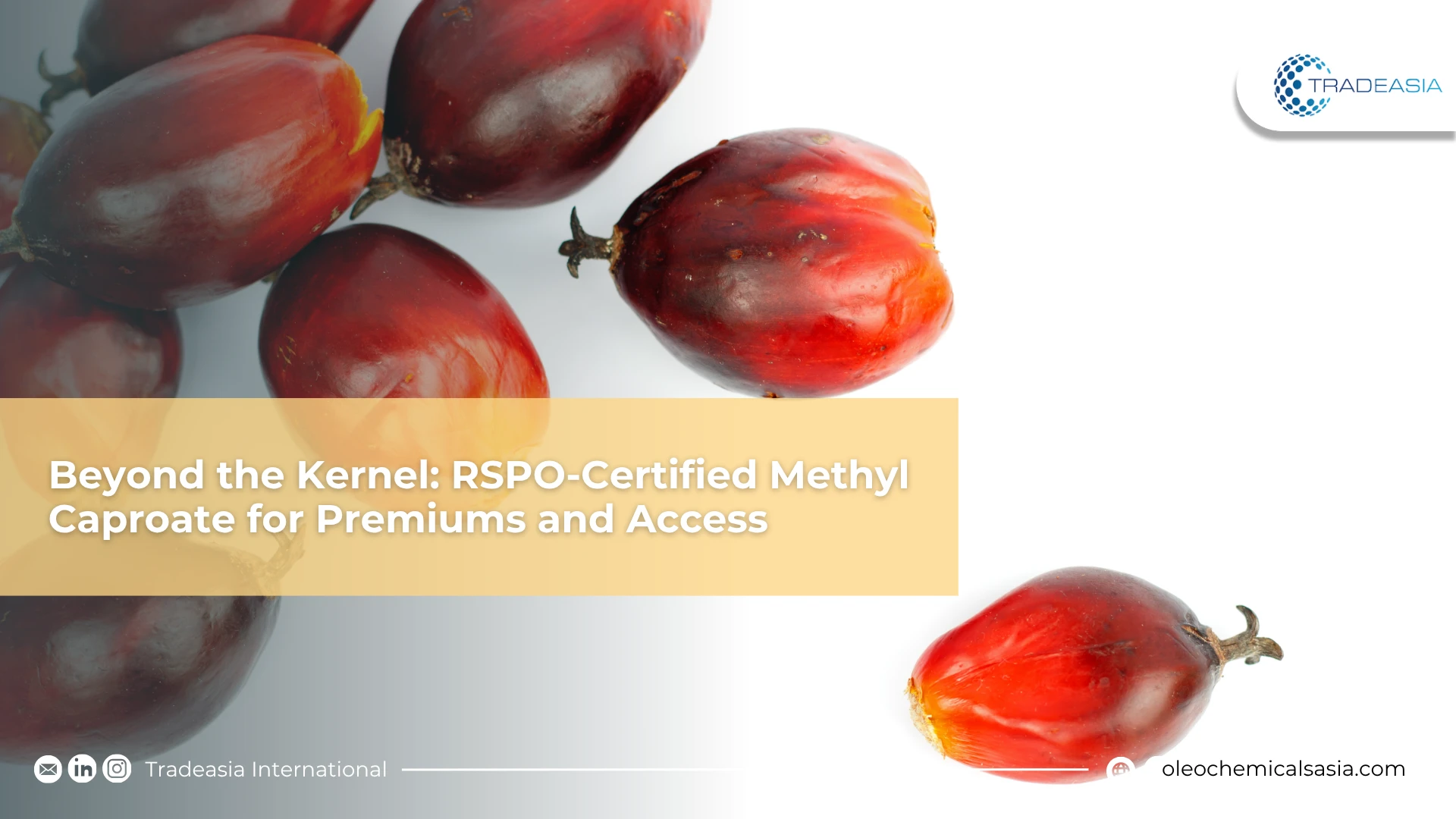
In the modern supply chain, sustainability is no longer a marketing buzzword; it's a non-negotiable condition for market access. For Methyl Caproate, whose value is overwhelmingly tied to the 85% of its volume used by the food and personal care industries, this scrutiny is intense. B2B buyers are now under immense pressure to prove the sustainable origin of their ingredients. This consumer-driven pressure translates directly to procurement, where proof of sustainability is no longer optional. For global oleochemical suppliers like Tradeasia International, this isn't a challenge; it's a core operating principle—connecting certified, sustainable palm sources to the global brands that demand them.
The data reveals a critical supply-and-demand gap. As of 2024, only 19.7% of the world's palm oil supply is RSPO certified. Yet, demand for certified ingredients from CPGs in Europe and North America has grown by over 25% year-over-year. This has created a two-tier market where RSPO Mass Balance (MB) certified Methyl Caproate consistently commands a $50-$70/ton premium. This premium isn't just a cost; it's an investment in market access. It's the tangible value of a transparent, responsible palm supply chain, proving that what's good for the planet is also good for the bottom line.
Beyond certification, palm-derived Methyl Caproate has another powerful sustainability story. As a bio-based ester, its cradle-to-gate carbon footprint is inherently lower than its synthetic, petroleum-based alternatives. Multiple Life Cycle Assessments (LCAs) show that bio-based esters can have a 30-50% lower carbon footprint, a critical metric for any company reporting on Scope 3 emissions. This combination of RSPO certification with a low-carbon footprint makes it a clear strategic choice.
Sources:
We're committed to your privacy. Tradeasia uses the information you provide to us to contact you about our relevant content, products, and services. For more information, check out our privacy policy.
How can we assist you?

 English
 Indonesian
 简体字
简体字
 العربية
 Español
 Français
 Português
 日本語
日本語
 한국어
한국어
 Tiếng Việt




















