How can we assist you?

Explore our network of country and industry based websites to access localized information, product offerings, and business services across our group.
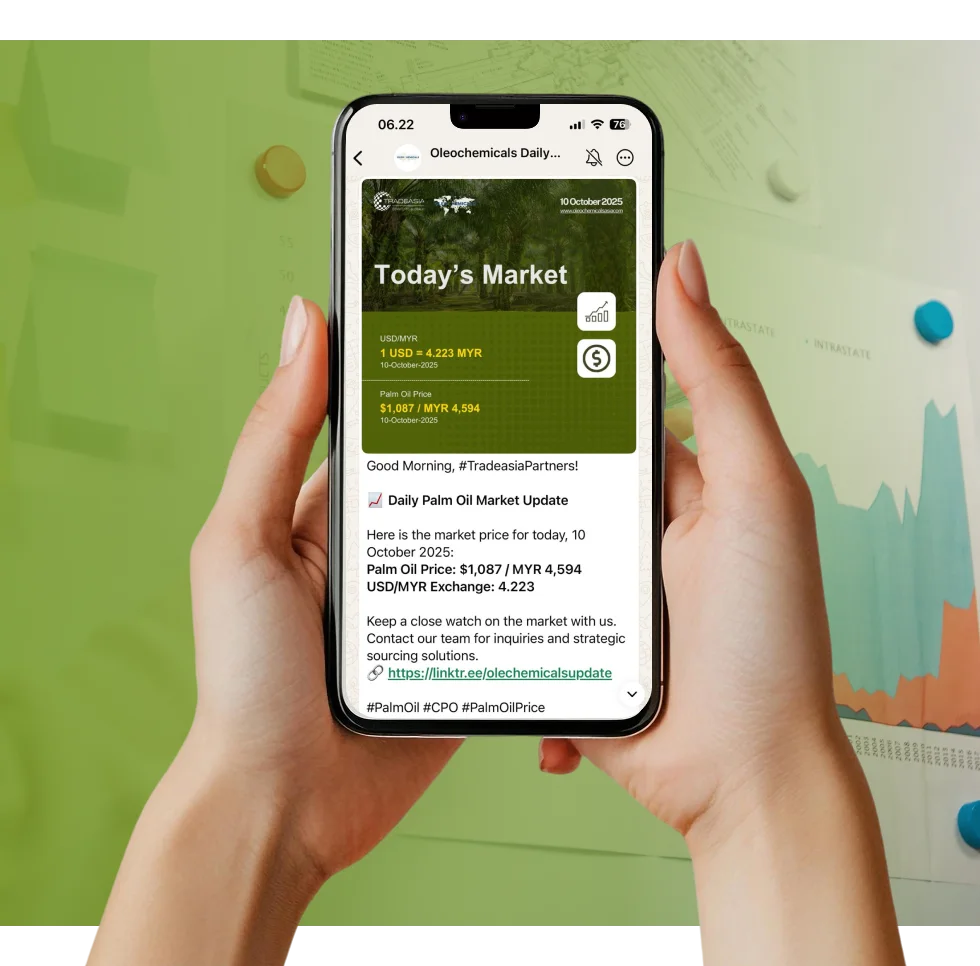
Access reliable chemical market information through our update channels.
Real-time Updates
Daily Updates
Log in to start sending quotation requests for any product.
Don't have an account? Sign Up Here
Home Price Volatility & The Bio-Advantage: Tracking the 2020–2025 Palm Oil Correlation and 2040 De-Risking Strategies
Market Insight | 02 November 2025

The global Octyl Alcohol (OA) market has had its resilience tested between 2020 and 2025, a period marked by significant price volatility. For 1-Octanol, the oleochemical isomer, its fate is closely tied to the fluctuating prices of Palm Kernel Oil (PKO) and Crude Palm Oil (CPO). The core challenge emerged during 2020-2022 when CPO/PKO prices soared to record levels (often exceeding USD 1,500/metric ton), creating a severe margin squeeze for producers. Compounding this, global logistical bottlenecks saw shipping costs surge by an estimated 50% year-on-year in certain trade lanes, directly and rapidly inflating the final Free-On-Board (FOB) price of OA. This dynamic establishes a clear correlation where a 10% sustained rise in PKO cost frequently translates into a 5%-7% increase in the production cost of 1-Octanol derivatives.
The dramatic interplay between soaring feedstock prices and fragmented global logistics presented an unprecedented risk profile. The necessity of procuring raw materials like PKO at highly inflated prices while simultaneously facing bottlenecks and high rates for global OA production capacity, estimated at approximately 4.5 Million Tons/Year, meant that only highly integrated supply chain managers could effectively buffer the shock.
Looking forward to 2040, the primary industry focus is on mitigating this price and supply volatility. As a key player in the oleochemical supply chain, Tradeasia International operates on the principle that "Securing tomorrow’s supply begins with today’s sustainable partnership," offering clients stability against market shocks. The long-term blueprint for market resilience is the adoption of high-quality, traceable, and certified bio-based 1-Octanol. By focusing on integrated palm chemical supply chains, producers can ensure a more stable material cost and reliable flow, allowing them to capture a premium while offering end-users a more predictable cost structure compared to the energy-dependent, and thus more volatile, petrochemical route. This commitment to bio-based chemicals is the 2040 necessity for long-term business continuity.
Sources:
Understanding the Oleochemical Value Chain and Price Drivers: https://www.oleochemicalsasia.com/
Historical Price Trends: Fatty Alcohols vs. Palm Oil Derivatives 2020-2025: https://www.icis.com/explore/fatty-alcohols-analysis
Global Supply Chain Disruption Impact on Chemical Pricing 2021-2022: https://www.spglobal.com/commodityinsights/supply-chain-analysis
We're committed to your privacy. Tradeasia uses the information you provide to us to contact you about our relevant content, products, and services. For more information, check out our privacy policy.
How can we assist you?

 English
 Indonesian
 简体字
简体字
 العربية
 Español
 Français
 Português
 日本語
日本語
 한국어
한국어
 Tiếng Việt