How can we assist you?

Explore our network of country and industry based websites to access localized information, product offerings, and business services across our group.

Access reliable chemical market information through our update channels.
Real-time Updates
Daily Updates
Log in to start sending quotation requests for any product.
Don't have an account? Sign Up Here
Home The Palm Acid Oil Revolution: Sizing the Market Shift from Animal Feed to High-Value Oleochemicals (2020-2040)
Market Insight | 18 November 2025
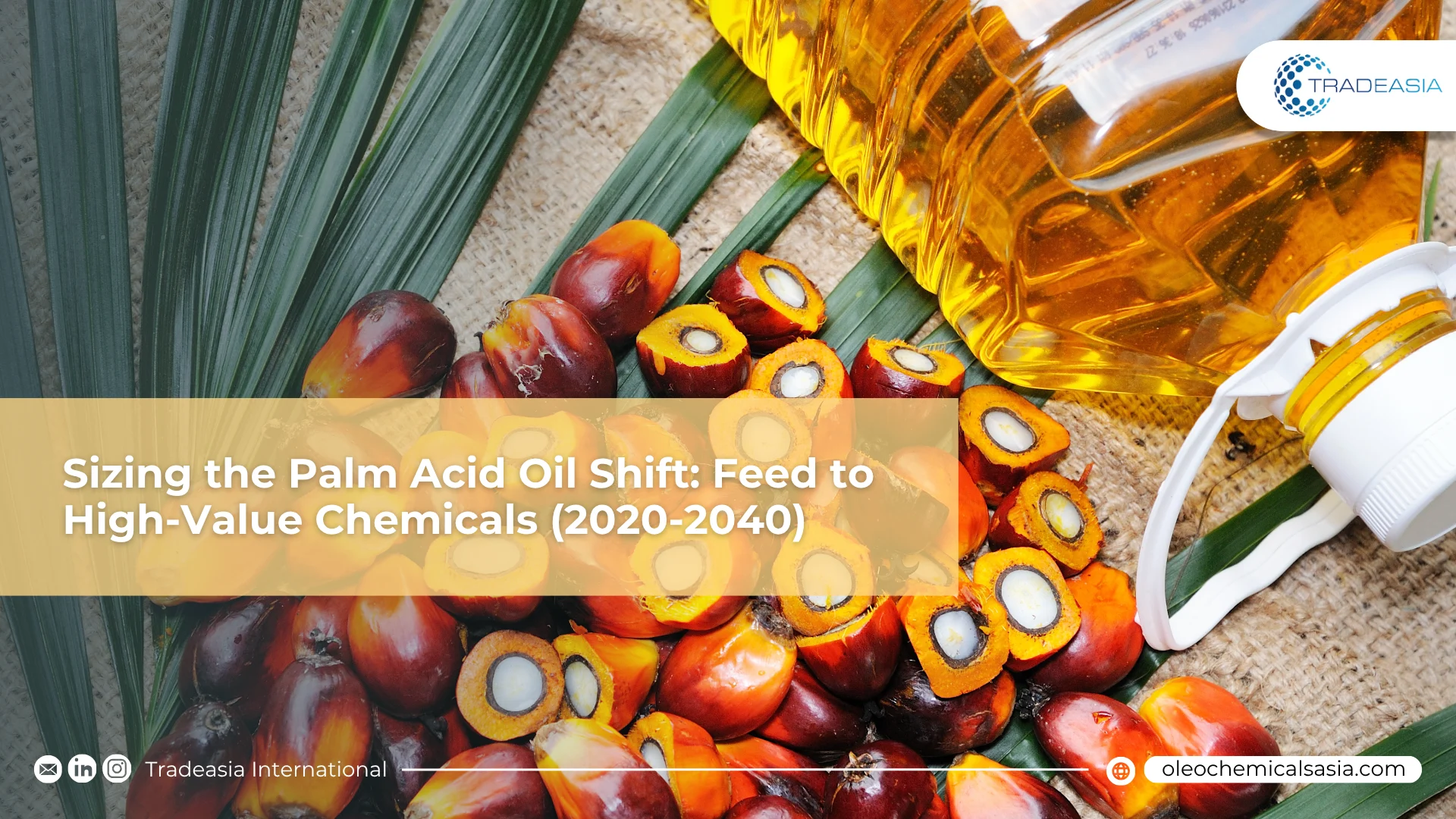
While biofuel grabs the headlines, a quieter but equally significant revolution is occurring within Palm Acid Oil’s application stack. The market's end-use segmentation is shifting rapidly, moving Palm Acid Oil from a low-cost bulk ingredient to a versatile feedstock for high-value applications. This evolution from a single-use ingredient to a versatile feedstock is opening new profit pools. At Tradeasia International, our deep roots in the oleochemical and palm sectors provide us with a unique perspective on how to unlock the maximum value from every drop.
To understand the future, we must look at the recent past. In 2020, the Palm Acid Oil market was a simple affair: animal feed dominated with roughly a 45% share, followed by soap noodles and industrial uses at 30%. Biofuel was a growing but secondary player at ~20%, with high-value oleochemicals a mere 5% niche. Today, that hierarchy has been completely disrupted. The animal feed sector, despite Palm Acid Oil's high energy value (8,000-8,500 kcal/kg), is being priced out. Feed producers simply cannot compete with the premiums biofuel refineries are willing to pay, and we project the feed segment's market share will collapse to under 25% by 2040.
By 2040, the market will be dominated by biofuels, projected to consume over 55% of all Palm Acid Oil. But this isn't the only growth story. The "green chemistry" push is quietly transforming Palm Acid Oil into a prized feedstock for high-value oleochemicals. This segment is projected to grow at a steady 6-7% CAGR, capturing nearly 15% of the market by 2040. This "green chemistry" push is creating a strategic dilemma for producers. As one partner in the global supply chain observed, "The real vision isn't just selling to the HVO plant down the road; it's having the technical and market expertise to fractionate Palm Acid Oil into higher-margin products for specialty chemical markets." This creates a two-speed market: one for high-volume energy, and one for high-value specialty chemicals.
Sources:
Palm-Chemicals.com: Palm Oil Distilled Fatty Acids (PDFA) Specifications
Journal of Oleo Science: Advances in Biolubricant Feedstocks from Palm Oil Derivatives
We're committed to your privacy. Tradeasia uses the information you provide to us to contact you about our relevant content, products, and services. For more information, check out our privacy policy.
How can we assist you?

 English
 Indonesian
 简体字
简体字
 العربية
 Español
 Français
 Português
 日本語
日本語
 한국어
한국어
 Tiếng Việt