How can we assist you?

Explore our network of country and industry based websites to access localized information, product offerings, and business services across our group.

Access reliable chemical market information through our update channels.
Real-time Updates
Daily Updates
Log in to start sending quotation requests for any product.
Don't have an account? Sign Up Here
Home The Great Diversion: How CPO Production & Biofuel Mandates Will Define Palm Acid Oil Supply to 2040
Article | 18 November 2025
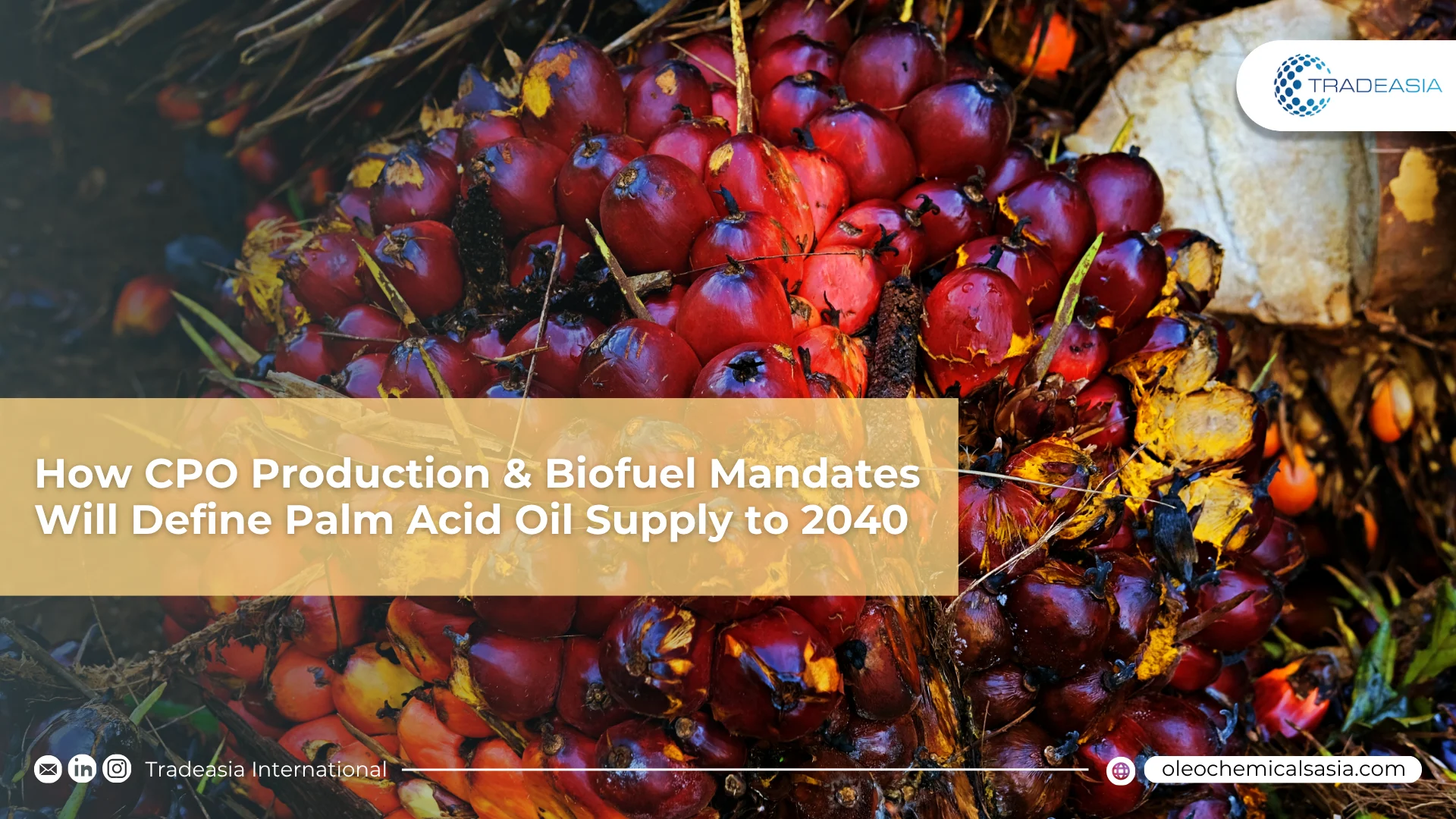
The future availability of Palm Acid Oil is one of the most misunderstood dynamics in the oleochemical market. As a byproduct, its supply is not an independent metric; it is a direct consequence of Crude Palm Oil (CPO) refining volumes. Understanding this critical, and changing, link is the key to forecasting supply chain volatility through 2040. At Tradeasia International, our advantage lies in analyzing this complete CPO-to-byproduct value chain, allowing our partners to secure supply in a market defined by increasing competition.
The primary raw material equation has always been simple: CPO is refined, and Palm Acid Oil is the resulting byproduct, typically at a yield of 3.5% to 5% of the CPO input. This stable relationship, however, is being fundamentally disrupted. Global CPO production, which stood around 75 million tonnes in 2023 (with 85-90% from Indonesia and Malaysia), is now facing a massive new domestic competitor. Indonesia's B35 biodiesel mandate alone consumed over 12 million kiloliters (approx. 10.5 million tonnes) of palm oil in 2023. As Indonesia pushes aggressively towards B40 and even B50, it will "lock in" millions more tonnes of CPO for domestic energy, diverting it from the global food, oleochemical, and export refining pool.
This creates a structural supply squeeze for Palm Acid Oil. CPO production growth is slowing, projected at a CAGR below 2.5% due to land moratoriums and replanting cycles. "Success in this market is no longer just about trading Palm Acid Oil," as one industry analyst noted, "it's about understanding the entire CPO energy balance, from plantation to fuel tank." If domestic biofuel consumption in Indonesia grows faster than this modest CPO growth, the volume available for traditional refining (which produces Palm Acid Oil) will inevitably shrink. By 2035, Indonesia's domestic mandates could absorb an additional 5-8 million tonnes of CPO annually. For global buyers, this signals a future of intense price competition and a critical need for suppliers with deep, priority access to refinery output.
Sources:
We're committed to your privacy. Tradeasia uses the information you provide to us to contact you about our relevant content, products, and services. For more information, check out our privacy policy.
How can we assist you?

 English
 Indonesian
 简体字
简体字
 العربية
 Español
 Français
 Português
 日本語
日本語
 한국어
한국어
 Tiếng Việt




















