How can we assist you?

Explore our network of country and industry based websites to access localized information, product offerings, and business services across our group.

Access reliable chemical market information through our update channels.
Real-time Updates
Daily Updates
Log in to start sending quotation requests for any product.
Don't have an account? Sign Up Here
Home The Strategic Evolution of PKFAD: Mapping Global Supply Dynamics (2020–2040)
Market Insight | 28 December 2025
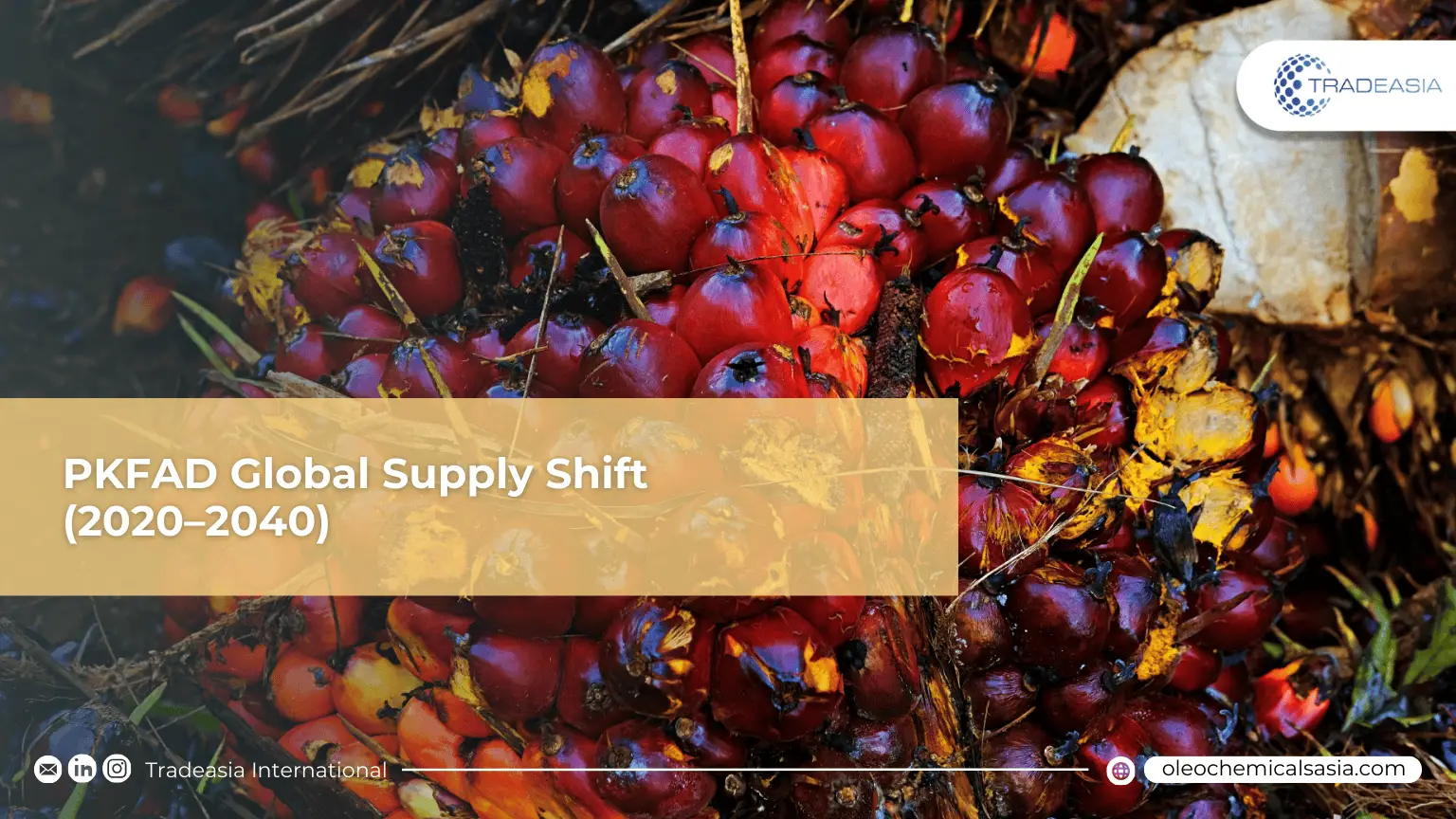
The global market for Palm Kernel Fatty Acid Distillate (PKFAD) has transitioned from a refinery byproduct into a cornerstone of industrial strategy. Looking back at the 2020 baseline, the industry faced significant labor constraints that saw production dips, yet the market demonstrated remarkable resilience. By 2024, the valuation of the PKFAD sector reached approximately $1.32 billion, and current modeling suggests a steady climb to $2.38 billion by 2033. This growth is underpinned by a CAGR of 2.3%, reflecting a world that increasingly values non-food-competing feedstocks. As we eye the 2040 horizon, the shift toward high-purity grades, specifically those with a Total Fatty Matter (TFM) of 97% min, is expected to outpace traditional grades as precision manufacturing becomes the global standard.
Navigating these shifting tides requires a partner with deep-rooted expertise in the Southeast Asian supply hub, where Indonesia and Malaysia provide over 85% of global exports. Tradeasia International serves as this vital link, streamlining the movement of palm and oleochemical derivatives to ensure that industrial consumers can bypass the volatility of local markets. By leveraging a global distribution network, Tradeasia ensures that the growing demand for sustainable derivatives is met with consistent quality and logistical transparency..
The geography of supply remains concentrated, with the Asia-Pacific region maintaining a 50% market share as of 2024. However, the next fifteen years will be defined by "Supply Security" rather than just volume. With global palm oil production growth projected to slow to roughly 1.2% annually through 2040, the availability of PKFAD is tightening. This scarcity is expected to drive a 30% price premium by 2040 compared to 2020 levels, particularly for refined grades used in specialized chemical applications. For businesses aiming to hedge against these long-term costs, the focus must remain on securing high-purity streams that offer better yields in downstream processing.
By 2040, the integration of advanced distillation technologies will be the primary differentiator for market leaders who wish to maintain margins in an increasingly competitive landscape. As Indonesia and Malaysia tighten their export policies to favor domestic downstream industries, the global trading landscape will require more sophisticated logistical maneuvering. Traders who can manage the intricacies of these regional shifts will be the ones to secure the most consistent feedstock for the international market, ensuring that the TFM 97% demand is satisfied despite tightening raw material availability.
Sources:
We're committed to your privacy. Tradeasia uses the information you provide to us to contact you about our relevant content, products, and services. For more information, check out our privacy policy.
How can we assist you?

 English
 Indonesian
 简体字
简体字
 العربية
 Español
 Français
 Português
 日本語
日本語
 한국어
한국어
 Tiếng Việt




















