How can we assist you?

Explore our network of country and industry based websites to access localized information, product offerings, and business services across our group.
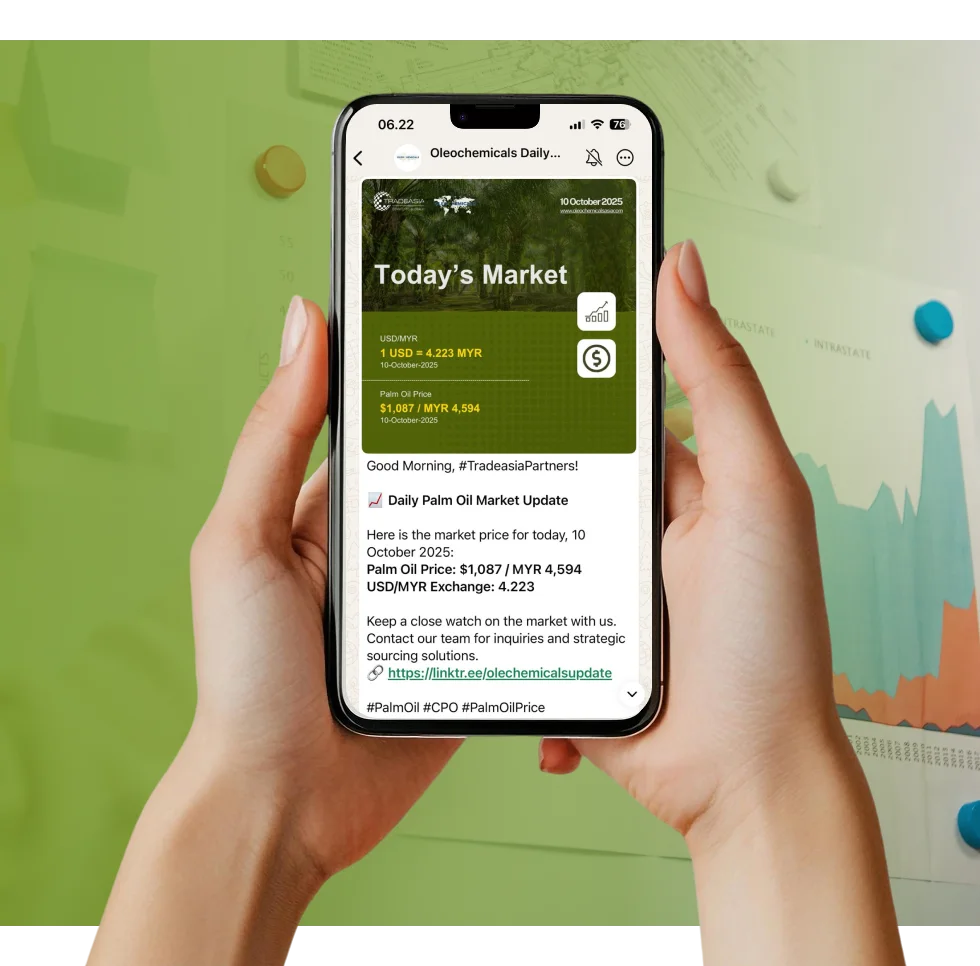
Access reliable chemical market information through our update channels.
Real-time Updates
Daily Updates
Log in to start sending quotation requests for any product.
Don't have an account? Sign Up Here
Home The Cost of Compliance: Securing Market Access for Decyl Alcohol Under the EU Deforestation Mandate
Market Insight | 19 October 2025
The sustainability mandate is rapidly evolving from a corporate social responsibility talking point into a mandatory, market-shaping regulation. For Decyl Alcohol (1-Decanol), a vital component in surfactants and cosmetics, this is best exemplified by the looming European Union Deforestation Regulation (EUDR). Companies unable to verify their supply chain risk losing access to the world’s most lucrative consumer market. The global 1-Decanol market, currently valued at approximately $256.36 million in 2024, is projected to surge to $380.14 million by 2030, but this growth is now conditional on achieving full traceability.
Securing a consistent and compliant supply of palm-derived chemicals requires a partner with deep regional expertise and an unwavering commitment to responsible sourcing. This is where the intricacies of the global oleochemical supply chain come into sharp focus. As a principle of business, "Reliable supply is not just about logistics; it’s about tracing the very origin of every molecule."
The EUDR’s demand for products to be deforestation-free post-December 31, 2020, necessitates precise geolocation data—a level of diligence that adds a measurable cost, known as the 'Green Premium.' Today, the premium paid for certified sustainable (RSPO or ISCC-certified) Decyl Alcohol is trading 3% to 5% higher than conventional grades, translating to an additional $45 to $75 per metric ton (MT). This premium reflects the significant investment required in robust monitoring and verification systems. Worryingly, only an estimated 25% of the current palm-based Decyl Alcohol supply chain has this full, verifiable traceability. Non-compliance is simply not an option for operators, as EU penalties can reach up to 4% of annual turnover, making the cost of the Green Premium a necessary investment to protect long-term revenue.
The business case for segregated, fully certified supply chains is now overwhelmingly clear: they dramatically reduce supply disruption risk. Data shows that companies utilizing segregated sustainable C10 experience less than a 1% rejection rate for shipments into the EU, compared to an estimated 5% for non-certified goods (Source: EUDR Compliance Monitoring, Q3 2025). For the high-value cosmetic and personal care sectors, where Decyl Alcohol is a critical input, protecting margin and brand reputation makes this stability invaluable. According to analysis on the certified market, procurement managers find that supply assurance for traceable products is at an 85% confidence level, compared to 60% for conventional sources. The prudent course of action for any chemical procurement executive is to move swiftly toward fully compliant sourcing to insulate their business from both regulatory and operational risk in this rapidly polarizing market.
Sources:
Palm-Chemicals.com - The Critical Role of Palm Derivatives in High-Performance Emollients and Personal Care (https://www.palm-chemicals.com/personal-care-emollients)
Precision Business Insights - 1-Decanol Market Size, Share Analysis 2031 (https://www.precisionbusinessinsights.com/market-reports/1-decanol-market)
Sustainalytics - EUDR Compliance Monitoring, Q3 2025: Geolocation and Traceability Impact. (https://www.sustainalytics.com/esg-research/resource/investors-esg-blog/palm-oil-in-focus--the-eudr-and-corporate-efforts-on-transparent-sourcing)
We're committed to your privacy. Tradeasia uses the information you provide to us to contact you about our relevant content, products, and services. For more information, check out our privacy policy.
How can we assist you?

 English
 Indonesian
 简体字
简体字
 العربية
 Español
 Français
 Português
 日本語
日本語
 한국어
한국어
 Tiếng Việt