How can we assist you?

Explore our network of country and industry based websites to access localized information, product offerings, and business services across our group.

Access reliable chemical market information through our update channels.
Real-time Updates
Daily Updates
Log in to start sending quotation requests for any product.
Don't have an account? Sign Up Here
Home The Great Palm Fatty Acid Distillate Pivot: Forecasting Global Market Share and Demand Shifts
Market Insight | 17 December 2025
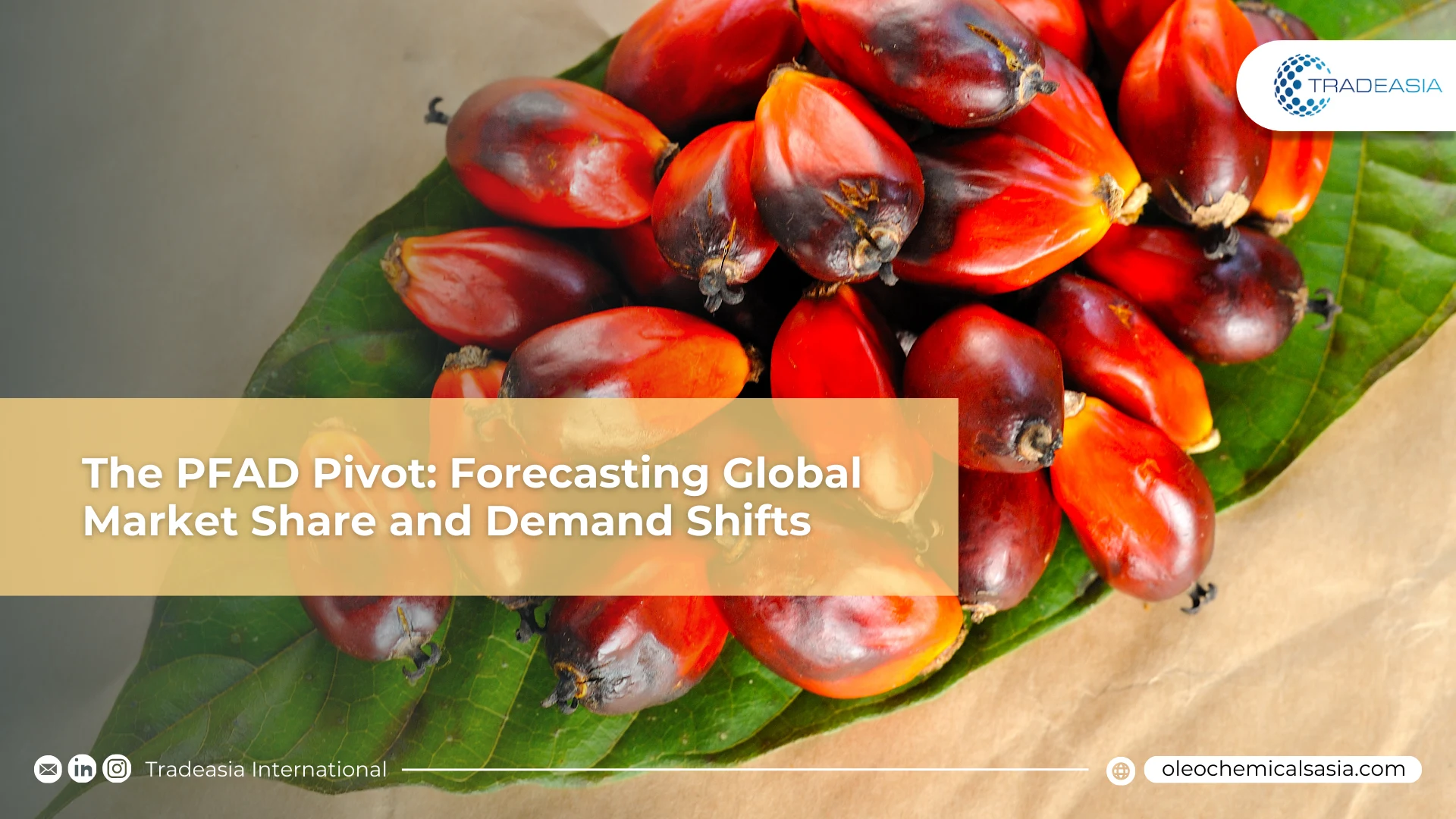
The Palm Fatty Acid Distillate (PFAD) market is standing at a critical inflection point. For decades, this versatile palm oil derivative was largely relegated to the soap and animal feed sectors, often viewed as a commodity byproduct. However, a seismic shift in global energy policy is poised to redefine PFAD’s role, transforming it into a high-value industrial feedstock that will dominate trade flows over the next two decades. For a leading palm trading house like Tradeasia International, understanding this upcoming demand restructuring is the difference between simply reacting to the market and actively shaping it. After all, as the industry adage goes, "In palm trading, the smart money follows the molecule's highest utility."
Our analysis forecasts a robust, non-linear growth trajectory for the global PFAD trade volume, which is projected to accelerate from a Compound Annual Growth Rate (CAGR) of 5.8% (2026-2035) to 6.1% (2036-2045), culminating in an estimated 13.5 Million Metric Tons (MMT) traded by 2045. This expansion is driven almost entirely by the relentless pull from the green fuel sector. The Biofuel segment—encompassing Hydrotreated Vegetable Oil (HVO) and Sustainable Aviation Fuel (SAF)—is forecast to boast a staggering 9.2% CAGR from 2026 to 2045. This unprecedented growth will see the biofuel sector's volume share balloon from 35% in 2026 to a commanding 65% by 2045, consuming over 8.7 MMT of PFAD annually. This surge is predicated on an estimated 18 MMT of new HVO/SAF capacity expected to commence operations in Europe and North America by 2030, directly fueled by regulatory frameworks like the EU’s RED III. In contrast, traditional sectors like oleochemicals and feed/soap will see their combined market share shrink from 65% to just 35%.
This structural shift introduces immense arbitrage and pricing opportunities. Historically, PFAD traded at an average discount of 15% to 20% against Crude Palm Oil (CPO). However, due to its newfound status as a coveted biofuel feedstock, this price dynamic is reversing. By 2028, we anticipate that certified PFAD in the European market will frequently trade at a premium of $50-$70 per Metric Ton (MT) over CPO, a complete reversal of historical norms. This is a clear signal: access to certified, sustainable supply chains is no longer a compliance burden but a strategic pathway to unlocking significant value-added revenue. Companies that successfully pivot their sourcing and certification processes now will be best positioned to capture these high-premium markets over the next two decades.
Sources:
We're committed to your privacy. Tradeasia uses the information you provide to us to contact you about our relevant content, products, and services. For more information, check out our privacy policy.
How can we assist you?

 English
 Indonesian
 简体字
简体字
 العربية
 Español
 Français
 Português
 日本語
日本語
 한국어
한국어
 Tiếng Việt




















