How can we assist you?

Explore our network of country and industry based websites to access localized information, product offerings, and business services across our group.

Access reliable chemical market information through our update channels.
Real-time Updates
Daily Updates
Log in to start sending quotation requests for any product.
Don't have an account? Sign Up Here
Home Purity Mandate: Why Bio-Based ODA is the New Standard for 'Clean Beauty'
Market Insight | 10 November 2025
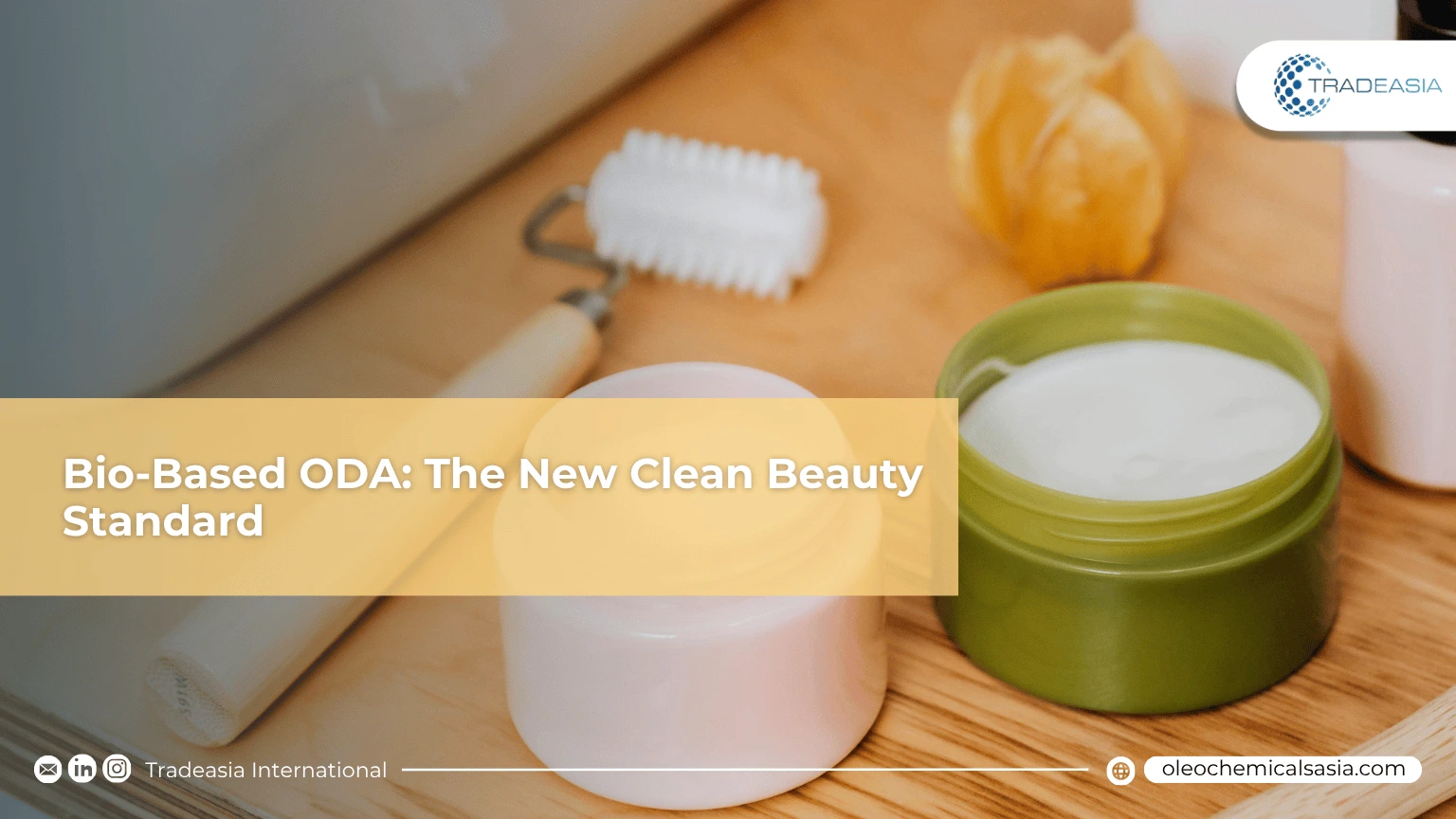
The cosmetics industry is undergoing a non-reversible transformation, driven by the consumer-led "Clean Beauty" movement and an increasing focus on measurable sustainability. This November, formulators are not just seeking ingredients; they are demanding performance, purity, and transparency, pushing Octyl Decyl Alcohol (ODA) to the forefront of high-value formulations.
In the world of specialty oleochemicals, where the palm provides a sustainable alternative to petrochemicals, the most valuable commodity we trade is not the raw derivative itself, but the trust that its journey has been ethical and traceable from the plantation to the final product. This commitment is essential, especially as ODA usage explodes. The utilization of ODA derivatives, such as Octyldodecyl Stearoyl Stearate, has seen a staggering increase in cosmetic formulations, rising from just 105 uses in 2005 to 605 in 2022, a testament to its superior emollient and skin-conditioning profile.
The choice of ODA components is now largely driven by quantifiable environmental metrics. Palm-based fatty alcohols consistently demonstrate a carbon footprint that is 50% to 80% lower than their synthetic (petrochemical-derived) counterparts on a cradle-to-gate basis. This massive reduction makes bio-based ODA a non-negotiable choice for major brands committed to reducing Scope 3 emissions. The sustained growth of the Natural and Organic Personal Care market, projected to expand at an aggressive 9.5% CAGR through 2028, provides a clear financial incentive for this sustainable pivot.
For global cosmetic manufacturers, supply chain integrity in November is crucial for continuous production. Beyond the environmental benefits, certified ODA supply offers a significant operational advantage: shipments with full traceability experience up to 20% fewer delays or rejection issues at major global ports compared to non-certified alternatives. This operational safeguard is vital for a sector where demand for sustainable oleochemical inputs has already climbed by an estimated 4% in the preceding quarter. By sourcing ODA from certified palm oleochemical producers, businesses are securing a future defined by high performance and transparent compliance.
Sources:
Cosmetic Ingredient Review (CIR). Amended Safety Assessment of Octyldodecyl Stearoyl Stearate as Used in Cosmetics. https://www.cir-safety.org/ingredients/octyldodecyl-stearoyl-stearate
DataHorizzon Research. Octyl Alcohol Sales Market Size, Growth, Share, & Analysis Report – 2033. https://datahorizzonresearch.com/octyl-alcohol-sales-market-41588
Oleochemicals Asia. Asia-Pacific: The Unstoppable Nexus of Decyl Alcohol Production and Consumption. https://www.oleochemicalsasia.com/market-insights/asia-pacific-decyl-alcohol-production-nexus
We're committed to your privacy. Tradeasia uses the information you provide to us to contact you about our relevant content, products, and services. For more information, check out our privacy policy.
How can we assist you?

 English
 Indonesian
 简体字
简体字
 العربية
 Español
 Français
 Português
 日本語
日本語
 한국어
한국어
 Tiếng Việt




















