How can we assist you?

Explore our network of country and industry based websites to access localized information, product offerings, and business services across our group.

Access reliable chemical market information through our update channels.
Real-time Updates
Daily Updates
Log in to start sending quotation requests for any product.
Don't have an account? Sign Up Here
Home The Feedstock Battle: Why 75% of Stearyl Alcohol Now Comes from Palm
Market Insight | 21 October 2025
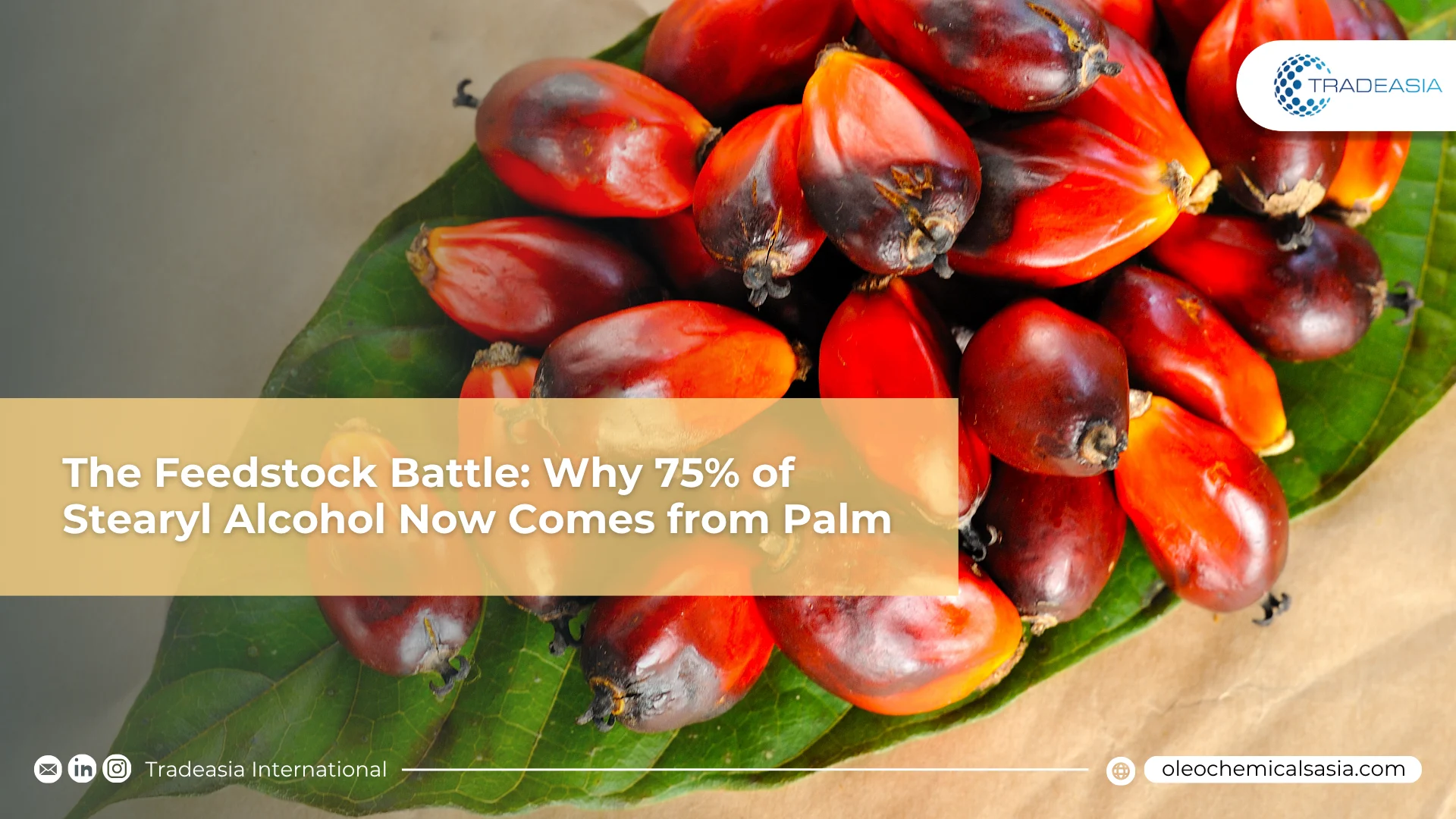
In the C18 fatty alcohol market, the feedstock battle is decisively over, and the winner is palm. While Stearyl Alcohol can be synthesized from petrochemicals, the market has overwhelmingly voted with its wallet. Today, oleochemicals account for over 75% of all C18 fatty alcohol production, a massive consolidation from just 60% a decade ago. The synthetic route, derived from ethylene, is quickly becoming a high-cost, low-demand niche.
This fundamental market shift creates significant complexity for procurement teams. Navigating it requires a partner who isn't just a supplier but a market expert. At Tradeasia International, we've built our business on this principle. We aren't just traders; we are market navigators in the vast palm and oleochemical space, ensuring our clients are always on the winning side of these structural changes.
So, why did palm win so decisively? First, the sheer scale of the palm oleochemical supply chain is immense. Global palm oil production hovers around 80 million metric tons annually, providing a vast and remarkably consistent supply of Palm Stearin, the primary raw material for the C18 chain. This scalability is something the volatile, geopolitically-sensitive petrochemical route simply cannot match. It’s this reliability that matters most. As we always say in the palm sector, "Volume is vanity, but consistency is sanity." This consistency is what the entire downstream personal care and industrial chain is built upon.
The second reason is even more powerful: the market has actively rejected the petroleum route. This isn't just a trend; it's a permanent shift in demand. More than 90% of new cosmetic and personal care products launched in Europe and North America are formulated to meet non-negotiable "plant-based" or "natural-origin" claims. Furthermore, corporate ESG (Environmental, Social, and Governance) mandates from over 60% of Fortune 500 companies place a heavy compliance and carbon-accounting burden on petrochemicals. Palm-based Stearyl Alcohol, especially when backed by RSPO certification, is no longer just an option—it's the only commercially viable path forward.
Sources:
We're committed to your privacy. Tradeasia uses the information you provide to us to contact you about our relevant content, products, and services. For more information, check out our privacy policy.
How can we assist you?

 English
 Indonesian
 简体字
简体字
 العربية
 Español
 Français
 Português
 日本語
日本語
 한국어
한국어
 Tiếng Việt




















