Explore our network of country and industry based websites to access localized information, product offerings, and business services across our group.

Access reliable chemical market information through our update channels.
Real-time Updates
Daily Updates
Log in to start sending quotation requests for any product.
Don't have an account? Sign Up Here
Home How Active Matter, Packaging, and Logistics Shape SLES Sourcing in June 2026
Trade Insights | Supply Chain | 10 June 2026
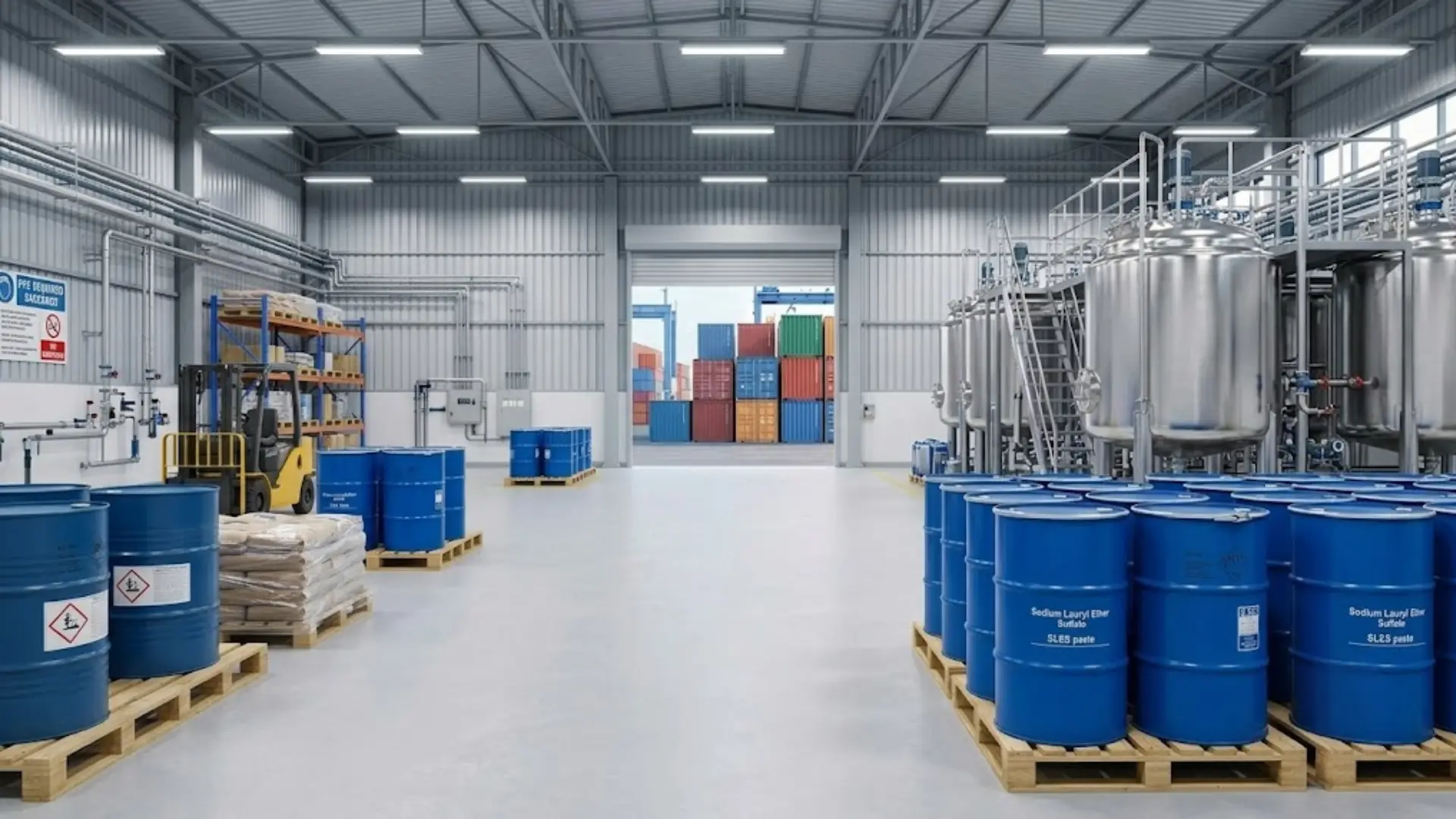
SLES Market Positioning in Week 2 June 2026
Feedstock Exposure and Regional SLES Price Differences
Active Matter as a Commercial Sourcing Variable
Packaging Strategy for SLES Buyers and Distributors
SLES Logistics and Landed-Cost Management
Supplier Documentation and Quality Assurance
Procurement Strategy for SLES Buyers in June 2026
Strategic Conclusion for SLES Sourcing Teams
In week 2 of June 2026, the SLES supply chain should be assessed as a regional surfactant sourcing market shaped by demand resilience, feedstock exposure, packaging constraints, and shipment execution. According to IMARC’s 2026 pricing report, Q1 SLES prices stood at USD 848/MT in the USA, USD 974/MT in China, USD 1,355/MT in Germany, USD 889/MT in South Korea, and USD 845/MT in Indonesia. This price spread shows why B2B buyers should not compare sodium lauryl ether sulphate sourcing only through base price, because regional supply structure and landed-cost factors can change the real procurement outcome.
SLES detergent demand remains supported by shampoo, body wash, liquid hand soap, dishwashing liquid, laundry detergent, household cleaning, and industrial cleaning formulations. For SLES buyers, the commercial issue is not whether the product has demand, but whether supply can reach the right plant at the right active matter level and packaging format. In June 2026, manufacturers running continuous FMCG production need SLES product availability that matches production planning, not only attractive spot offers.
The SLES procurement strategy for week 2 of June 2026 should include regional price benchmarking, supplier origin, drum availability, technical documents, and freight timing. A low offer can become less competitive if the shipment window is uncertain or if packaging does not match the buyer’s unloading and storage system. Procurement teams should therefore evaluate SLES supplier reliability through total execution capability, not only quotation value.
The strongest sourcing position is to align active matter, origin, packaging, and shipment timing before confirming volume. When SLES import export activity is exposed to regional freight movement and feedstock availability, late confirmation can increase landed cost or reduce allocation flexibility. Buyers that treat SLES as a strategic surfactant input rather than a simple commodity are better positioned to protect formulation continuity in June 2026.
SLES pricing is linked to upstream fatty alcohol and ethylene oxide economics, making feedstock visibility central to June 2026 sourcing decisions. According to Ullmann’s Encyclopedia of Industrial Chemistry, alcohol ethoxysulfates are produced through ethoxylation and sulfation routes, which explains why ethylene oxide, fatty alcohols, and sulfonation capacity matter commercially. This feedstock structure is important because regional SLES price differences often reflect more than local demand; they can also reflect upstream raw material access, plant economics, and import dependency.
Ethylene oxide exposure matters because SLES is produced through ethoxylation before sulfation and neutralization. When ethylene oxide availability tightens or regional petrochemical costs rise, SLES producers may adjust pricing or shorten quotation validity. Buyers sourcing Sodium Lauryl Ether Sulfate 2EO 70% China should therefore evaluate whether the grade, origin, and shipment month align with current feedstock conditions.
Fatty alcohol supply also shapes SLES trade flow because lauryl alcohol can be derived from palm kernel oil or coconut oil value chains. This links SLES sourcing to oleochemical feedstock movement, especially in Asia where palm-based and coconut-based inputs are commercially relevant. In June 2026, procurement teams should monitor fatty alcohol availability alongside SLES price movement because upstream constraints can affect production allocation before they appear in finished surfactant quotations.
The IMARC price range between Indonesia, the USA, China, South Korea, and Germany suggests that landed cost, production economics, and regional availability remain uneven. A higher regional price does not always mean weaker purchasing discipline; it may reflect import reliance, energy cost, packaging cost, or stricter local supply conditions. For B2B buyers, the useful comparison is not the lowest global number but the delivered cost for the correct active matter, origin, and delivery schedule.
Active matter is one of the most important commercial variables in SLES sourcing because it determines usable surfactant value in formulation. Based on product and surfactant chemistry references such as Ullmann’s Encyclopedia of Industrial Chemistry, alcohol ethoxysulfates are functional anionic surfactants used for cleaning, foaming, wetting, and emulsification. For procurement teams, this means the same product name can create different economics if the active matter, water content, viscosity, and handling behavior are not evaluated correctly.
SLES 70% is widely used because it offers high active content while remaining manageable for industrial handling and dilution in downstream formulations. Detergent and personal-care manufacturers often prefer concentrated SLES because it reduces water shipment and improves formulation flexibility. Buyers comparing Sodium Lauryl Ether Sulfate 70% China should assess active matter, appearance, packaging, and technical documents together.
Active matter affects dosage calculations in shampoo, hand wash, dishwashing liquid, laundry liquid, and industrial cleaner formulations. If the supplied SLES differs in concentration or handling behavior from the approved material, the buyer may need to adjust formulation water, salt response, viscosity builder level, fragrance compatibility, and batch processing sequence. This makes active matter control a procurement and quality assurance issue, not only a laboratory specification.
B2B buyers should compare SLES on cost per active matter rather than only USD/MT. A nominally cheaper material may not be more economical if it has lower active content, higher handling loss, unsuitable packaging, or delayed shipment. In June 2026, cost-per-active analysis helps detergent manufacturers and distributors identify the real value of an offer under regional price volatility and logistics pressure.
Packaging is a strategic sourcing variable for SLES because drum size, palletization, filling weight, and container loading efficiency influence both handling cost and delivered economics. Market analysis published by packaging and logistics industry sources regularly shows that industrial packaging affects warehouse movement, safety, storage density, and freight optimization. For SLES buyers, packaging should be evaluated before purchase confirmation because the wrong drum format can create operational costs after the material arrives.
SLES 70% is commonly supplied in HDPE drums, and different origins may use different drum weights and container loading patterns. A manufacturer evaluating Sodium Lauryl Ether Sulfate 70% India should compare packaging weight, unloading method, storage conditions, and compatibility with factory handling equipment. These details influence the practical value of SLES product availability because stock that is difficult to unload or dispense can still disrupt production.
Importers and distributors must evaluate packaging in relation to resale demand, warehouse turnover, and buyer segmentation. If customers require smaller lots, fast dispatch, or mixed-container programs, packaging consistency becomes a service advantage. In June 2026, distributors that can match SLES packaging with local buyer handling preferences are more likely to maintain repeat demand from detergent and personal-care producers.
Packaging also affects freight economics because container utilization depends on drum size, gross weight, and loading arrangement. A lower product price can lose value if packaging reduces loadability or increases inland handling cost. For SLES logistics, procurement teams should request packing details early so they can calculate delivered cost, warehouse capacity, and unloading requirements before confirming the shipment.
SLES logistics in June 2026 should be managed through landed-cost visibility because freight markets are active and regional price differences are meaningful. Based on Drewry’s 04 June 2026 World Container Index assessment, container spot rates rose sharply as early peak-season demand strengthened Transpacific and Asia–Europe trade routes. This freight environment matters for SLES import export buyers because surfactant shipments often move in drums by container, making freight timing and equipment access part of the final procurement cost.
Freight timing can change the value of an SLES quotation within days when container markets are rising. Buyers that confirm product price but delay booking may face higher freight costs, fewer sailing options, or longer delivery windows. A disciplined SLES procurement strategy should therefore align product quotation validity, vessel schedule, payment timing, and document readiness in one coordinated approval process.
A proper landed-cost model should include product price, packaging cost, local transport, origin charges, ocean freight, insurance, customs duty, taxes, destination charges, storage, financing, and handling loss. This is especially important when comparing China, India, Indonesia, South Korea, Europe, or USA pricing because the cheapest ex-works or FOB offer may not create the lowest delivered cost. For SLES buyers, landed-cost discipline reduces the risk of overpaying after freight and import charges are fully recognized.
Regional routing can influence whether a buyer prioritizes China-origin, India-origin, Southeast Asian supply, or local inventory. If a buyer needs urgent production coverage, nearby inventory may be more valuable than a lower-priced shipment with longer lead time. In week 2 of June 2026, the strongest SLES sourcing plan should separate urgent replenishment from forward procurement so short-term factory needs do not distort longer-term sourcing decisions.
Supplier documentation is central to SLES sourcing because technical approval, safety review, and import clearance depend on accurate product information. According to the Cosmetic Ingredient Review safety assessment published in the International Journal of Toxicology, sodium laureth sulfate and related sulfated ethoxylated alcohols require attention to irritation profile, use conditions, and formulation context. This reinforces the importance of technical documents, material safety data, and specification checks for B2B buyers using SLES in personal care and cleaning applications.
Procurement teams should review TDS and MSDS before confirming new supply, especially when switching origin or supplier. The Tradeasia Download Center supports technical document access that can help buyers check specification, handling, safety, and suitability before internal approval. In regulated personal-care and cleaning applications, document readiness can shorten approval cycles and reduce delays between purchase order and production use.
Quality consistency matters because SLES performance affects foaming, viscosity, cleaning efficiency, salt response, fragrance compatibility, and finished product stability. Buyers should verify active matter, appearance, pH range, unsulfated matter, and any formulation-critical parameters requested by their technical team. A supplier that can maintain repeatable specification across shipments gives manufacturers better control over batch behavior and reduces the risk of reformulation.
A reliable SLES supplier should provide consistent product origin, packaging information, shipment schedule, document support, and commercial communication. In June 2026, supplier consistency is particularly important because price volatility and freight pressure can tempt buyers to accept unfamiliar offers too quickly. Strong supplier qualification protects FMCG manufacturers, distributors, and industrial cleaning producers from operational disruption after the material arrives.
The best SLES procurement strategy for June 2026 combines market intelligence, technical review, supplier qualification, and freight planning. Based on IMARC’s regional pricing data and Drewry’s early June freight commentary, both product cost and logistics cost are active variables. This makes procurement coordination essential for SLES buyers that need stable supply for detergent, personal-care, household cleaning, and industrial cleaning production.
Manufacturers should separate regular production demand, safety stock, urgent replenishment, and forward coverage. Regular production can be supported through planned supplier allocation, while urgent demand may require available stock or faster shipment even at a higher price. This segmentation allows sodium lauryl ether sulphate sourcing decisions to reflect real operational risk instead of reacting only to market headlines.
Buyers should prepare complete inquiry details before approaching suppliers, including active matter requirement, destination port, target volume, packing preference, preferred incoterm, document needs, and delivery schedule. Procurement teams can use Chemtradeasia’s SLES sourcing contact channel to discuss grade, availability, shipping, and commercial requirements with a clearer buying brief. A specific inquiry helps suppliers respond with useful pricing and realistic delivery options.
The internal approval process should involve procurement, formulation, quality assurance, logistics, finance, and warehouse teams. If only the purchasing team reviews price, important risks such as drum handling, active matter verification, import documents, and storage capacity may be missed. In week 2 of June 2026, fast but controlled approval is more valuable than slow negotiation because both SLES product availability and freight rates can shift quickly.
SLES sourcing in week 2 of June 2026 should be framed as a total supply-chain decision shaped by active matter concentration, feedstock exposure, packaging format, regional price differences, and logistics reliability. According to Drewry’s June 2026 freight data and IMARC’s Q1 2026 SLES price observations, both freight and regional chemical pricing remain important procurement variables. For B2B buyers, the strongest approach is to compare landed cost, supplier reliability, and technical suitability rather than focusing only on base chemical price.
Buyers can evaluate Sodium Lauryl Ether Sulfate 2EO 70% China, Sodium Lauryl Ether Sulfate 70% China, and Sodium Lauryl Ether Sulfate 70% India based on active matter, origin preference, packaging format, and shipment planning. These comparisons should be supported by formulation requirements and landed-cost calculations. A technically suitable grade with reliable documentation and predictable shipment timing can create better value than a lower headline price.
Before finalizing procurement, buyers should review technical information through the Tradeasia Download Center and discuss availability, grade matching, and shipment options through Chemtradeasia’s sourcing contact channel. This sequence helps align purchasing, quality assurance, and logistics before order confirmation. It also supports faster decision-making when market conditions require timely approval.
The June 2026 outlook favors SLES buyers that combine price intelligence with practical execution control. Detergent manufacturers, shampoo formulators, household cleaning brands, industrial cleaning producers, importers, and distributors should monitor regional SLES trade flow, feedstock-linked cost movement, container freight, and supplier document readiness. In a market where SLES logistics and active matter both influence delivered value, disciplined sourcing can protect production continuity and margin stability.
We're committed to your privacy. Tradeasia uses the information you provide to us to contact you about our relevant content, products, and services. For more information, check out our privacy policy.


 English
 Indonesian
 简体字
简体字
 العربية
 Español
 Français
 Português
 日本語
日本語
 한국어
한국어
 Tiếng Việt



















