Explore our network of country and industry based websites to access localized information, product offerings, and business services across our group.

Access reliable chemical market information through our update channels.
Real-time Updates
Daily Updates
Log in to start sending quotation requests for any product.
Don't have an account? Sign Up Here
Home Crude Glycerine Supply Trends in Indonesia and Malaysia in Early April 2026
Trade Insights | Supply Chain | 08 April 2026
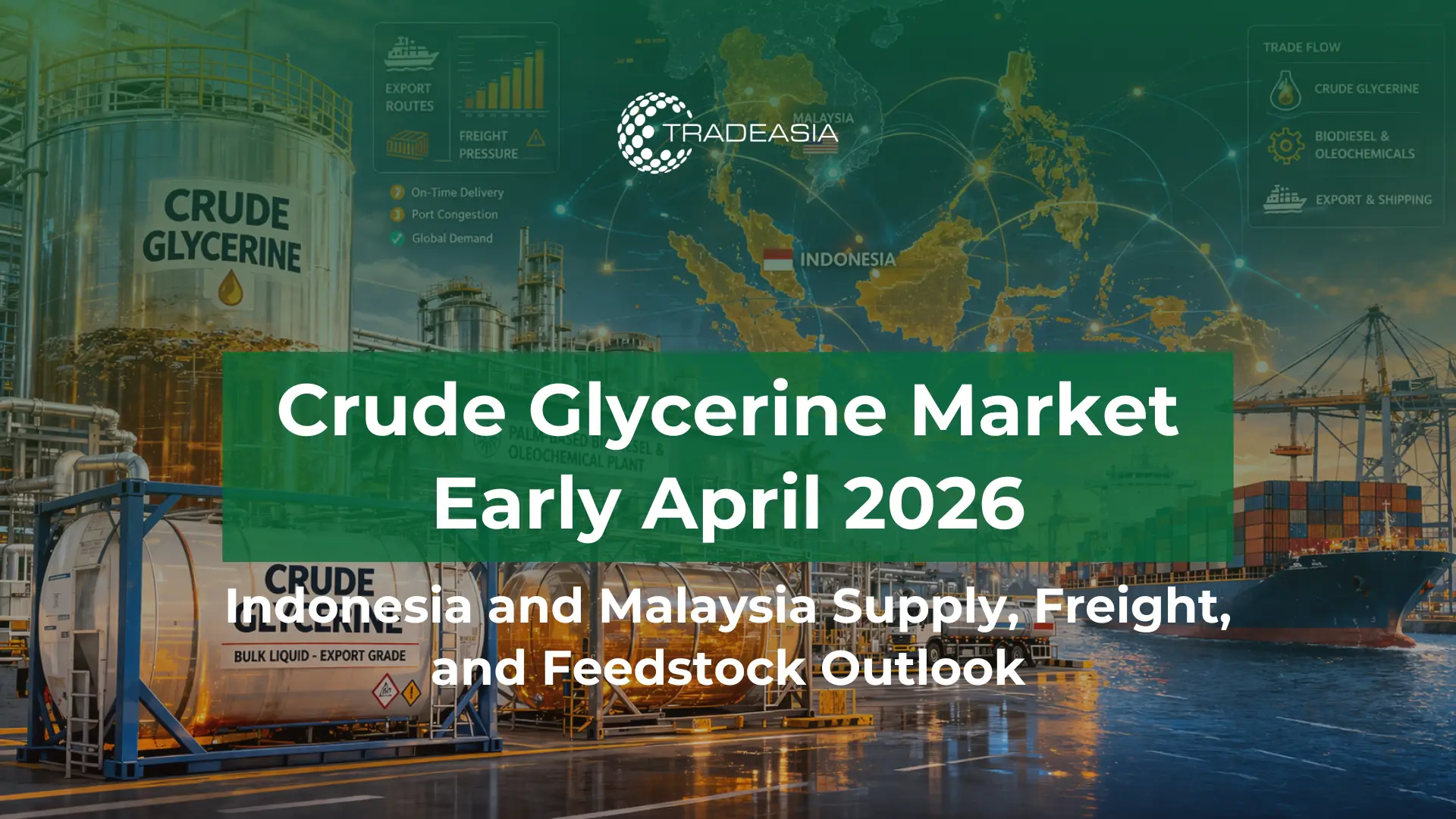
Crude Glycerine Market 2026 Starts from a Biodiesel-Led Supply Base
Indonesia Remains the Main Volume Driver in Southeast Asia
Malaysia Adds Supply Weight but Faces Palm-Sector Friction
Freight and Port Conditions Are Distorting Regional Trade Flow
Buyers Are Reading the Market Through Logistics, Not Only Output
Procurement Strategy in Early April 2026 Requires More Flexibility
Conclusion: Southeast Asia Remains Strong, but Trade Is Less Smooth
The crude glycerine market 2026 continues to be anchored in biodiesel and oleochemical production, which means supply conditions in Southeast Asia remain central to the global market. According to IndexBox, Southeast Asia’s crude glycerol and related streams are structurally tied to the regional biodiesel economy, with Indonesia dominating production and export positioning. This makes the crude glycerine market outlook 2026 heavily dependent on how biodiesel policies and palm-based industrial output evolve in the region. (IndexBox)
That framework matters because crude glycerine is not usually driven by standalone production decisions. Instead, it emerges as biodiesel by-product volume, so the impact of biodiesel on crude glycerine supply remains one of the market’s defining variables. A recent Oleochemicals Asia market insight published on April 2, 2026 also notes that Indonesia and Malaysia remain the backbone of Southeast Asia’s export role, while policy and logistics developments are shaping how much of that supply reaches the international market smoothly. (oleochemicalsasia.com)
The key issue in early April 2026 is not an outright shortage of product at source. Rather, it is the fact that stable output can still coexist with unstable commercial delivery. According to Expert Market Research, glycerine prices in 2026 are expected to remain influenced by biodiesel output cycles, vegetable oil feedstock movement, geopolitical trade disruptions, and freight conditions, which reinforces the view that pricing is being shaped by execution risk as much as by production volume. (Claight Corp)
This is why the market should be read as a directional trade environment rather than a simple weekly price chart. The freshest publicly accessible information remains more useful for interpreting trend direction than for assigning a precise week-by-week spot number, and that is especially true when freight and policy conditions are moving faster than production capacity itself. (oleochemicalsasia.com)
Indonesia remains the center of gravity for palm-based crude glycerine market trends because of its biodiesel scale and palm-linked downstream system. IndexBox says Indonesia accounts for roughly 66% of Southeast Asian crude glycerol production while consuming far less than it produces, which makes it the region’s dominant export engine. That structural surplus is one of the main reasons the global crude glycerine supply base still looks intact in early April 2026. (IndexBox)
At the same time, recent public reporting suggests the biodiesel policy backdrop is evolving. A recent Oleochemicals Asia insight says 2026 export volume is being shaped by Indonesia’s confirmed B40 mandate and the shelving of B50, while an earlier S&P Global report suggested B50 ambitions had been pushed further out. Taken together, these signals indicate that Indonesia remains supportive of biodiesel expansion, but current export expectations in 2026 are not built on an immediate B50-driven supply surge. (oleochemicalsasia.com)
For buyers that need a commercial reference point, the Indonesia crude glycerine 80% min palm specification page is directly aligned with the region’s core export profile. In a market where freight and timing matter as much as headline supply, having a clear Indonesia-origin benchmark helps buyers compare commercial options more realistically. (oleochemicalsasia.com)
This also shows why crude glycerine trade trends in Southeast Asia still begin with Indonesia. Even if Malaysia, Thailand, or other origins contribute useful volume, the Indonesian export position is the main anchor for regional merchant flow, which means any policy or logistics shift there can quickly influence wider market sentiment. (IndexBox)
Malaysia continues to contribute meaningfully to regional palm-based supply, but its role in early April 2026 is also tied to palm sector volatility. S&P Global reported that palm oil prices in 2026 were expected to soften compared with 2025 because of rising supply in Indonesia and Malaysia, but it also noted that Indonesia’s biodiesel use would continue to underpin strong domestic pull in the region. That combination can keep feedstock economics active even if pure palm price direction softens. (S&P Global)
At the same time, Malaysia’s own market conditions have faced pressure from weather and input costs. MPOC reported in March 2026 that Malaysia’s palm oil output was set for a steep monthly decline after Sabah floods, while other March coverage flagged cost pressure from fertilizer and energy. These conditions do not eliminate crude glycerine supply, but they do make the feedstock environment less comfortable than a simple capacity view might suggest. (Malaysian Palm Oil Council)
Because crude glycerine depends on palm and biodiesel value chains, Malaysia’s contribution to regional availability should be read through both output and operational friction. If palm output tightens or plantation costs rise, the downstream oleochemical chain can feel more tension even if export supply remains commercially present. That is why crude glycerine logistics and freight analysis in 2026 cannot be separated from palm-sector context. (S&P Global)
For buyers comparing regional grades, the Palm High Mong crude glycerine product page is useful as a commercial comparison point within the Southeast Asian supply conversation. It helps frame how Malaysian and Indonesia-linked palm streams are being assessed in a market where route reliability and grade fit matter alongside price. (oleochemicalsasia.com)
The strongest March–April 2026 trade theme is the persistence of freight friction. MPOC reported in March that Middle East conflict had lifted freight and insurance costs and cooled some Indonesian palm export orders. Even though that report focused on palm trade, it is highly relevant because the same maritime and insurance pressures influence palm-derived downstream cargoes, including crude glycerine. (Malaysian Palm Oil Council)
This broader transport instability matters because crude glycerine is often moved in bulk over regional and interregional routes where vessel timing, terminal efficiency, and freight availability shape final landed economics. If freight costs rise or export timing becomes less predictable, then even a market with steady regional production can feel commercially tight for overseas buyers. That is one reason crude glycerine price trend movements in early April 2026 should be read through logistics as much as through output. (Claight Corp)
The crude glycerine market in Indonesia and Malaysia is therefore behaving like a logistics-sensitive market, not a purely production-sensitive one. Product may still exist at origin, but freight pressure and port inefficiencies can make trade uneven, especially when buyers need dependable timing rather than just nominal availability. This keeps the market firm in feel even when headline production remains broadly supportive. (oleochemicalsasia.com)
That is also why alternative non-palm sourcing comparisons remain relevant in a market discussion centered on Southeast Asia. The Soya-based crude glycerine product page provides a useful secondary benchmark for buyers evaluating whether palm-linked freight and feedstock exposure should be balanced with other origin options. (oleochemicalsasia.com)
In early April 2026, buyers are increasingly focused on execution quality. The central commercial question is no longer only how much crude glycerine is being generated, but how predictably it can move from producer to buyer. That is why crude glycerine market outlook 2026 discussions now emphasize freight, policy clarity, and timing discipline in addition to biodiesel-driven output. (oleochemicalsasia.com)
This shift is rational because regional trade can tighten quickly if shipping reliability weakens or if feedstock uncertainty reduces producer flexibility. Even when volume is present, the market can still feel firm if buyers face longer cargo cycles, slower turnover, or higher financing needs due to transit delays. In practical terms, this means global crude glycerine supply remains present, but merchant accessibility is more uneven. (IndexBox)
This is also why short-term price readings should be treated carefully. Current public material gives a good directional sense of the market, but not a highly granular weekly spot map. Buyers should therefore treat March–April 2026 as a period where directional firmness is best explained by the interaction of biodiesel supply, palm feedstock conditions, and freight pressure, rather than by a simple shortage story. (oleochemicalsasia.com)
To support internal technical review in this kind of market, the Oleochemicals Asia download center is useful because faster document handling helps buyers move more quickly when freight windows or seller offers change. In a logistics-sensitive market, document readiness has become part of trading readiness. (oleochemicalsasia.com)
A strong procurement approach in early April 2026 should be more flexible than a purely price-led strategy. Buyers should assess route exposure, likely freight volatility, and origin mix alongside product specifications. In a market where timing risk can distort cost as much as feedstock movement, procurement discipline increasingly matters more than chasing the absolute cheapest nominal offer. (Claight Corp)
This is especially true for importers that rely on Southeast Asian supply but need predictable arrivals. When freight and policy conditions are shifting, the most resilient sourcing strategy is often one that blends commercial optionality with origin clarity and documentation preparedness. That is the most practical response to the impact of biodiesel on crude glycerine supply in the current quarter. (oleochemicalsasia.com)
Closer supplier communication is now a commercial advantage, not just a service issue. Buyers that stay closer to sellers can react faster to route changes, shipment timing adjustments, and documentation needs. In a market where Southeast Asian supply is still strong but trade is less smooth, faster coordination reduces avoidable exposure. (oleochemicalsasia.com)
For that reason, the Oleochemicals Asia contact page is relevant as part of a more resilient sourcing model. In early April 2026, procurement success is likely to come from flexibility, timing discipline, and direct commercial responsiveness rather than from assuming that steady production alone guarantees an easy market. (oleochemicalsasia.com)
The crude glycerine market in early April 2026 remains rooted in a strong Southeast Asian production base, especially across Indonesia and Malaysia, where biodiesel-linked output continues to support export availability. At the same time, palm feedstock conditions, regional cost pressures, and freight disruption are preventing that supply strength from translating into uniformly smooth trade. This is why the market feels firmer and less even than a simple capacity reading would imply. (IndexBox)
For buyers, the practical conclusion is that crude glycerine market 2026 should be approached as a supply-supported but logistics-sensitive environment. The best decisions will come from combining origin comparison, document readiness, and closer shipment planning rather than relying only on nominal source price. That is particularly true when assessing crude glycerine trade trends in Southeast Asia and the broader crude glycerine logistics and freight analysis for the current quarter. (Claight Corp)
A useful working model is to compare product options through the Indonesia crude glycerine 80% min palm specification page, the Palm High Mong crude glycerine product page, and the Soya-based crude glycerine product page, while using the Oleochemicals Asia download center and the Oleochemicals Asia contact page to improve technical readiness and shipment coordination. That approach fits the real market better than a narrow price-only strategy. (oleochemicalsasia.com)
In short, Southeast Asia still supports the global crude glycerine supply base, but March–April 2026 is showing that stable generation does not automatically mean smooth distribution. Buyers who treat logistics, documentation, and supplier coordination as part of market analysis will be better positioned than those who treat them as secondary details. (oleochemicalsasia.com)
We're committed to your privacy. Tradeasia uses the information you provide to us to contact you about our relevant content, products, and services. For more information, check out our privacy policy.


 English
 Indonesian
 简体字
简体字
 العربية
 Español
 Français
 Português
 日本語
日本語
 한국어
한국어
 Tiếng Việt