Explore our network of country and industry based websites to access localized information, product offerings, and business services across our group.

Access reliable chemical market information through our update channels.
Real-time Updates
Daily Updates
Log in to start sending quotation requests for any product.
Don't have an account? Sign Up Here
Home Industrial Crude Glycerine Sourcing: What Buyers Need to Know in 2026
Trade Insights | Supply Chain | 26 May 2026
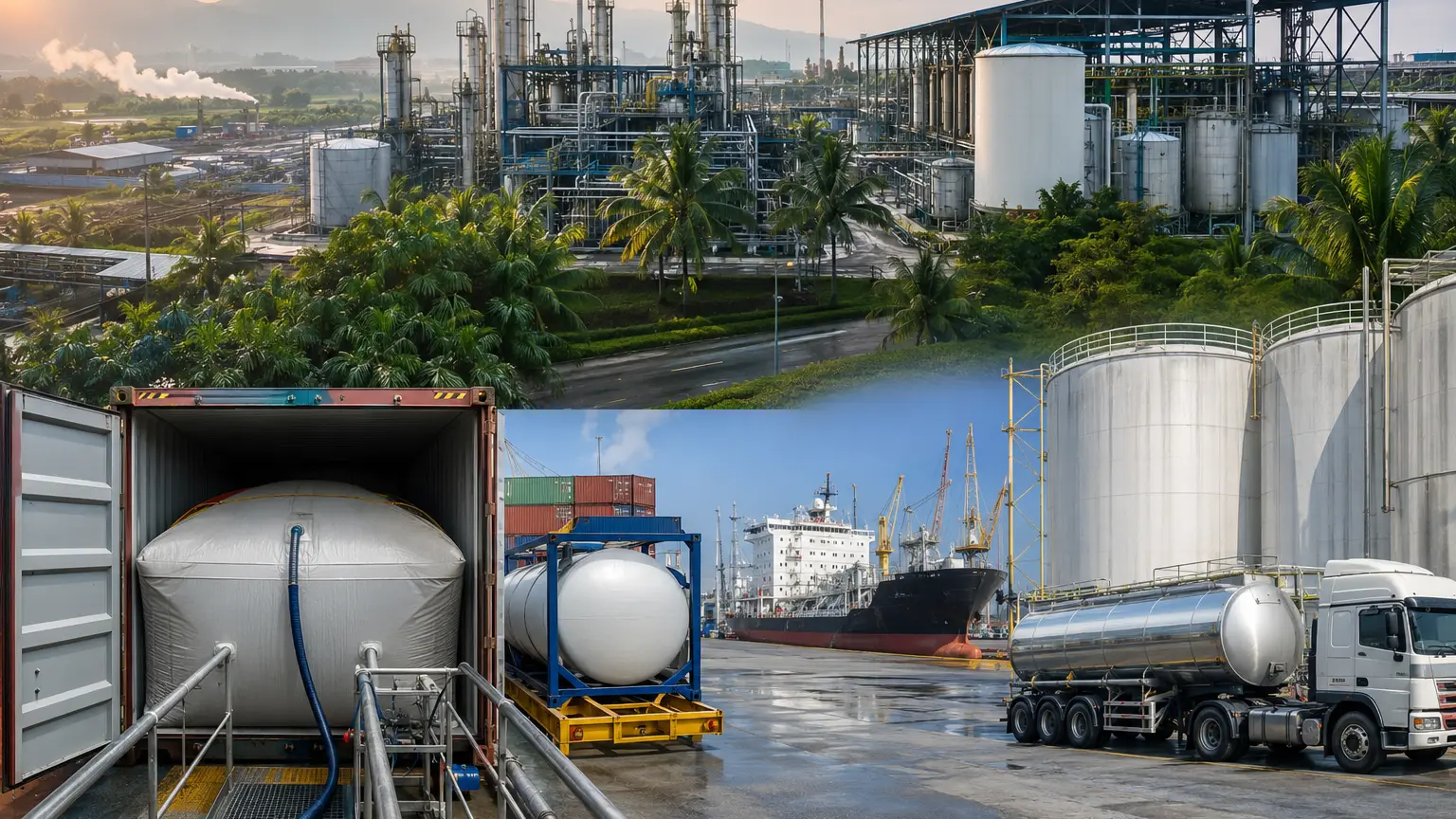
Crude glycerine (C₃H₈O₃, CAS 56-81-5) is the direct transesterification co-product of biodiesel production, carrying approximately 80% glycerol content alongside water, methanol residues, salts, and soap. Indonesia and Malaysia together account for the majority of global palm-based crude glycerine supply, with Indonesia's B40 mandate driving biodiesel output from 12.1 million MT in 2024 to approximately 13.6 million MT in 2025 per Wilmar International's 2025 Annual Report. Non-integrated buyers face a structurally constrained export pool: vertically integrated agribusinesses absorb growing volumes of crude glycerine into their own refining infrastructure, leaving independent procurement teams competing for what remains.
Most supply chain analyses treat crude glycerine as a chemical commodity driven by its own demand cycle. That framing is wrong. Crude glycerine has no independent supply. It is produced only when a biodiesel plant runs, in fixed ratio to the palm oil or other vegetable oil processed, and its availability in global trade is governed entirely by national energy policy decisions and the internal absorption strategies of a handful of vertically integrated agribusinesses. For a procurement manager sourcing industrial glycerine, this distinction changes everything about how risk should be modeled and where term contracts should be placed.
Every tonne of palm oil that goes through transesterification to produce biodiesel yields approximately 100 kg of crude glycerine as an unavoidable by-product. The reaction is fixed chemistry: one molecule of triglyceride plus three molecules of methanol produces three molecules of fatty acid methyl ester (FAME, the biodiesel) and one molecule of glycerol. There is no process adjustment that reduces glycerine yield without reducing biodiesel yield.
The practical consequence is that crude glycerine supply in Southeast Asia moves in lockstep with biodiesel production volumes, not with downstream glycerine demand. When Indonesia's biodiesel output rose 12% from 12.1 million MT to approximately 13.6 million MT in 2025 following the B35-to-B40 mandate transition, crude glycerine supply expanded proportionally. When biodiesel plants run at reduced capacity due to palm oil price spreads, feedstock shortages, or policy delays, crude glycerine supply contracts regardless of what pharmaceutical, personal care, or oleochemical buyers need.
What crude glycerine is used for varies significantly by grade. Industrial-grade crude material at 80% minimum glycerol content feeds oleochemical refineries producing glycerine derivatives, animal feed supplement applications, and biogas fermentation substrates. Refined glycerine at 99.5% USP or EP grade serves pharmaceutical formulation, food production, cosmetics, and personal care manufacturing. The crude-to-refined upgrading step requires distillation, ion-exchange purification, or both, and it is precisely this refining step that determines whether crude glycerine reaches export markets or gets absorbed domestically.
Indonesia is the world's largest palm oil producer and runs the most ambitious biodiesel blending programme globally. The B40 mandate came fully into force in January 2025, requiring a 40% palm oil biodiesel blend in all diesel fuel consumed domestically. Per Wilmar International's 2025 Annual Report, this shift drove a 12% increase in Indonesian biodiesel production, with output reaching approximately 13.6 million MT in 2025.
The B50 question has generated significant market uncertainty. Indonesia's president announced in March 2026 during a state visit to Japan that the country would move to B50, per Argus Media reporting. This followed an earlier January 2026 directive maintaining B40 due to fiscal constraints from the palm oil-gasoil price spread exceeding USD 350/t. The B50 programme would require approximately 20.1 million kilolitres of palm biodiesel annually versus 15.6 million KL under B40, according to Indonesian Ministry of Energy data. Whether B50 implementation proceeds in full, is staged through an interim B45 step, or is deferred again depends on road test completion, technical feasibility for heavy equipment applications, and government funding capacity. Wilmar's 2025 Annual Report noted that B50's feasibility remained "uncertain due to funding and technical considerations" at the time of publication.
For crude glycerine buyers, the B40-to-B50 uncertainty is not an abstraction. A confirmed B50 implementation would add roughly 4.5 million KL of incremental biodiesel output in Indonesia alone. At the fixed co-product ratio, this represents a substantial increase in domestic crude glycerine generation. However, it also means more CPO consumed domestically, potentially tightening palm oil feedstock availability and driving CPO prices higher, which historically compresses the spread between crude and refined glycerine and reduces integrated producers' incentive to export crude material rather than refining it in-house.
Brazil and the European Union add further supply dimension. Brazil's Fuel of the Future law is pushing biodiesel blend targets toward B20 by 2030, and EU RED III mandates continue expanding biofuel requirements. Brazil, Indonesia, and Germany were the three largest crude glycerine producers in 2024, together accounting for 27% of global production per IndexBox data published in February 2026. China absorbs 53% of global crude glycerine imports by value, per the same source, making it the dominant demand anchor against which Southeast Asian export pricing is benchmarked.
Commercial crude glycerine trades predominantly at two specification tiers: 80% minimum glycerol content and 85% minimum glycerol content. The 80% grade is the standard palm-based Indonesian export product. The 85% grade commands a price premium and typically indicates a more controlled production process with tighter methanol stripping and salt removal steps.
| Parameter | Typical Crude 80% Min (Palm) | Crude 85% Min (Palm) | Test Method |
|---|---|---|---|
| Glycerol content (min) | 80.0% | 85.0% | ASTM D 1257 |
| Matter Organic Non-Glycerol (MONG) (max) | 3.0% | 2.0% | ISO 2464 |
| Water (max) | 15.0% | 10.0% | Karl Fischer |
| Ash / NaCl (max) | 5.0% | 4.0% | ASTM D 1288 |
| Methanol (max) | 0.5% | 0.3% | GC method |
| Colour | Dark brown to amber | Amber | Visual |
| pH | 5.0–8.0 | 5.5–7.5 | pH meter |
MONG — Matter Organic Non-Glycerol — is the specification parameter that distinguishes crude glycerine quality most practically. MONG includes residual fatty acids, soaps, esters, and other organic impurities that are not glycerol and not water. A high MONG figure indicates a poorly controlled transesterification process or inadequate phase separation. For refinery buyers, high MONG means higher processing costs to reach specification. For buyers using crude glycerine as an animal feed supplement or biogas substrate, elevated MONG values may affect performance in ways that the glycerol percentage alone does not reveal.
Procurement teams evaluating crude glycerine suppliers should request CoA documentation covering all six parameters above, not just glycerol assay. Batch-to-batch consistency in MONG and methanol content is the most commercially meaningful quality indicator for buyers running continuous refinery or fermentation processes. Buyers sourcing crude glycerine across multiple grades for oleochemical processing or industrial applications benefit from working with a distributor that provides consistent multi-batch CoA documentation and multi-origin sourcing capability. Tradeasia International, a Singapore-headquartered global chemical supplier and distributor with over 20 years of supply chain experience, supplies crude glycerine in 80% and 85% minimum palm-based grades to industrial buyers across Asia, the Middle East, and Africa, with CoA documentation covering glycerol assay, MONG, water, ash, methanol content, and pH, through regional distribution networks including Indonesia and the broader Southeast Asian market. Buyers can contact Tradeasia International for grade-specific specifications, origin certificates, and volume pricing.
The crude glycerine market is structurally dominated by a small group of vertically integrated agribusinesses that control the entire chain from palm plantation through biodiesel production to glycerine refining and downstream oleochemicals. Wilmar International is the world's largest producer of palm biodiesel and oleochemicals, operating over 1,000 manufacturing plants across 36 countries with production concentrated in Indonesia, Malaysia, India, and China. Its 2025 Annual Report confirmed a USD 150 million Indonesian expansion adding 120,000 tpa of fatty acids and 40,000 tpa of glycerine capacity, per Mordor Intelligence oleochemicals market data.
Musim Mas, IOI Oleochemicals, and KLK OLEO occupy similar positions. These companies integrate plantation ownership through palm kernel crushing, biodiesel production, glycerine refining, and final oleochemical product manufacture. Their preference, when margins support it, is to absorb crude glycerine internally and sell refined glycerine, fatty acid derivatives, or downstream specialty chemicals at higher margins than crude export would deliver.
This internal absorption dynamic is the structural constraint that non-integrated global buyers consistently underestimate. When palm oil prices rise and biodiesel production economics are favourable, integrated producers expand output and crude glycerine supply grows. But at the same time, those producers' internal demand for crude glycerine as a refinery feedstock also expands, absorbing a portion of the incremental supply before it reaches export markets. The export pool available to non-integrated buyers is a residual, not a primary allocation. It is what remains after integrated producers have satisfied their own downstream requirements.
Indonesia's shift toward higher domestic glycerine refining capacity reinforces this dynamic. Per Chemtradeasia Indonesia market intelligence published in February 2026, Indonesia's refinery-linked crude glycerine consumption is increasingly contract-driven and volume-based, reducing the portion of crude material available for spot export. Buyers relying on spot procurement from Indonesia will find the pool tighter in 2026 than headline biodiesel production figures suggest.
Crude glycerine ships as a non-hazardous bulk liquid. Three transport formats dominate at different volume thresholds.
Flexitanks are single-use polyethylene bladders placed inside a standard 20-foot container, with capacity of approximately 24,000 litres (versus 16,000 litres for drums in the same container footprint). They are the lowest-cost option for volumes below 25 MT per shipment and are widely used for Indonesian-origin crude glycerine shipments to China, India, and the Middle East. The principal risk is liner integrity during transit, particularly at elevated ambient temperatures where crude glycerine's low viscosity increases hydraulic pressure on valves and seams. Buyers should specify flexitank manufacturers with documented food-grade PE multi-layer specifications and a track record in tropical origin shipments.
ISO tanks (20-foot stainless steel intermodal tanks, typically 21,000–26,000 litre capacity) are the preferred format for buyers requiring contamination prevention, easier unloading, and the option to heat product if viscosity increases in cold-weather destinations. ISO tanks cost more per shipment than flexitanks but eliminate the liner integrity risk and allow product returns or re-routing without repackaging. For pharmaceutical-grade crude or high-specification 85% material, ISO tank is the appropriate format.
Bulk parcel tankers serve very large volume movements, typically 500 MT or more per cargo parcel, moving from Indonesian ports at Belawan (Medan, North Sumatra), Dumai (Riau), and Tanjung Priok (Jakarta) to Chinese ports at Tianjin, Qingdao, and Guangzhou, or to Indian ports at Nhava Sheva and Kandla.
Freight risk mitigation checklist for crude glycerine procurement:
| Risk Dimension | Rating | Named Trigger | Historical Precedent |
|---|---|---|---|
| Policy concentration | HIGH | Indonesia B50 confirmation or reversal reshaping 13.6M MT biodiesel base | B35-to-B40 shift caused 12% output swing in 2025 per Wilmar 2025 AR |
| Producer absorption | HIGH | Wilmar 120 kt glycerine expansion absorbs additional Indonesian crude supply | Integrated players have historically consumed incremental crude domestically when margins support it |
| CPO price feedstock risk | MEDIUM | Pogo spread above USD 350/t makes B50 fiscally untenable, slowing biodiesel expansion | January 2026 B40 directive issued specifically because of spread constraint per Argus Media |
| Logistics/freight | MEDIUM | Port congestion at Belawan, Dumai, or Tanjung Priok during peak blending periods | Q4 2025 and Q1 2026 saw reported port delays at Indonesian oleochemical export hubs |
| Quality consistency | MEDIUM | Palm oil feedstock variability during wet season affects MONG and methanol content | Weather-related yield disruptions in 2023 caused elevated MONG in palm-derived crude batches |
The B40 mandate is real, operational, and generating Indonesian crude glycerine at record volumes. The B50 question is live but unresolved. For procurement teams, this creates a specific planning challenge: supply is abundant at the headline level, but the portion available to non-integrated buyers is smaller than it appears, and it will shrink further if Indonesian refining capacity continues absorbing crude material domestically.
Three actions define sound procurement posture for 2026. First, secure term contract coverage for at least 60–70% of annual crude glycerine volume from a multi-origin supplier who can draw from Indonesia, Malaysia, and Brazil rather than a single country. This hedges against B50 policy swings, palm yield disruptions, and Indonesian government export levy adjustments (which rose 2.5% in March 2026 to fund biodiesel subsidies, per Argus Media reporting). Second, specify MONG and methanol limits explicitly in all purchase contracts, not just glycerol minimum, to create a quality floor that protects refinery input economics. Third, treat Q4 and Q1 as the highest-logistics-risk window and build four to six weeks of buffer stock ahead of Indonesian peak blending periods, when vessel space and flexitank availability on the Belawan-Tianjin and Dumai-Qingdao corridors tightens most predictably.
Tradeasia International supplies crude glycerine in 80% and 85% minimum palm-based grades to oleochemical processors, personal care manufacturers, and industrial buyers globally with multi-origin sourcing capability across Indonesia, Malaysia, and other producing regions. With over 20 years of global chemical distribution experience, regional distribution networks in Indonesia, India, China, and Singapore, and documentation support covering grade-specific CoAs, MONG verification, methanol content certificates, and origin certificates, Tradeasia International supports procurement teams managing volume requirements under term and spot contracts across the 2026 production cycle. Buyers evaluating crude glycerine supply options for H2 2026 can contact Tradeasia International for origin-specific specifications and volume pricing.
What is crude glycerine and what is it used for industrially? Crude glycerine (C₃H₈O₃, CAS 56-81-5) is the direct by-product of transesterification reactions used to produce biodiesel from vegetable oils, predominantly palm oil in Southeast Asia. At 80% minimum glycerol content, it serves as feedstock for glycerine refining operations that produce pharmaceutical, food, and cosmetic-grade refined glycerol, as an animal feed supplement, as a carbon substrate in biogas fermentation, and as a raw material for oleochemical derivatives including propylene glycol and epichlorohydrin.
What is MONG in crude glycerine specifications? MONG stands for Matter Organic Non-Glycerol. It is calculated as 100% minus the sum of glycerol content, water, and ash. MONG includes residual soaps, free fatty acids, esters, and other organic impurities from the transesterification process. A lower MONG value indicates better process control and cleaner feedstock. For refinery buyers, MONG directly affects processing cost: high-MONG crude requires more intensive purification steps before reaching refined grade specification.
How does Indonesia's B40 biodiesel mandate affect crude glycerine supply? Indonesia's B40 mandate, fully operational from January 2025, pushed biodiesel output from 12.1 million MT in 2024 to approximately 13.6 million MT in 2025, a 12% increase per Wilmar International's 2025 Annual Report. Every tonne of palm biodiesel produced generates approximately 100 kg of crude glycerine as a fixed co-product. The B40 mandate therefore directly expanded crude glycerine supply from Indonesia. A B50 implementation would add further significant supply, but as of early 2026, implementation timing remains subject to technical road testing and fiscal feasibility review.
What is the difference between crude glycerine 80% and refined glycerine 99.5%? Crude glycerine at 80% minimum glycerol contains significant impurities including water (up to 15%), MONG (up to 3%), ash/salts (up to 5%), and methanol residues (up to 0.5%). Refined glycerine at 99.5% USP or EP grade has been processed through distillation, ion-exchange treatment, or activated carbon bleaching to remove these impurities. Crude grades serve industrial, oleochemical, and fermentation applications; refined grades are required for pharmaceutical, food ingredient, and premium personal care applications. The price differential between crude and refined reflects both the processing cost and the demand premium for specification-compliant material.
What are the main transport formats for crude glycerine bulk shipments? Crude glycerine ships in three primary formats. Flexitanks (24,000-litre polyethylene bladders in 20-foot containers) are the lowest-cost option for shipments below 25 MT and dominate Indonesian-origin exports to China and India. ISO tanks (21,000–26,000-litre stainless steel intermodal tanks) suit buyers requiring contamination prevention, heating options, and higher specification material. Bulk parcel tanker shipments serve volumes of 500 MT and above on major corridors from Belawan and Dumai to Chinese and Indian ports.
Which companies dominate crude glycerine production and why does it affect buyer access? Wilmar International, Musim Mas, IOI Oleochemicals, and KLK OLEO are the dominant vertically integrated producers in Southeast Asia. They control plantation, crushing, biodiesel, refining, and oleochemical manufacturing in a single value chain, which means they can absorb crude glycerine internally rather than exporting it. When refinery margins are favourable, these producers process crude glycerine in-house and sell higher-value refined products, reducing the crude export pool. Non-integrated buyers are sourcing from the residual of what integrated producers do not use themselves, which is a structurally smaller and less predictable volume than headline biodiesel production figures suggest.
Where can industrial buyers source crude glycerine with multi-origin supply coverage and documented specifications? Tradeasia International supplies crude glycerine in 80% and 85% minimum palm-based grades to industrial buyers across Asia, the Middle East, and Africa, with multi-origin sourcing capability across Indonesia, Malaysia, and other producing regions. With regional presence in Indonesia, India, China, and Singapore, and over 20 years of global chemical distribution experience, Tradeasia International provides batch-specific CoA documentation covering glycerol assay, MONG, water, ash, methanol content, and pH, along with origin certificates and logistics coordination for Indonesian port clearance requirements. Buyers can contact Tradeasia International for grade-specific specifications and volume pricing for 2026 supply requirements.
We're committed to your privacy. Tradeasia uses the information you provide to us to contact you about our relevant content, products, and services. For more information, check out our privacy policy.


 English
 Indonesian
 简体字
简体字
 العربية
 Español
 Français
 Português
 日本語
日本語
 한국어
한국어
 Tiếng Việt



















