Explore our network of country and industry based websites to access localized information, product offerings, and business services across our group.

Access reliable chemical market information through our update channels.
Real-time Updates
Daily Updates
Log in to start sending quotation requests for any product.
Don't have an account? Sign Up Here
Home The Future of Lauric Acid Supply Chains in Asia’s Oleochemical Industry
Trade Insights | Supply Chain | 18 May 2026
Introduction Lauric Acid
Lauric Acid in the Asian Oleochemicals Landscape
2026 Supply-Demand Dynamics for Lauric Acid in Asia
Key Supply Chain Challenges and Risk Management
Role of chemtradeasia and Strategic Sourcing Approaches
Conclusion
Lauric Acid is a critical building block in the global oleochemicals industry, and Asia sits at the center of its production, trade, and consumption. As manufacturers across home care, personal care, plastics, rubber, and food industries push for more sustainable and bio-based raw materials, demand for Lauric Acid and derivative oleochemicals continues to grow. By 2026, structural changes in feedstock availability, logistics routes, and regulatory frameworks are expected to reshape how Lauric Acid is sourced, processed, and delivered across Asian markets.
For supply chain, procurement, and business development professionals, understanding these shifts is essential to securing reliable volumes at competitive prices. The region’s dominance in palm and coconut oil feedstocks, combined with evolving ESG expectations and decarbonization targets, is transforming Lauric Acid from a commodity chemical into a strategically managed resource. Companies that anticipate these changes can gain a cost and resilience advantage; those that do not may face volatility in both pricing and availability.
This article examines the 2026 trends shaping the Lauric Acid supply chain in Asia, with a particular focus on industrial oleochemical applications. It covers the role of Lauric Acid in regional value chains, projected supply–demand balances, key risks and constraints, and the strategic role of integrated suppliers and distributors such as chemtradeasia. The objective is to provide decision‑makers with structured market insight to support medium‑term sourcing and investment planning.
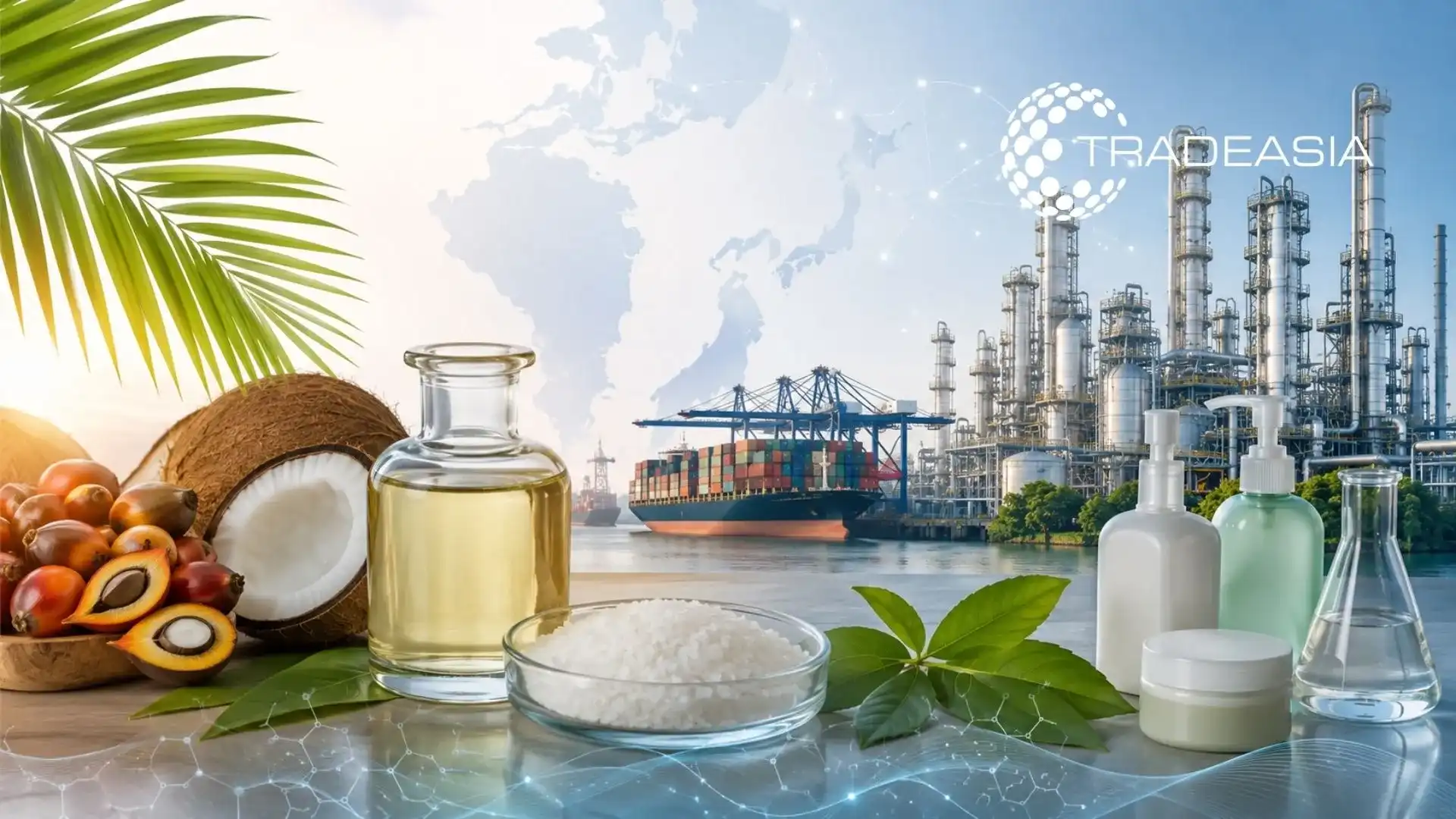
Lauric Acid (dodecanoic acid, C12:0) is a saturated medium-chain fatty acid predominantly derived from lauric-rich oils such as crude palm kernel oil (CPKO) and coconut oil. Asia—especially Indonesia, Malaysia, the Philippines, Thailand, and India, accounts for the majority of global lauric oil production. Indonesia and Malaysia together represent over 80% of global palm oil output, and a significant share of palm kernel oil, providing a natural advantage for Lauric Acid production through splitting, fractionation, and distillation processes.
Within the oleochemicals value chain, Lauric Acid is a key intermediate for producing fatty alcohols, fatty amines, surfactants, soaps, glycerol esters, and a wide range of specialty esters. These derivatives are essential in detergents, shampoos, cosmetics, lubricants, plasticizers, rubber processing aids, and food emulsifiers. As multinational brands commit to higher renewable content and lower carbon footprints in formulations, the relative importance of lauric-based oleochemicals has been increasing compared with purely petrochemical-based alternatives.
Asia’s role is not limited to raw material production; it is also a rapidly growing consumer market. Rising middle-class incomes and urbanization in China, India, Southeast Asia, and parts of South Asia continue to drive demand for personal and home care products, flexible packaging, and processed foods. This domestic pull, combined with export-oriented oleochemical clusters in Indonesia, Malaysia, and Singapore, positions Asia as both the primary production hub and a key demand center for industrial Lauric Acid by 2026.
By 2026, global demand for Lauric Acid and lauric-based oleochemicals is expected to grow in the low- to mid-single digits annually, with Asia outpacing other regions due to demographic and industrial growth. Industry analyses indicate that Asia’s share of global oleochemicals consumption already exceeds 40% and is rising, driven by detergent, personal care, and food processing sectors. As more manufacturers reformulate toward bio-based surfactants and emulsifiers, the demand for high-purity Lauric Acid (typically 99% min) and tailored cuts (e.g., C12–C14 blends) is projected to increase.
On the supply side, capacity expansions in Indonesia and Malaysia are expected to continue, especially in integrated complexes that convert palm kernel oil into fatty acids, fatty alcohols, and downstream specialties. However, this growth is constrained by land-use policies, sustainability certification requirements, and yield improvements rather than simple plantation expansion. Climate variability, including El Niño and La Niña events, can also affect palm and coconut yields, introducing cyclical volatility into feedstock availability and prices of Lauric Acid.
By 2026, the Lauric Acid market in Asia will likely exhibit a tighter balance between supply and demand than in previous cycles. While nameplate capacity may appear sufficient, effective capacity can be limited by sustainability requirements (RSPO, ISCC), logistics bottlenecks, and regulatory barriers. Users of Lauric Acid in sectors such as surfactants and food emulsifiers may see more pronounced price swings and differentiated pricing based on certification status, origin, and carbon footprint. As a result, buyers increasingly seek multi‑origin sourcing strategies and long-term offtake arrangements with reliable suppliers and distributors such as chemtradeasia to stabilize their supply base.
The Lauric Acid supply chain in Asia faces several structural challenges that will remain relevant through 2026. First, feedstock concentration is high: a large portion of Lauric Acid production depends on palm kernel oil from Indonesia and Malaysia and coconut oil from the Philippines and Indonesia. This geographic concentration exposes the supply chain to weather events, plant diseases, policy changes on export duties, and sustainability-driven restrictions. For instance, past episodes of export tax adjustments and moratoriums on new plantations have had ripple effects on lauric-based oleochemical pricing.
Second, logistics and infrastructure constraints can impact lead times and reliability. Port congestion in major exporting hubs, container availability issues, and rising freight costs—exacerbated during global disruptions—can lengthen supply cycles for Lauric Acid shipments into North Asia, South Asia, and other importing regions. The shift towards decarbonizing shipping and potential carbon cost pass-through under schemes like the EU ETS for maritime transport may further influence delivered costs and routing decisions for Asian exporters and traders.
Third, regulatory and sustainability expectations are tightening. Large FMCG and industrial buyers increasingly require traceability, deforestation-free sourcing, and compliance with certifications such as RSPO (Roundtable on Sustainable Palm Oil) and ISCC (International Sustainability & Carbon Certification). This affects not only palm-based Lauric Acid but also customer perception of coconut-based alternatives. Risk management in this context involves diversifying feedstock origins where feasible, securing certified volumes, building safety stocks closer to consumption points, and partnering with experienced distributors like chemtradeasia that can navigate multi-country regulations, documentation, and quality standards across Asia.
As the Lauric Acid market becomes more complex, buyers in Asia and beyond increasingly rely on specialized chemical supply platforms and distributors. chemtradeasia operates as a multi-country sourcing and distribution network focused on chemicals and oleochemicals, including Lauric Acid. By aggregating demand, managing supplier relationships, and offering logistics and documentation support, such platforms help bridge the gap between producers in Southeast Asia and industrial users across the region, the Middle East, Europe, and Africa.
From a sourcing strategy perspective, working with a networked supplier like chemtradeasia offers several advantages. Buyers can access multiple Lauric Acid grades—such as distilled Lauric Acid 99% min, blended C12–C14 fatty acids, or customized cuts, sourced from different origins and producers. This multi-origin model reduces dependence on a single mill or country and helps manage geopolitical and climate-related risks. Additionally, centralized quality control, standardized specifications, and harmonized documentation simplify procurement for multinational manufacturers that operate plants across several Asian markets.
Looking ahead to 2026, strategic Lauric Acid sourcing will emphasize long-term contracts, transparent pricing formulas linked to feedstock indices, and closer collaboration on inventory planning. Distributors like chemtradeasia can support vendor-managed inventory (VMI), just-in-time deliveries, and regional warehousing to mitigate port and transport disruptions. They can also assist in obtaining and maintaining sustainability certifications, ensuring that Lauric Acid and derivative oleochemicals meet the ESG and traceability requirements of end customers. For procurement teams, leveraging this kind of integrated supply chain support will be a key lever for cost optimization and risk reduction.
By 2026, the Lauric Acid supply chain in Asia will be defined by its dual role as both a global production hub and a fast-growing demand center for oleochemicals. Structural drivers—such as rising consumer incomes, the shift toward renewable and bio-based ingredients, and tightening sustainability requirements—are expected to sustain demand growth for Lauric Acid and its derivatives. At the same time, supply-side constraints related to feedstock concentration, climate variability, and regulatory complexity will continue to introduce volatility and differentiation in the market.
For industrial users of Lauric Acid in detergents, personal care, food emulsifiers, plastics, and rubber, the key to navigating this environment lies in proactive supply chain strategy. This includes diversifying sourcing origins, securing access to certified and traceable volumes, and building collaborative relationships with integrated suppliers and distributors such as chemtradeasia. By aligning procurement practices with market trends and ESG expectations, companies can improve resilience, manage costs, and support their own sustainability commitments while ensuring steady access to this essential oleochemical building block.
This article is intended solely for informational and market insight purposes and does not constitute technical, safety, or professional advice. Readers should independently verify all information with qualified experts, consult official documentation such as MSDS/SDS, and, where appropriate, contact our team or other professional advisors before making decisions related to specific products, processes, or applications.
We're committed to your privacy. Tradeasia uses the information you provide to us to contact you about our relevant content, products, and services. For more information, check out our privacy policy.


 English
 Indonesian
 简体字
简体字
 العربية
 Español
 Français
 Português
 日本語
日本語
 한국어
한국어
 Tiếng Việt