Explore our network of country and industry based websites to access localized information, product offerings, and business services across our group.

Access reliable chemical market information through our update channels.
Real-time Updates
Daily Updates
Log in to start sending quotation requests for any product.
Don't have an account? Sign Up Here
Home Stearic Acid Supply Chain Challenges and Opportunities Through 2030
Trade Insights | Supply Chain | 18 May 2026
Introduction Stearic Acid
Global Stearic Acid Market Overview 2026–2030
Industrial Stearic Acid: Properties, Grades, and Applications
Supply Chain Dynamics and Risk Factors for Stearic Acid
Role of Suppliers like chemtradeasia in the Oleochemical Ecosystem
Conclusion
The period from 2026 to 2030 will be pivotal for the global stearic acid and oleochemical supply chain. As manufacturers accelerate the shift from petrochemical-based inputs to bio-based, renewable feedstocks, stearic acid stands out as a critical building block for a wide array of industries. From personal care and pharmaceuticals to plastics, rubber, lubricants, and candles, this versatile saturated fatty acid is deeply embedded in modern manufacturing value chains.
At the same time, the supply landscape is becoming more complex. Feedstock availability, geopolitical pressures, sustainability expectations, and tightening environmental regulations are reshaping how stearic acid is produced, traded, and consumed. Supply chain decision-makers now need granular visibility into sourcing options, product grades, certifications, and logistics routes to ensure reliable and competitive supply.
This article provides an in-depth look at the global stearic acid market and its oleochemical supply chain outlook for 2026–2030. It examines demand and pricing trends, technical characteristics and applications of industrial stearic acid, risk factors that could disrupt supply, and the strategic role of integrated distributors and solution providers such as chemtradeasia in helping companies navigate this evolving landscape.
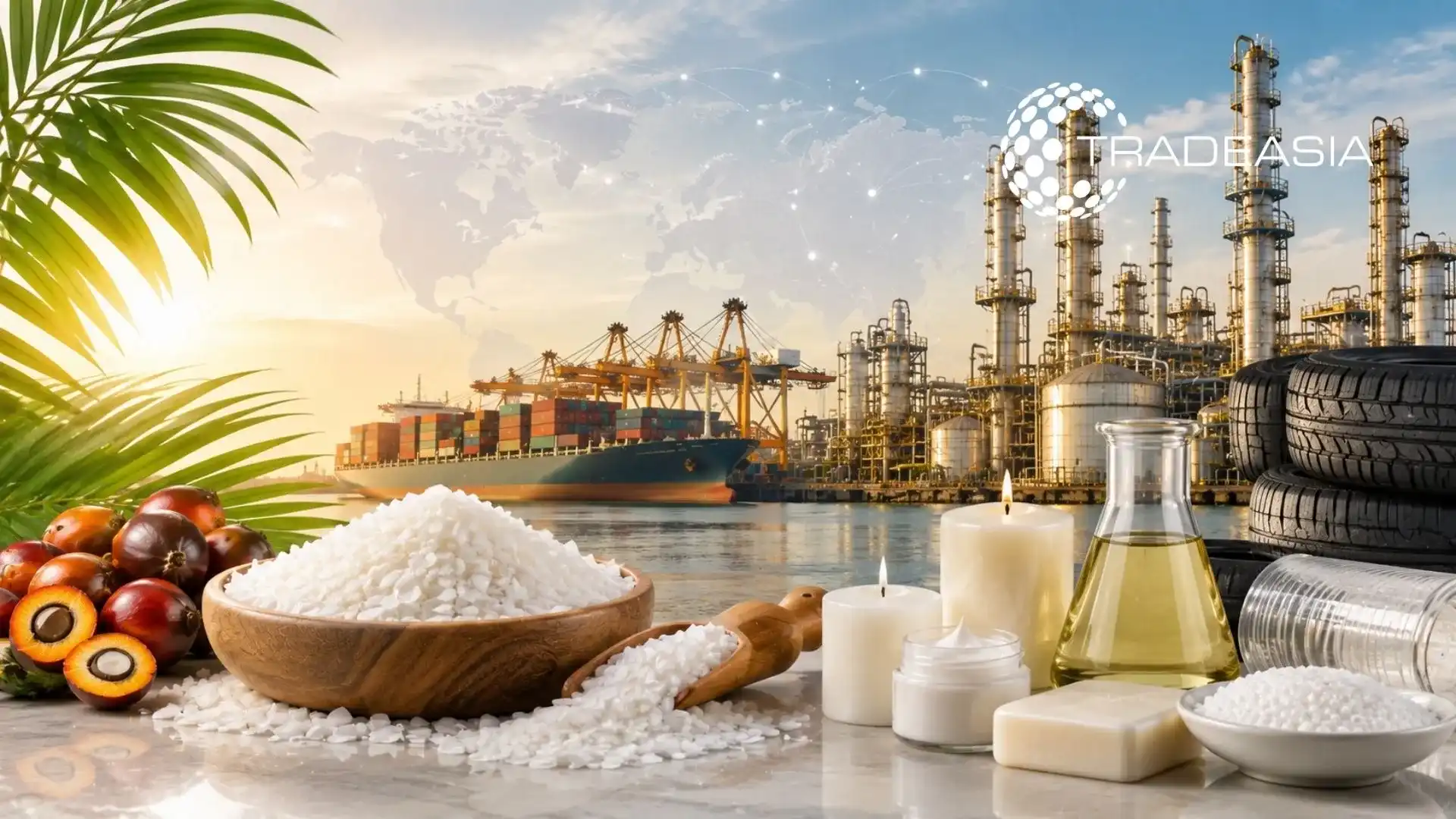
Stearic acid is a long-chain saturated fatty acid (C18) primarily derived from natural fats and oils, notably palm oil, palm kernel oil, tallow, and other vegetable or animal sources. The global stearic acid market was estimated in the mid-2020s at roughly USD 3–4 billion in value, with volumes in the range of several million metric tons annually. Between 2026 and 2030, most analysts expect a compound annual growth rate (CAGR) in the low to mid single digits, driven by underlying growth in personal care, plastics, rubber processing, and food & pharmaceutical additives.
Regionally, Asia-Pacific remains the dominant production and consumption hub. Countries such as Indonesia, Malaysia, China, and India play a central role due to their access to palm-based feedstocks and competitive manufacturing costs. Europe and North America, while smaller in volume, maintain significant demand for higher-purity and specialty grades, especially in cosmetics, pharmaceuticals, and high-performance industrial applications. Latin America, the Middle East, and Africa are emerging markets where rising incomes, urbanization, and industrialization are steadily increasing stearic acid consumption.
From 2026 to 2030, sustainability will be a key strategic theme. Buyers are increasingly requesting Roundtable on Sustainable Palm Oil (RSPO) certification or equivalent sustainability credentials for palm-derived stearic acid. Carbon footprint reduction, traceability, and deforestation-free supply chains are moving from optional differentiators to baseline requirements for many multinational brands. This is prompting producers and distributors, including chemtradeasia, to expand certified sourcing networks, improve transparency, and invest in digital tools that provide end-to-end visibility from feedstock to finished product.
Industrial stearic acid is valued for its unique combination of physical and chemical properties. It is typically a white, waxy solid at room temperature, with a melting point around 55–70 °C depending on grade and composition. In practice, commercial stearic acid is often a mixture of stearic (C18) and palmitic (C16) acids, with varying iodine values and free fatty acid content. These parameters, alongside color, odor, and metal impurity levels, define the suitability of a particular grade for specific applications.
Common grades include triple-pressed stearic acid, rubber-grade stearic acid, cosmetic- and pharmaceutical-grade stearic acid, and food-grade variants. Triple-pressed grades offer high purity and low color, making them suitable for applications where appearance and stability are critical, such as candles, plastics, and some personal care products. Rubber-grade stearic acid is formulated to optimize performance as an activator and processing aid in rubber compounding, while cosmetic and pharma grades must comply with stringent purity and regulatory standards, often conforming to pharmacopeia or food additive specifications.
Industrial applications are broad and strategically important to many manufacturing sectors. In rubber and tire production, stearic acid functions as an activator for vulcanization, improving processing and enhancing final mechanical properties. In plastics, it acts as a lubricant and release agent in PVC and other polymer systems. The personal care industry uses stearic acid as an emulsifier, thickener, and opacifier in creams, lotions, and soaps, where its skin-feel and stability benefits are highly valued. It is also widely used in candles, where it improves hardness, opacity, and burn characteristics, and in metalworking fluids, lubricants, and surfactant synthesis. Suppliers such as chemtradeasia typically offer a portfolio of grades and packaging options to align with these diverse use cases.
The stearic acid supply chain is structured around upstream feedstocks, midstream oleochemical processing, and downstream distribution and conversion. Upstream, the main variables are the availability and price of palm oil, palm kernel oil, and tallow, which are influenced by agricultural yields, weather patterns (including El Niño and La Niña events), land-use policies, and biofuel mandates. Any disruption in these areas can ripple through to stearic acid pricing and availability. For example, policy-driven increases in biodiesel blending mandates in Southeast Asia or Europe can tighten the supply of key vegetable oil feedstocks, indirectly affecting fatty acid markets.
Midstream, stearic acid is produced via hydrolysis and subsequent fractionation of fats and oils, often in integrated oleochemical complexes that also yield glycerin, other fatty acids, and derivatives such as fatty alcohols. Capacity utilization rates, plant maintenance schedules, and regional energy costs all influence the cost base. Environmental regulations related to wastewater, emissions, and energy efficiency are becoming more stringent in major production hubs, which may raise compliance costs but also drive investment in more efficient and lower-emission technologies.
Logistics and trade routes are another critical dimension of risk. Stearic acid is shipped globally in flake, bead, or pastille form, typically in bags, big bags, or bulk containers. Port congestion, container shortages, freight rate volatility, and geopolitical tensions affecting key shipping lanes can disrupt just-in-time supply models. Between 2026 and 2030, companies are likely to increase their focus on multi-sourcing strategies, regional safety stocks, and longer-term contracts with reliable partners such as chemtradeasia to mitigate these risks. Digital supply chain tools—such as real-time shipment tracking, demand forecasting, and supplier risk dashboards—will increasingly be used to enhance resilience.
In a market where feedstock volatility, regulatory complexity, and customer-specific quality requirements are all intensifying, specialized distributors and solution providers play a central role. Companies such as chemtradeasia act as a bridge between global stearic acid producers and downstream users, aggregating supply from multiple origins and offering a standardized, quality-assured product portfolio. This model can significantly reduce procurement complexity for manufacturers that lack the scale or resources to manage a large network of direct supplier relationships across multiple regions.
Beyond simple trading, value-added services are becoming a key differentiator. For industrial stearic acid, this can include technical support on grade selection, assistance with regulatory and documentation requirements (such as REACH, FDA, or cosmetic regulations), and advice on handling, storage, and compatibility with other formulation components. Distributors with broad oleochemical portfolios can also help customers optimize formulations by recommending complementary products, such as fatty alcohols, glycerin, or surfactants—that work synergistically with stearic acid in specific end-use applications.
From a supply chain perspective, partners like chemtradeasia can enhance resilience through diversified sourcing, strategic inventories, and flexible logistics solutions. By maintaining stock in multiple regional hubs, they can shorten lead times and buffer customers against short-term disruptions. Digital platforms that provide online product catalogs, technical data sheets, and order tracking capabilities allow procurement teams to compare grades, check availability, and manage orders more efficiently. As sustainability becomes integral to procurement decisions, distributors are also expected to curate portfolios of certified, traceable stearic acid products and to provide transparent information on origin, certifications, and environmental performance.
Between 2026 and 2030, the stearic acid and oleochemical supply chain will continue to evolve under the combined influence of sustainability pressures, regulatory changes, and shifting global trade patterns. Demand for industrial stearic acid is likely to grow steadily across key sectors, particularly in Asia-Pacific, while higher-value applications in personal care, pharmaceuticals, and specialty polymers will support demand in mature markets. Companies that proactively manage feedstock risk, invest in supply chain visibility, and align with partners capable of delivering both product quality and logistical reliability will be best positioned to secure competitive advantage.
Suppliers and distributors such as chemtradeasia will remain essential in this ecosystem, helping manufacturers navigate complex sourcing decisions, regulatory requirements, and technical challenges. By offering a diversified portfolio of stearic acid grades, robust quality assurance, and integrated logistics, they can help downstream users balance cost, performance, and sustainability objectives. As digitalization and data-driven decision-making become standard in procurement and supply chain management, collaboration between producers, distributors, and end-users will be crucial to building resilient and sustainable value chains for stearic acid and related oleochemicals.
This article is provided solely for informational and market insight purposes and does not constitute technical, safety, regulatory, or professional advice. Users should independently verify all information with qualified experts, consult official documentation such as MSDS/SDS and relevant standards, and contact appropriate professionals or our team before making decisions or using stearic acid in specific applications.
We're committed to your privacy. Tradeasia uses the information you provide to us to contact you about our relevant content, products, and services. For more information, check out our privacy policy.


 English
 Indonesian
 简体字
简体字
 العربية
 Español
 Français
 Português
 日本語
日本語
 한국어
한국어
 Tiếng Việt



















