Explore our network of country and industry based websites to access localized information, product offerings, and business services across our group.

Access reliable chemical market information through our update channels.
Real-time Updates
Daily Updates
Log in to start sending quotation requests for any product.
Don't have an account? Sign Up Here
Home Tracking Palm Oil's Dominance in Crude Glycerine Feedstock (2020-2040)
Pricing Indices | 27 November 2025
Unpacking the Raw Material Dynamics: Growth Rates and Market Share
Feedstock Price Correlation and Managing Supply Risk
The stable supply of Refined Glycerine hinges entirely on the complex and often volatile raw material landscape, primarily dictated by the output from the global biodiesel industry. Analyzing the feedstock mix reveals a continuous battle for dominance between major vegetable oils. For businesses operating in the palm trading sector, understanding these dynamics is not just strategic planning—it's essential risk management. Navigating the competitive interests of agricultural powerhouses requires robust supply chain oversight, which is precisely why Tradeasia International dedicates expertise to connecting reliable sources to global markets, ensuring our partners benefit from the most stable and price-competitive palm-based oleochemical streams.
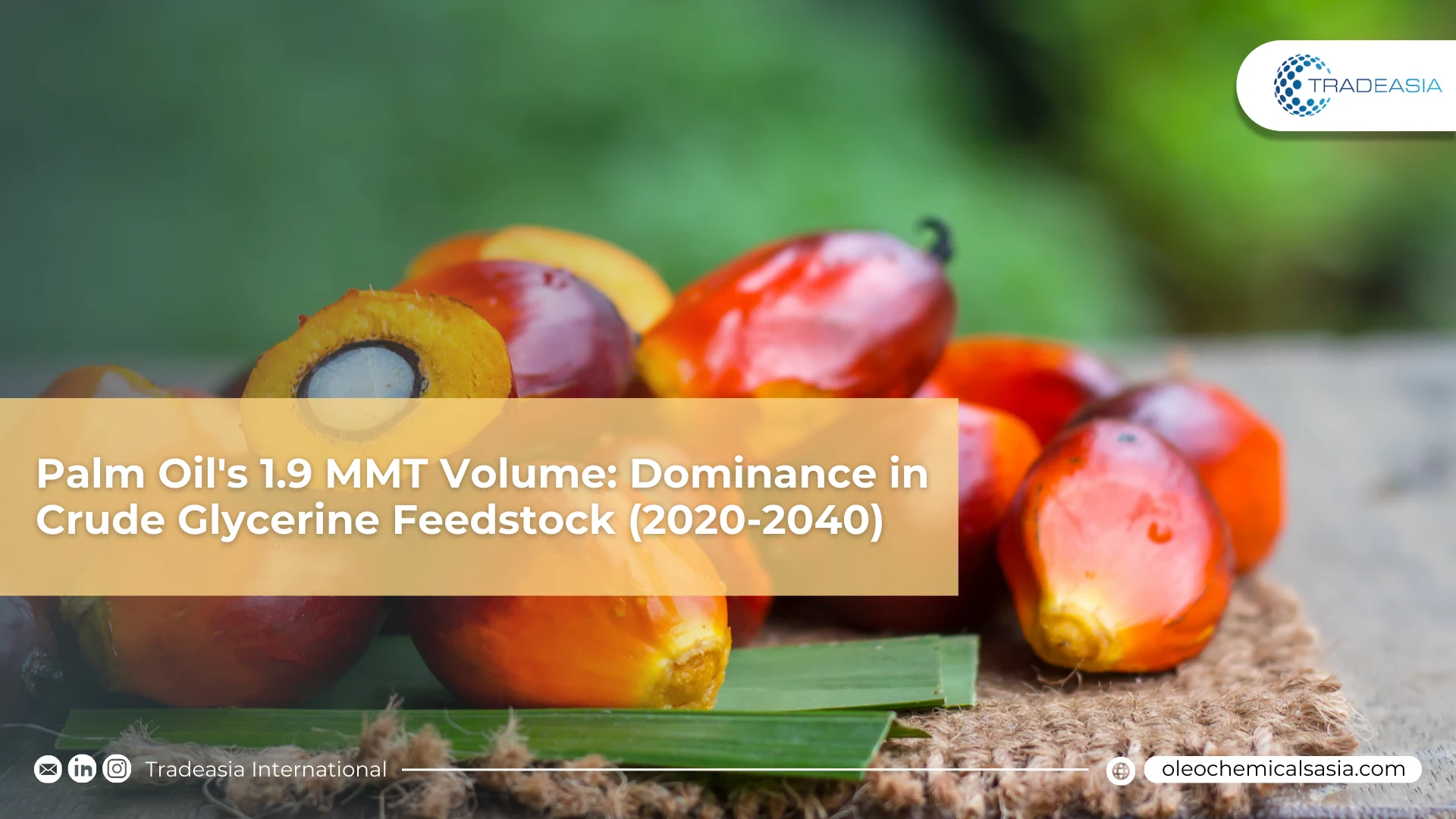
Historically, the supply of crude glycerine has relied heavily on two giants: Palm Oil and Soybean Oil. Back in 2020, glycerine derived from palm oil commanded the largest volume share, estimated at 45% of the global natural supply, with soybean oil-based glycerine close behind at approximately 35% (Source: Industry Feedstock Report). However, future growth projections indicate that the gap is widening in palm's favor. Glycerine production sourced from palm oil in key Southeast Asian markets is projected to sustain a strong volume CAGR of 5.5% through 2030, driven by aggressive national mandates for biodiesel blending. This trajectory stands slightly ahead of the projected CAGR for soy-derived glycerine, estimated at 4.8%, confirming the entrenched and critical role of palm-based derivatives in meeting global glycerine demand. By 2040, projections suggest the volume of palm-based crude glycerine supplied from Southeast Asia will exceed 1.9 Million Metric Tons (MMT).
The constant challenge for buyers is the direct correlation between upstream feedstock price and downstream crude glycerine cost. Data over the 2020-2024 period reveals that the price of Crude Palm Oil (CPO) demonstrated a consistently higher positive correlation coefficient (estimated at +0.78) with crude glycerine prices compared to Soybean Oil (estimated at +0.65) (Source: Commodity Research Group). This strong link emphasizes the necessity of efficient CPO sourcing and logistics. This high correlation underscores the imperative for managing supply chain reliability from the region that will contribute the largest single source of feedstock, making reliable access to palm-based oleochemicals a top corporate priority.
Sources:
Oleochemicals Asia: Market Share Analysis of Palm and Oleochemical Feedstocks.
Industry Feedstock Report: Global Vegetable Oil Utilization in Biodiesel Production, 2020-2030.
Commodity Research Group: Price Correlation Data for Major Vegetable Oils and Crude Glycerine (2020-2024).
Access the complete article and discover related coverage.
We're committed to your privacy. Tradeasia uses the information you provide to us to contact you about our relevant content, products, and services. For more information, check out our privacy policy.


 English
 Indonesian
 简体字
简体字
 العربية
 Español
 Français
 Português
 日本語
日本語
 한국어
한국어
 Tiếng Việt