How can we assist you?

Explore our network of country and industry based websites to access localized information, product offerings, and business services across our group.
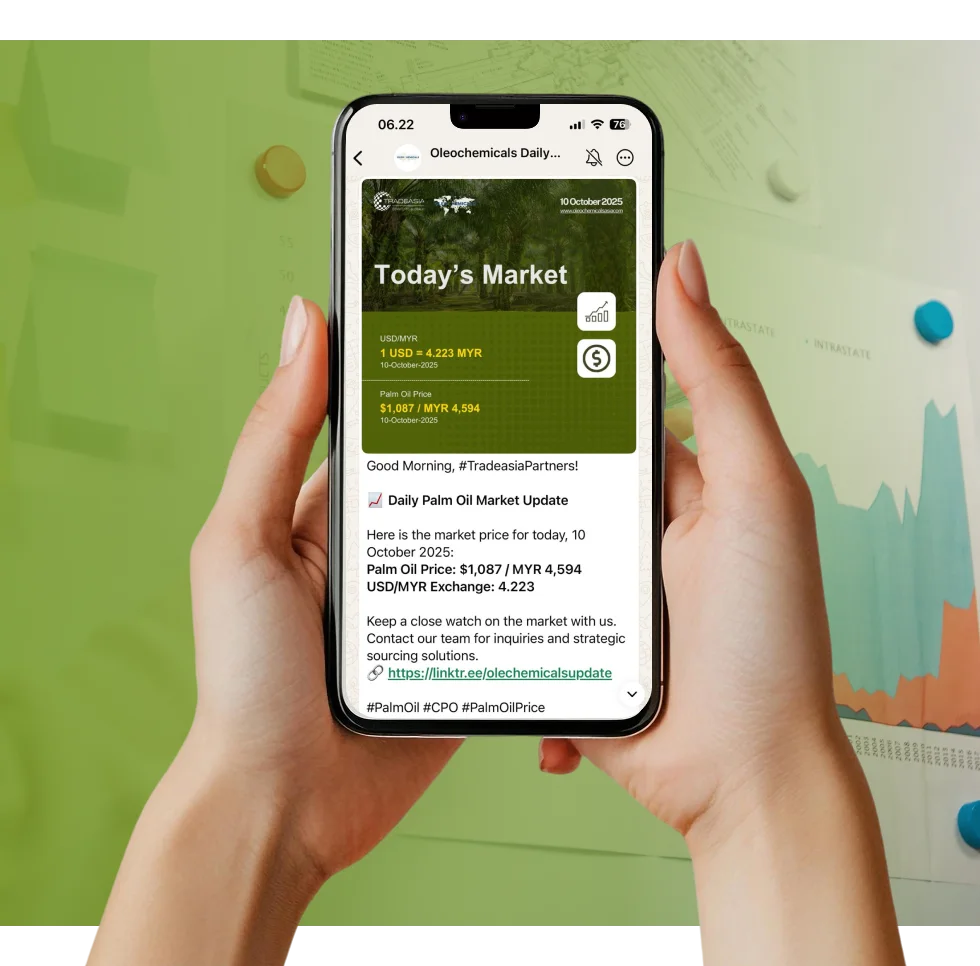
Access reliable chemical market information through our update channels.
Real-time Updates
Daily Updates
Log in to start sending quotation requests for any product.
Don't have an account? Sign Up Here
Home Why 70% of Global Lauryl Alcohol Feeds the $500B+ Surfactant Market
Market Insight | 30 October 2025

Lauryl Alcohol, or C12 Alcohol, is the single most important feedstock for the anionic surfactant industry. Its dominance in this space is staggering: approximately 65-70% of all Lauryl Alcohol produced globally is not sold as 'alcohol' but is immediately consumed as a precursor for Sodium Lauryl Sulfate (SLS) and Sodium Lauryl Ether Sulfate (SLES). These two ingredients are the undisputed workhorses that generate the foam and cleaning power in countless products we use daily.
This dominant application makes Lauryl Alcohol a true cornerstone of the global oleochemical market. At Tradeasia International, our expertise is built on navigating this complex demand landscape. We connect our partners to the right grade of Lauryl Alcohol, from the palm source to the final application, ensuring supply chain integrity for this vital ingredient.
The demand for Lauryl Alcohol is, therefore, a direct reflection of the $500 Billion+ global Home and Personal Care (HPC) market. For every 1% of growth in the detergent or shampoo sector, the industry requires thousands of additional metric tons of Lauryl Alcohol. This direct link was proven unequivocally during the 2020-2021 hygiene boom, where demand for SLES-based hand soaps and surface cleaners surged by 8-10% in key markets.
This tight coupling to consumer habits provides incredible stability. It's a clear illustration of the modern global supply chain, where the price of a palm kernel derivative in Southeast Asia is ultimately set by consumer demand for a bottle of shampoo in Ohio. Understanding this complete journey from plantation to product is the key to smart sourcing.
Within this dominant HPC segment, the end-use is further broken down. Industrial and household detergents (laundry and dishwashing) represent the largest consumer, accounting for roughly 40% of all SLES/SLS produced. The personal care sector (shampoos, body washes, and hand soaps) follows closely, consuming another 30%. The C12 carbon chain is prized for its "flash foam" properties, creating the rich, instant lather consumers associate with cleaning power. This demand isn't fading; the global HPC market is forecast to grow at a stable 4.5% CAGR through 2030, cementing Lauryl Alcohol's status as a "blue chip" oleochemical.
We're committed to your privacy. Tradeasia uses the information you provide to us to contact you about our relevant content, products, and services. For more information, check out our privacy policy.
How can we assist you?

 English
 Indonesian
 简体字
简体字
 العربية
 Español
 Français
 Português
 日本語
日本語
 한국어
한국어
 Tiếng Việt




















